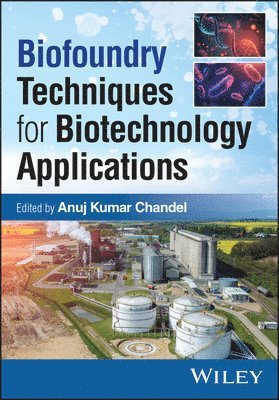
Biofoundry Techniques for Biotechnology Applications
2 075 kr
Beställningsvara. Skickas inom 5-8 vardagar. Fri frakt över 249 kr.
Beskrivning
Produktinformation
- Utgivningsdatum:2026-02-27
- Mått:176 x 252 x 22 mm
- Vikt:851 g
- Format:Inbunden
- Språk:Engelska
- Antal sidor:384
- Förlag:John Wiley & Sons Inc
- ISBN:9781394309924
Utforska kategorier
Mer om författaren
Dr. Anuj Kumar Chandel, Renewable Carbon and Biology Systems Laboratory-ReCABS, Department of Biotechnology, Engineering School of Lorena, University of São Paulo (EEL-USP), Lorena, São Paulo, Brazil. Dr Chandel has over 23 years’ research experience working on various aspects of industrial biotechnology, including the production of industrial enzymes, biofuels, and bio-based products and membrane-based separation of fats, proteins, and viruses. He is currently coordinating research on lignin valorization into PHA, biolipids, biogas, and catalytic links.
Innehållsförteckning
- List of Contributors xvAbout the Editor xxiPreface xxiii1 Biomass Refining and Biofoundry: Key Products, Process Limitations, and Future Aspects 1Lucas Ramos, Jesús Jiménez Ascencio, James Villar, Mónica Ma. Cruz- Santos, and Anuj Kumar Chandel1.1 Introduction 11.1.1 Biomass Diversity and Major Principle Feedstock in the World 21.1.1.1 Major Feedstocks 31.1.2 Biomass Refining Methods 41.1.2.1 Sugars- First Approach 41.1.2.2 Lignin- First Approach 51.1.3 Key Products from Biorefinery Based from Listed Top 12 Biochemicals from U.S. Department of Energy 91.1.4 Process Limitations and Net- Zero Environment 131.1.5 Biofoundry and Advanced Bioeconomy 141.1.6 Conclusion and Future Directions 16Acknowledgments 17References 172 Structural Carbohydrates Conversion into Sugars, Fuels, Chemicals, and Sustainable Materials 27Katarina Mihajlovski, Nevena Ilić, Galina Jevđenović, and Marija Milić2.1 Introduction 272.1.1 What are Structural Carbohydrates? 272.1.2 Cellulose 282.1.2.1 Cellulose Conversions to Sugars 292.1.2.2 Cellulose Conversions to Fuels 312.1.2.3 Cellulose Conversions to Sustainable Materials 322.1.3 Hemicellulose 332.1.3.1 Hemicellulose Conversion to Sugars 332.1.3.2 Hemicellulose Conversion to Chemicals 352.1.3.3 Hemicellulose Conversion to Fuels 372.1.3.4 Hemicellulose Conversion to Sustainable Materials 392.1.4 Pectin 392.1.4.1 Pectin Conversions to Sugars 412.1.4.2 Pectin Conversions to Fuels 422.1.4.3 Pectin Conversions to Chemicals 422.1.4.4 Pectin Conversions to Sustainable Materials 452.1.5 Oligosaccharides 462.1.5.1 Oligosaccharides Conversions to Sugars 462.1.5.2 Oligosaccharides Conversions to Fuels 482.1.5.3 Oligosaccharides Conversions to Chemicals 482.2 Conclusions 51References 513 Integrating Lignocellulosic Biomass Processing, Biomanufacturing, and Biofoundries: Innovations and Challenges in the Bioeconomy 59Yaimé Delgado- Arcaño, Alisson Dias da Silva Ruy, Leila Maria Aguilera Campos, and Oscar Daniel Valmaña- García3.1 Introduction 593.2 Advances in Biomass Processing: Pretreatment and Purification Strategies 603.2.1 Pretreatment Methods of Lignocellulosic Biomass 603.2.2 Separation and Purification of the Interest Compounds 643.3 Bioeconomy and Biofoundries: How Automation and Synthetic Biology can Enhance Biorefineries 653.3.1 Bibliometric Analysis 663.3.2 Design- Build- Test- Learn (DBTL) in Biofabrication and Synthetic Biology 683.3.3 Biofoundry and Process Integration in Biorefinery 693.3.4 Global Expansion of Biofoundries: Innovation and Collaboration 713.4 Economic Competitiveness in the Production of Bioproducts of Commercial Interest 723.4.1 Techno- Economic Analysis and Life Cycle Assessments for Sustainable Bioproducts 723.4.2 Market of Bioproducts: Insights and Challenges 753.4.3 Market Growth, Cost Challenges, and Policy Drivers in Biorefineries 763.4.4 Biomanufacturing and Biofoundries: Addressing Technological and Operational Challenges 773.5 Conclusions 78References 794 Lignin Valorization Is the Key for a Win–Win Situation in a Biomass Refinery 87Lucas Ramos, Carina Prado, Maria Teresa Ferreira Ramos Raimundo, Uirajá C. M. Ruschoni, Vinícius Pereira Shibukawa, and Anuj Kumar Chandel4.1 Introduction 874.2 Lignin: Dispensable Source of Renewable Carbon 884.3 Lignin Chemistry 904.4 Lignin Extraction Methods 924.5 Lignin Conversion Route 944.6 Biological Routes 944.6.1 Microbial Degradation 954.6.2 Enzymatic Conversion 954.6.3 Fermentation 964.7 Chemical Routes 964.7.1 Thermal Decomposition 964.7.2 Catalytic Depolymerization 964.7.3 Electrochemical Conversion 974.8 Lignin in the Pulp and Paper Industry 974.9 Conclusion and Future Directions 99Acknowledgment 99References 995 Sustainable Production of Advanced Alcohol- Based Biofuels in Biorefinery: From Alcohols to Sustainable Aviation Fuels 105Danielle Matias Rodrigues, Paula Zaghetto de Almeida, Allan H. Félix de Mélo, Juliana Velasco de Castro Oliveira, Ana Paula Jacobus, and Henrique Macedo Baudel5.1 Introduction 1055.2 Bioethanol 1065.3 Advanced Alcohol- Based Fuels 1085.4 Biobutanol: The Biofoundry as a Tool to Optimize 1095.4.1 Clostridium Pathway: Acetone- Butanol- Ethanol (ABE) Synthesis 1105.4.2 S. cerevisiae 1115.4.3 E. coli 1125.5 Biofoundry Synthetic Biology Tools 1135.5.1 2,3- Bdo 1155.6 Sustainable Aviation Fuel (SAF) 1175.7 Conclusion 118References 1196 Biomanufacturing of Smart Packaging Materials, Cosmetics, Therapeutics, and Nanomaterials Through Lignocellulosic Biorefinery Framework 127Sounak Maitra, Muskaan Sethi, Prisha Inani, Palak Shrivastava, C. Shriya, and Samuel Jacob6.1 Introduction 1276.2 Lignocellulosic Raw Materials and Their Potential as Industrial Raw Materials 1286.2.1 Corn Wastes 1286.2.2 Sugarcane and Sugar Beet Residues 1296.2.2.1 Bagasse 1296.2.2.2 Molasses 1306.2.2.3 Vinasse 1306.2.2.4 Wastewater from the Sugar Industry 1306.2.3 Paddy Processing Wastes 1306.2.4 Potato Processing Wastes 1316.2.4.1 Potato Peels 1336.2.4.2 Potato Starch from Processing Wastes 1336.2.4.3 Potato Protein 1336.2.4.4 Potato Wastewater 1336.2.5 Oil Processing Industry Residues 1346.3 Smart Packaging Materials 1356.3.1 Starch and Lignocellulose- Based Biopolymers 1356.3.1.1 Starch- Based Biopolymer 1356.3.1.2 Lignocellulosic- Based Biopolymer 1366.3.2 PLA, PHA, and PHB 1366.3.2.1 Polylactic Acid (PLA) 1366.3.2.2 Polyhydroxyalkanoates (PHA) 1376.3.2.3 Polyhydroxybutyrate (PHB) 1376.4 Cosmetics and Therapeutics 1386.4.1 Active Pharmaceutical Components from Bioresources 1386.4.2 Bio- Oil as a Resource for the Cosmetics Industry 1396.4.3 Application of Bio- Oils in the Cosmetics Industry 1416.5 Bio- Nanotechnology Through Biomass 1416.6 Conclusion 142References 1427 White Biotechnology for Skincare: Unveiling the Power of Bioactives for the Cosmetic Industry 151Samatha Paladugu, Sarepalli Sai Sathwik, and Mamatha Potu7.1 Introduction 1517.2 Fermented Bioactives 1537.3 Innovative Approaches in Green Bio- ferment Cosmetic Formulations 1567.4 Green Bio Ferments 1587.5 Active Compounds from Bioferments 1607.5.1 Organic Acids 1607.5.2 Amino Acids 1617.5.2.1 The Function of Amino Acids in Skin and Hair Care 1627.5.3 Gaba 1647.5.3.1 Efficacy of Lactobacillus- Fermented GABA on Dermal Fibroblasts 1657.5.4 Peptides 1667.5.4.1 Types of Peptides 1677.5.5 Antioxidant Substances 1687.5.6 Short- Chain Fatty Acids 1697.6 Application of Bioferments in Skincare 1707.6.1 Reducing Wrinkles and Signs of Aging 1707.6.2 Strengthening Skin Barrier 1707.6.3 Reducing Inflammation 1717.6.4 Helping Wound Healing 1727.6.5 Fighting Acne 1727.7 KINMATI: The Advanced Probiotic Biofermented Raw Material for Skincare 1737.8 Future of Bio- ferments, Active Ingredients, and Green Formulations 1737.8.1 Increasing Demand for Eco- Friendly Ingredients 1747.8.2 Shift to Natural Emollients, Solvents, Surfactants, Thickeners, Exfoliators, Fragrances, Colourants, and Antioxidants 1747.8.3 Safer Preservation Methods 1757.8.4 Balancing Efficacy and Stability with NaDES 1757.8.5 Sustainability Commitments of Industry Leaders 1757.9 Conclusion 1767.9.1 Regulatory Challenges 1767.9.2 Challenges in Sustainable Packaging 1777.9.3 Manufacturing Challenges 1777.9.4 Challenges for Biotech Skincare Startups 1777.9.5 From a Consumer Perspective 178Acknowledgments 178References 1788 Biotechnological Advancements in Lactic Acid Bacteria Fermentation: Metabolic Pathways and Metabolite Profiles 189Samatha Paladugu, Sarepalli Sai Sathwik, and Sreelatha Beemagani8.1 Introduction 1898.2 Metabolism of Carbohydrates (Mono, Di, Oligo, and Polysaccharides) 1908.2.1 Homofermentation 1908.2.2 Heterofermentation 1918.3 Monosaccharides 1918.4 Disaccharides 1928.5 Oligosaccharides 1938.6 Polysaccharides and Indigestible Carbohydrates 1938.7 Indigestible Starch/Resistant Starch 1938.8 Metabolism of Nitrogen Source (Proteins) 1958.8.1 Metabolism of Amino Acids 1978.8.2 Arginine Deiminase Pathway 1978.8.3 Glutamate Decarboxylase Pathway 1978.8.4 Metabolism of Branched- Chain and Aromatic Amino Acids 1988.8.5 d- Amino Acid Production 1988.9 Utilization and Metabolism of Malic Acid and Citric Acid 1998.10 Metabolite Profiles of Lactobacillus Ferments 2008.10.1 Organic Acids 2008.10.2 Bacteriocins 2008.11 Vitamins 2018.12 Short- chain Fatty Acids 2028.13 Exopolysaccharides 2028.14 Antioxidant Substances 2028.15 Production of Polyols 2038.16 Metabolomic Profiles of Different Lactic Acid Bacteria in the Rice Fermentation 2038.16.1 Nonvolatile Compounds 2048.16.2 Volatile Compounds 2048.16.3 Other Volatile Compounds 204Acknowledgments 208References 2089 Biofoundry in Microbial Protein Production: Process Challenges and Future Scenario 219Simab Kanwal, Sher Zaman Safi, Aphichart Karnchanatat, and Piroonporn Srimongkol9.1 Introduction 2199.2 Microorganisms and Protein Production 2209.3 Strain Selection for Protein Production 2219.4 Protein- Rich Biomass Production 2229.5 Microbial Bioprocessing 2239.6 Cultivation Systems 2249.7 Bioreactors for Protein Production 2249.8 Downstream Processing 2259.9 Strategies in Synthetic Bioengineering 2279.9.1 Microbial Engineering 2279.9.2 Metabolic Pathway Optimization 2289.9.3 High- Throughput Screening 2289.10 Challenges and Future Prospects 2299.11 Conclusions 231References 23110 Nanotechnological Interventions in the Advancement of Lignocellulose Bio- Foundry: Current Status and Future Prospects 237Carlos Lopez- Ortiz, Alan Chavez- Hita Wong, Aldo Sosa, and Nagamani Balagurusamy10.1 Introduction 23710.2 Advancing Lignocellulose Bio- Foundries: Pretreatment Strategies and Nanotechnology Integration 23810.3 Catalytic Nanomaterials and Enzyme Immobilization for Lignocellulose Biomass Conversion 23910.4 Underlying the Interactions of Nanotechnology Mechanism in Lignocellulose Bio- Foundry 24210.5 Factors Affecting Nanotechnology Use and Its Performance in Bio- Foundry Using Lignocellulosic Biomass 24510.6 Challenges and Considerations Using Nanotechnology in Lignocellulose Bio- Foundry 24610.7 Future Perspectives of Nanotechnology in Biofuel Production 24810.8 Conclusion 248References 24911 Synthetic Biology in the Realm of Genome Engineering for Improved Biocatalysts and Production 257José Daniel Cano Montoya, Diego Hernandez, and Josman Velasco11.1 Introduction 25711.2 The Design–Build–Test–Learn Cycle for Optimizing Biological Systems 25811.3 The Synthetic Biology Toolkit for Genome Engineering 25911.3.1 DNA Fragment Assembly Tools 25911.3.1.1 Ligation- Independent Cloning 26011.3.1.2 Gibson Assembly 26011.3.1.3 Yeast- Assisted DNA Assembly 26111.3.2 Genome- Editing Techniques 26111.3.2.1 Clustered Regularly Interspaced Short Palindromic Repeats 26111.3.2.2 Transcription Activator- Like Effector Nucleases 26311.3.2.3 Zinc Finger Nucleases 26411.4 Production and Improvement of Biocatalysts 26411.4.1 Chassis Organisms for the Production of Biocatalysts 26511.4.1.1 Escherichia coli 26511.4.1.2 Bacillus subtilis 26711.4.1.3 Pseudomonas putida 26811.4.1.4 Filamentous Fungi 26811.4.1.5 Pichia pastoris 26911.4.1.6 Mammalian Cell Expression Systems 26911.4.1.7 Plant Cells 27011.4.2 Techniques for the Improvement of Biocatalysts 27111.4.2.1 Directed Evolution 27111.4.2.2 Rational Design 27211.4.2.3 Chemical Modification of Enzymes 27211.5 Conclusions and Final Remarks 273Acknowledgment 273Declaration 273References 27412 Multi- omics Technologies Paving the Way for the Success of Biorefinery 279Shruti Ahlawat, Somya Gupta, Ritika Yadav, and Krishna Kant Sharma12.1 Introduction 27912.2 Lignocellulosic Biomass 28012.3 Steps in Biorefinery 28012.3.1 Step 1- Pretreatment of LC Biomass 28112.3.1.1 Physical Pretreatment 28112.3.1.2 Chemical Pretreatment 28112.3.1.3 Physio- chemical Pretreatment Processes 28212.3.1.4 Biological Pretreatment Method 28312.3.2 Step 2- Saccharification 28312.3.3 Step 3- Fermentation 28412.4 Various Value- Added Products Generated from Lignocellulosic Biomass 28412.5 Cellulose- Based Value- Added Products 28512.5.1 Lactic Acid 28512.5.2 Bioethanol 28612.5.3 Biomethane 28612.5.4 Biodiesel 28612.5.5 Biobutanol 28612.6 Hemicellulose- Based Value- Added Products 28712.6.1 Xylitol 28712.6.2 Xylooligosaccharides (XOS) 28712.6.3 Furfural 28812.7 Lignin- Based Value- Added Products 28812.7.1 Biopolymers 28812.7.2 Biochar 28812.8 CRISPR/Cas9 and - Omics Technologies 28912.9 Utilization of - Omics Technologies Toward Biorefinery Success 28912.10 Role in Efficient Enzyme Production 29312.11 Role in Microalgae- Based Biorefinery 29612.12 Conclusion 297Conflict of Interest 298Author Contributions 298Funding 298References 29813 Sustainability Assessment of Genetically Engineered Biocatalysts Producing Biofuels and Biochemicals 309Andreza A. Longati, Christian de Oliveira Martins, Gabriel Baioni, Adilson José da Silva, Thais Suzane Milessi, and Felipe Fernando Furlan13.1 Introduction 30913.2 The Role of Genetically Modified Organisms in Biorefineries 31013.3 Metabolic Modeling in the Development of Genetically Modified Organisms 31213.3.1 Metabolic Modeling 31313.3.2 Metabolic Modeling for Genetically Modified Organisms 31513.4 Parameters to Evaluate the Sustainability of Genetically Modified Organisms 31513.4.1 Environmental Perspective 31613.4.2 Economic Perspective 32113.4.3 Social Perspective 32313.5 Case Studies of Genetically Modified Organisms 32413.6 Conclusions 327Acknowledgments 328References 32814 Lean Manufacturing Toward Minimum Waste Discharge and Potential Gains in the Biorefinery and Biotechnology Industries 337Fabricio M. Gomes, Messias Borges Silva, Giovani Maltempi- Mendes, and Anuj Kumar Chandel14.1 Introduction 33714.2 The Fundamentals of Lean Manufacturing 33714.3 The Five Principles of Lean 33814.4 Waste Reduction in Biotechnology: Unique Challenges 33814.5 Types of Waste in Biotechnology 33814.6 Managing Biohazardous Waste 33914.7 Lean Tools for Biotechnology 33914.7.1 Kaizen 34014.7.2 Value Stream Mapping (VSM) 34014.7.3 5s 34014.7.4 Kanban 34114.8 Total Productive Maintenance 34114.9 Lean Manufacturing and Digitalization in Biotechnology 34114.10 Real- Time Data Analytics 34114.11 Digital Twins 34214.12 Potential Gains from Lean Implementation in Biotechnology 34214.13 Cost Savings 34214.13.1 Improved Process Efficiency 34314.13.2 Environmental Sustainability 34314.14 Lean Manufacturing’s Role in Addressing Sustainability Goals 34314.15 Regulatory Compliance and Lean in Biotechnology 34414.16 Commercial Aspects of Lean Implementation in Biorefineries 34414.17 Case Study: Lean Implementation at Pfizer 34514.18 Case Study: Novartis and Lean Implementation in Biopharma 34814.19 Conclusion 348Acknowledgments 348References 348Index 351
Du kanske också är intresserad av
Lignocellulose Bioconversion Through White Biotechnology
Anuj Kumar Chandel, Anuj Kumar Chandel
Inbunden, 2022
1 925 kr
Current Advances in Biotechnological Production of Xylitol
Maria das Graças de Almeida Felipe, Anuj Kumar Chandel
Häftad, 2023
1 711 kr
Current Advances in Biotechnological Production of Xylitol
Maria das Graças de Almeida Felipe, Anuj Kumar Chandel
Inbunden, 2022
1 711 kr
Lignocellulosic Biorefining Technologies
Avinash P. Ingle, Anuj Kumar Chandel, Silvio Silverio da Silva
Inbunden, 2020
2 117 kr