Inbunden, Engelska, 2026
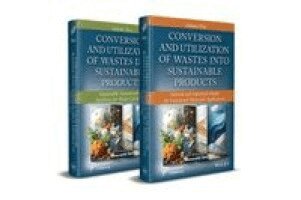
Conversion and Utilization of Wastes into Sustainable Products, 2 Volume Set
Av Mousumi Sen
5653 kr
Beställningsvara. Skickas inom 11-20 vardagar. Fri frakt över 249 kr.
Beskrivning
Conversion and Utilization of Wastes into Sustainable Products, Volume 1: Natural and Industrial Wastes for Functional Materials ApplicationsMaster the foundational strategies for transforming diverse waste streams into high-performance, carbon-based functional materials with this essential first volume, bridging the gap between innovative green fabrication and real-world industrial application.Growing pollution of the natural environment and depletion of conventional resources have become key motives for searching for eco-friendly, renewable, and sustainable alternative energy sources. Particular attention is paid to natural and industrial waste, which can be converted into fuels and energy that meet the growing needs of humanity. Natural and biowaste materials can be used as a template to create innovative nanocomposites and green nanocatalysts from biodegradable, earth-abundant, affordable, and renewable sources to prevent the accumulation and aggregation of nanomaterials. These two volumes highlight the latest research into the role of waste to create a cleaner, more sustainable future.This volume compiles and analyzes the most recent studies on waste conversion for value-added product production, exploring the relationships among the fabrication methods, their resulting structures and properties, and their performance in various applications. It also discusses current-state-of-the-art uses of carbon-based functional materials, which have proven their effectiveness and efficiency in many applications. This volume explores recent material-development strategies for converting diverse waste streams into carbon-based functional materials, highlighting greener, more sustainable, and environmentally benign alternatives with significant potential for both industry and academia.Readers will find the volume: Highlights recent material development strategies to convert various types of waste into valuable carbon-based functional materials;Discusses current state-of-the-art uses of carbon-based functional materials that have proven their effectiveness and efficiency for applications;Explores relationships between fabrication methods, the resulting structures and properties, and their performance in various applications.AudienceMaterials scientists, nanoscientists, nanotechnologists, chemical and biological engineers, and biochemists working in the field of nanostructure synthesis and nanoscience.Conversion and Utilization of Wastes into Sustainable Products, Volume 2: Sustainable Nanostructures Synthesis for Waste Conversion Advance your expertise in sustainability by mastering the transformation of industrial and electronic waste into sophisticated nanostructures that power high-efficiency remediation systems and bioelectrochemical technologies.Growing pollution of the natural environment and depletion of conventional resources have become key motives for searching for eco-friendly, renewable, and sustainable alternative energy sources. Particular attention is paid to natural and industrial waste, which can be converted into fuels and energy that meet the growing needs of humanity. Natural and biowaste materials can be used as a template to create innovative nanocomposites and green nanocatalysts from biodegradable, earth-abundant, affordable, and renewable sources to prevent the accumulation and aggregation of nanomaterials. These two volumes highlight the latest research into the role of waste to create a cleaner, more sustainable future.This volume examines current data and methodologies for transforming waste into sophisticated nanostructures that support environmentally responsible material design. It compiles and analyzes recent studies on nanostructures derived from waste generated across multiple sectors, including agriculture, industry, healthcare, electronics, personal hygiene products, and environmental remediation. The book addresses the growing challenge of electronic waste, which poses significant environmental and economic risks, and the integration of waste-derived nanomaterials into advanced treatment systems, advanced oxidation processes, and bioelectrochemical technologies, to enhance remediation efficiency and reduce operating costs. Through case studies and real-world data, this volume serves as an essential guide to a brighter future using growing global waste.Readers will find the volume: Highlights recent material-development strategies to convert various types of waste into valuable nano-based functional materials;Discusses modern sustainable waste treatment strategies that emphasize converting wastes and e-wastes into energy, fuels, and products to systematically utilize biomass resources;Explores recent progress in waste-derived synthesis of nanostructures for anti-microbial and biomedical applications.AudienceMaterials scientists, nanoscientists, nanotechnologists, chemical and biological engineers, and biochemists working in the field of nanostructure synthesis and nanoscience.
Produktinformation
- Utgivningsdatum: 2026-06-23
- Vikt: 2 245 g
- Format: Inbunden
- Språk: Engelska
- Antal sidor: 1 360
- Förlag: John Wiley & Sons Inc
- ISBN: 9781394371334
Utforska kategorier
Betyg & recensioner
0 recensioner
Inga recensioner tillgängliga.