• Fri frakt över 249 kr
  • •
  • Snabba leveranser
  • •
  • Billiga böcker
Kundservice

Du är på sajten för privatpersoner.

Företag, bibliotek eller offentlig verksamhet?

Du handlar på classic.bokus.com, där alla dina funktioner finns intakta.
Till classic.bokus.com
Bokus logotyp. Gå till startsidan.
  • Erbjudanden
  • Student
  • Topplistor
  • Barn & ungdom
  • Bokus Play
  • E-böcker
  • Ljudböcker
  • Pocketböcker
  • Spel och pussel

5% studentrabatt – använd koden KURSBOK27 →

Sidfot

Mina sidor

    Hjälp

    • Kundservice
    • Vanliga frågor och svar
    • Frakt och leverans
    • Retur vid ångerrätt
    • Reklamera vara
    • Betalning
    • Köpvillkor
    • Allmänna villkor
    • Information om webbplatsens tillgänglighet

    Om Bokus

    • Om oss
    • Pressrum
    • För studenter
    • För företag
    • För bibliotek och offentlig verksamhet
    • För leverantörer
    • Hållbarhet

    Populärt

    • Aktuella erbjudanden
    • Presentkort
    • Studentlitteratur
    • Nya böcker
    • Topplistor
    • Signerade böcker
    • Engelska böcker

    Inspiration

    • Boktips
    • BookTok
    • Barnbokskaraktärer
    • Populära författare
    Logotyp för Bokus
    Följ oss på Facebook (extern länk)Följ oss på Instagram (extern länk)Följ oss på YouTube (extern länk)Följ oss på TikTok (extern länk)
    bokus @ CookiesAnpassa cookiesIntegritetspolicyKöpvillkor
    Till Citymail hemsida (extern länk)Till Budbee hemsida (extern länk)Till Postnord hemsida (extern länk)Till Schenker hemsida (extern länk)Till Early Bird hemsida (extern länk)Till Walleys hemsida (extern länk)
    1. Data och IT
    2. Databaser

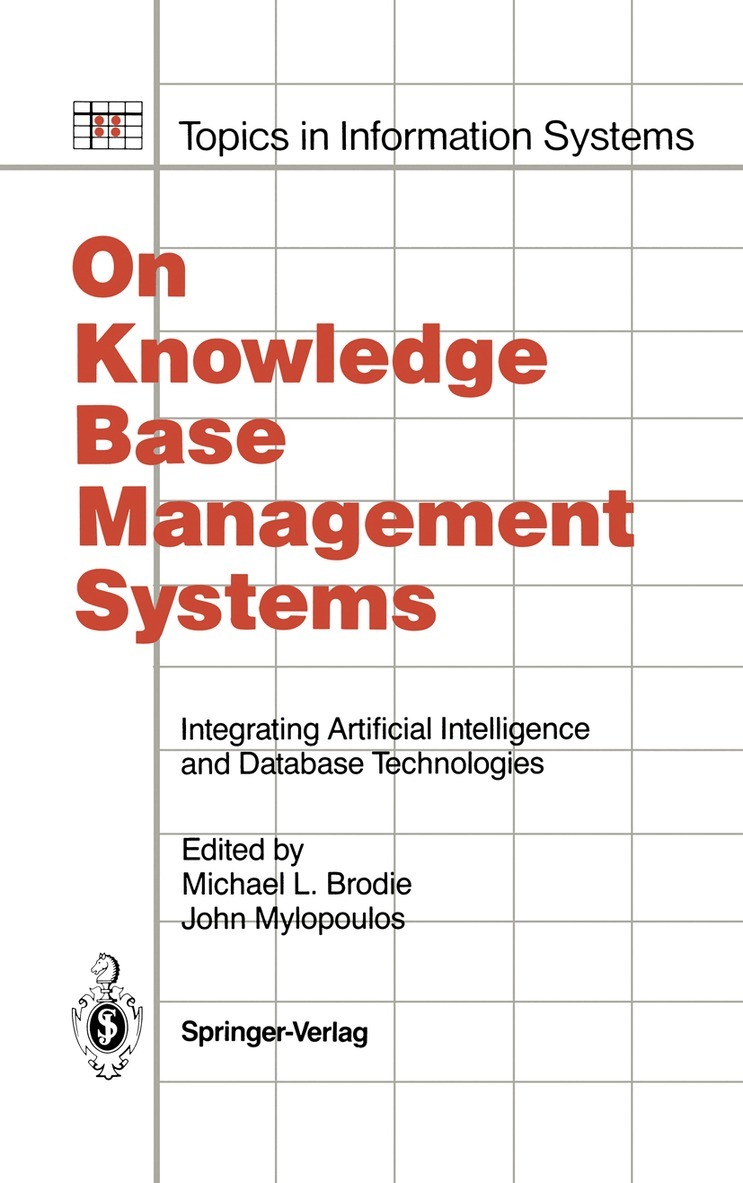
    On Knowledge Base Management Systems

    Integrating Artificial Intelligence and Database Technologies

    AvMichael L. Brodie,John Mylopoulos

    Häftad, Engelska, 2011

    Del i serien Topics in Information Systems

    561 kr

    Beställningsvara. Skickas inom 10-15 vardagar. Fri frakt över 249 kr.

    Beskrivning

    Current experimental systems in industry, government, and the military take advantage of knowledge-based processing. For example, the Defense Advanced Research Projects Agency (DARPA), and the United States Geological Survey (USGS) are supporting the develop­ ment of information systems that contain diverse, vast, and growing repositories of data (e.g., vast databases storing geographic informa­ tion). These systems require powerful reasoning capabilities and pro­ cessing such as data processing, communications, and multidisciplinary of such systems will scientific analysis. The number and importance grow significantly in the near future. Many of these systems are severely limited by current knowledge base and database systems technology. Currently, knowledge-based system technology lacks the means to provide efficient and robust knowledge bases, while database system technology lacks knowledge representation and reasoning capabilities. The time has come to face the complex research problems that must be solved before we can design and implement real, large scale software systems that depend on knowledge-based processing. To date there has been little research directed at integrating knowledge base and database technologies. It is now imperative that such coordinated research be initiated and that it respond to the urgent need for a tech­ nology that will enable operational large-scale knowledge-based system applications.

    Produktinformation

    • Utgivningsdatum:2011-10-05
    • Mått:155 x 235 x 37 mm
    • Vikt:1 019 g
    • Format:Häftad
    • Språk:Engelska
    • Serie:Topics in Information Systems
    • Antal sidor:660
    • Förlag:Springer-Verlag New York Inc.
    • ISBN:9781461293835

    Utforska kategorier

    • Databaser inom Data och IT
    • Artificiell intelligens inom Data och IT

    Innehållsförteckning

    • I: Knowledge Base Management Systems.- 1. On Knowledge Base Management Systems.- 2. The Knowledge Level of KBMS.- 3. Knowledge Level Interfaces to Information Systems.- 4. On Knowledge-Based Systems Architectures.- Discussion.- II: Knowledge Bases Versus Databases.- 5. A View Of Knowledge Representation.- 6. AI Knowledge Bases and Databases.- 7. Knowledge versus Data.- 8. Knowledge Bases versus Databases.- 9. Knowledge-Based and Database Systems: Enhancements, Coupling or Integration?.- Discussion.- III: Retrieval/Interface/Reasoning.- 10. Inference: A Somewhat Skewed Survey.- 11. Current Trends in Database Query Processing: A Survey.- 12. Logic and Database Systems.- 13. Negation in Knowledge Base Management Systems.- 14. An Approach to Processing Queries in a Logic-Based Query Language.- 15. Naive Evaluation of Recursively Defined Relations.- 16. Knowledge Base Retrieval.- Discussion.- IV: Extending Database Management Systems.- 17. Database Management: A Survey.- 18. Logic and Database Systems: A Survey.- 19. PROBE: A Knowledge-Oriented Database Management System.- 20. Learning Improved Integrity Constraints and Schemas From Exceptions in Databases and Knowledge Bases.- 21. Organizing a Design Database Across Time.- 22. Triggers and Inference in Database Systems.- 23. Extensible Database Systems.- Discussion.- V: Extending Knowledge-Based Systems.- 24. Knowledge-Based Systems: A Survey.- 25. Natural Language Processing: A Survey.- 26. Questions, Answers, and Responses: Interacting With Knowledge Base Systems.- 27. Learning in Knowledge Base Management Systems.- 28. The Role of Databases in Knowledge-Based Systems.- 29. An Integration of Knowledge and Data Representation.- Discussion.- VI: Knowledge-Based System Design Issues.- 30. Context Structures/Versioning: A Survey.- 31. Survey of Conceptual Modeling of Information Systems.- 32. A Requirements Modeling Language and Its Logic.- 33. Languages for Knowledge Bases.- 34. Control of Search and Knowledge Acquisition in Large-Scale KBMS.- Discussion.- VII: Advanced Hardware for Knowledge-Based Systems.- 35. New Computer Architectures: A Survey.- 36. The Role of Massive Memory in Knowledge Base Management Systems.- 37. Parallel Computers for AI Databases.- Discussion.- Epilogue.- 38. Concluding Remarks from the Artificial Intelligence Perspective.- 39. Concluding Remarks from the Database Perspective.- 40. Large-Scale Knowledge-Based Systems: Concluding Remarks and Technological Challenges.- Contributors’ Addresses.- References.