• Fri frakt över 249 kr
  • •
  • Snabba leveranser
  • •
  • Billiga böcker
Kundservice

Du är på sajten för privatpersoner.

Företag, bibliotek eller offentlig verksamhet?

Du handlar på classic.bokus.com, där alla dina funktioner finns intakta.
Till classic.bokus.com
Bokus logotyp. Gå till startsidan.
  • Erbjudanden
  • Student
  • Topplistor
  • Barn & ungdom
  • Bokus Play
  • E-böcker
  • Ljudböcker
  • Pocketböcker
  • Spel och pussel

5% studentrabatt – använd koden KURSBOK27 →

Sidfot

Mina sidor

    Hjälp

    • Kundservice
    • Vanliga frågor och svar
    • Frakt och leverans
    • Retur vid ångerrätt
    • Reklamera vara
    • Betalning
    • Köpvillkor
    • Allmänna villkor
    • Information om webbplatsens tillgänglighet

    Om Bokus

    • Om oss
    • Pressrum
    • För studenter
    • För företag
    • För bibliotek och offentlig verksamhet
    • För leverantörer
    • Hållbarhet

    Populärt

    • Aktuella erbjudanden
    • Presentkort
    • Studentlitteratur
    • Nya böcker
    • Topplistor
    • Signerade böcker
    • Engelska böcker

    Inspiration

    • Boktips
    • BookTok
    • Barnbokskaraktärer
    • Populära författare
    Logotyp för Bokus
    Följ oss på Facebook (extern länk)Följ oss på Instagram (extern länk)Följ oss på YouTube (extern länk)Följ oss på TikTok (extern länk)
    bokus @ CookiesAnpassa cookiesIntegritetspolicyKöpvillkor
    Till Citymail hemsida (extern länk)Till Budbee hemsida (extern länk)Till Postnord hemsida (extern länk)Till Schenker hemsida (extern länk)Till Early Bird hemsida (extern länk)Till Walleys hemsida (extern länk)
    1. Data och IT
    2. Systemvetenskap och AI
    3. Artificiell intelligens

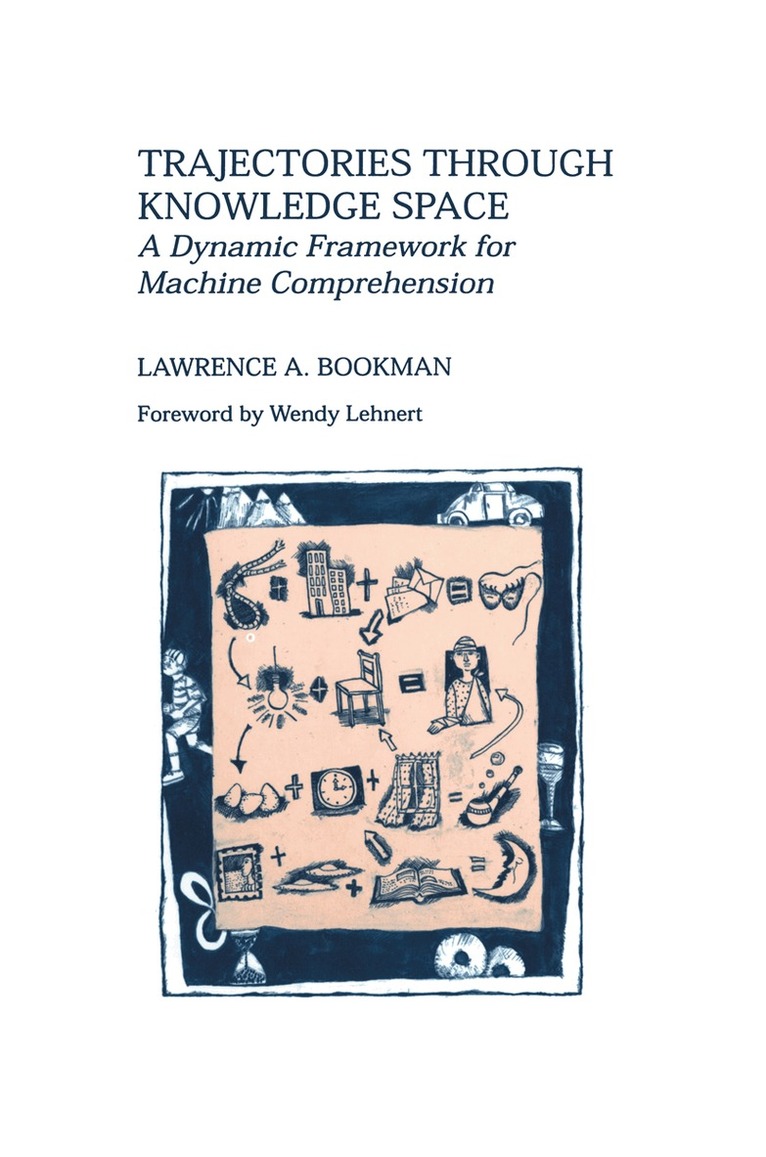
    Trajectories through Knowledge Space

    A Dynamic Framework for Machine Comprehension

    AvLawrence A. Bookman

    Häftad, Engelska, 2012

    Del i serien Springer International Series in Engineering and Computer Science

    2 214 kr

    Beställningsvara. Skickas inom 10-15 vardagar. Fri frakt över 249 kr.

    Fler format och utgåvor

    Inbunden

    2 214 kr

    E-bok

    2 917 kr

    Beskrivning

    As any history student will tell you, all events must be understood within their political and sociological context. Yet science provides an interesting counterpoint to this idea, since scientific ideas stand on their own merit, and require no reference to the time and place of their conception beyond perhaps a simple citation. Even so, the historical context of a scientific discovery casts a special light on that discovery - a light that motivates the work and explains its significance against a backdrop of related ideas. The book that you hold in your hands is unusually adept at presenting technical ideas in the context of their time. On one level, Larry Bookman has produced a manuscript to satisfy the requirements of a PhD program. If that was all he did, my preface would praise the originality of his ideas and attempt to summarize their significance. But this book is much more than an accomplished disser­ tation about some aspect of natural language - it is also a skillfully crafted tour through a vast body of computational, linguistic, neurophysiological, and psychological research.

    Produktinformation

    • Utgivningsdatum:2012-10-11
    • Mått:155 x 235 x 17 mm
    • Vikt:452 g
    • Format:Häftad
    • Språk:Engelska
    • Serie:Springer International Series in Engineering and Computer Science
    • Antal sidor:271
    • Förlag:Springer-Verlag New York Inc.
    • ISBN:9781461362012

    Utforska kategorier

    • Artificiell intelligens inom Data och IT
    • Språkvetenskap och lingvistik inom Språk och ordböcker

    Innehållsförteckning

    • 1 Introduction.- 1.1 Motivation.- 1.2 A View of Text Comprehension.- 1.3 Overview of the LeMICON System.- 1.4 Implementation.- 1.5 Points of Interest.- 1.6 The Impact of this Work on Four Related Fields.- 1.7 Development of the Two-Tier Model.- 1.8 A Guide to the Reader.- 2 An Overview of Connectionist and Probabilistic Approaches to Language Processing.- 2.1 A Computational Linguistics Perspective.- 2.2 A Connectionist Perspective.- 2.3 A Comparison of Connectionist and Probabilistic NLP Methods.- 2.4 Bridging the Gap — Integrating Connectionist and Computational Linguistic Approaches.- 3 Memory Architecture.- 3.1 The Relational Tier.- 3.2 The Associational or ASF Tier.- 3.3 Connecting the Two Tiers.- 3.4 Working Memory.- 3.5 How New Knowledge Is Integrated.- 4 The Basic Computation.- 4.1 A Functional Description of the Algorithm.- 4.2 Representing the Input.- 4.3 Computational Details and Program Output at each Step.- 4.4 General Discussion of the Algorithm.- 4.5 How LeMICON Handles Binding.- 4.6 The Links to Psychology and Neurophysiology Revisited.- 4.7 Some Comparisons to Other Text Understanding Systems.- 5 Analysis of the Interpretation at the Relational and ASF Level.- 5.1 Introduction.- 5.2 Analyzing the Interpretation at the Relational Level.- 5.3 Analyzing the Interpretation at the ASF Level.- 5.4 Analyzing Time-Dependent Interactions at the ASF Level.- 5.5 Comparing Interpretations — A Quantitative Analysis.- 5.6 An Ablation Study.- 6 Reasoning from the Relational Level of the Representation.- 6.1 Introduction.- 6.2 Identifying the Conceptual Roots.- 6.3 Explaining the Connections Between Events.- 6.4 Determining Important Concepts in the Interpretation Graph.- 6.5 Conceptual Roots and their Role in Summarization.- 7 Experiments in Acquiring Knowledgefrom On-line Corpora.- 7.1 Introduction.- 7.2 The Automatic Acquisition of Knowledge from On-line Sources.- 7.3 The Automatic Construction of the Relational Tier.- 7.4 The Automatic Construction of the Associational Tier.- 7.5 How Semantic Memory Evolves in Response to New Input.- 7.6 Changing the Link Weights.- 7.7 Implementation Details.- 8 An Analysis of the Acquired Knowledge.- 8.1 An Alternative View of the Underlying Knowledge Representation.- 8.2 Discussion of Soundness of Approach.- 8.3 An Evaluation of LeMICON’s Representation.- 8.4 Previous Text Systems Revisited.- 8.5 The Knowledge Acquisition Continuum.- 9 Conclusions.- 9.1 Some Consequences of the Two-Tier Model of Memory.- 9.2 Associational Representations.- 9.3 The Universality of ASFs.- 9.4 Scalability.- 9.5 Automatic Acquisition of Knowledge.- 9.6 Building Large-Scale Knowledge Bases.- 9.7 A Link to Corpus Linguistics.- 9.8 The Interplay between Computation and Representation.- 9.9 Limitations.- 10 Future Directions.- 10.1 Expanding The Knowledge Base.- 10.2 Finding Deeper Semantic Relationships via Corpus Analysis.- 10.3 Handling Contradictory Input.- 10.4 Learning New Relationships.- 10.5 A Basic Level Semantic Encoding.- 10.6 Child Versus Adult Comprehension.- References.- Author Index.