• Fri frakt över 249 kr
  • •
  • Snabba leveranser
  • •
  • Billiga böcker
Kundservice

Du är på sajten för privatpersoner.

Företag, bibliotek eller offentlig verksamhet?

Du handlar på classic.bokus.com, där alla dina funktioner finns intakta.
Till classic.bokus.com
Bokus logotyp. Gå till startsidan.
  • Erbjudanden
  • Student
  • Topplistor
  • Barn & ungdom
  • Bokus Play
  • E-böcker
  • Ljudböcker
  • Pocketböcker
  • Spel och pussel

Skapa nya rutiner – hälsoböcker upp till 50% →

Sidfot

Mina sidor

    Hjälp

    • Kundservice
    • Vanliga frågor och svar
    • Frakt och leverans
    • Retur vid ångerrätt
    • Reklamera vara
    • Betalning
    • Köpvillkor
    • Allmänna villkor
    • Information om webbplatsens tillgänglighet

    Om Bokus

    • Om oss
    • Pressrum
    • För studenter
    • För företag
    • För bibliotek och offentlig verksamhet
    • För leverantörer
    • Hållbarhet

    Populärt

    • Aktuella erbjudanden
    • Presentkort
    • Studentlitteratur
    • Nya böcker
    • Topplistor
    • Signerade böcker
    • Engelska böcker

    Inspiration

    • Boktips
    • BookTok
    • Barnbokskaraktärer
    • Populära författare
    Logotyp för Bokus
    Följ oss på Facebook (extern länk)Följ oss på Instagram (extern länk)Följ oss på YouTube (extern länk)Följ oss på TikTok (extern länk)
    bokus @ CookiesAnpassa cookiesIntegritetspolicyKöpvillkor
    Till Citymail hemsida (extern länk)Till Budbee hemsida (extern länk)Till Postnord hemsida (extern länk)Till Schenker hemsida (extern länk)Till Early Bird hemsida (extern länk)Till Walleys hemsida (extern länk)
    1. Samhälle och politik
    2. Samhälle och kultur
    3. Kultur och medier
    4. Referensverk och tvärvetenskap

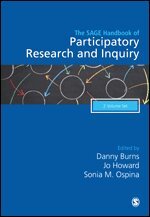
    The SAGE Handbook of Participatory Research and Inquiry

    AvDanny Burns,Jo Howard

    Inbunden, Engelska, 2021

    3 697 kr

    Beställningsvara. Skickas inom 5-8 vardagar. Fri frakt över 249 kr.

    Beskrivning

    This SAGE Handbook presents contemporary, cutting-edge approaches to participatory research and inquiry. It has been designed for the community of researchers, professionals and activists engaged in interventions and action for social transformation, and for readers interested in understanding the state of the art in this domain. The Handbook offers an overview of different influences on participatory research, explores in detail how to address critical issues and design effective participatory research processes, and provides detailed accounts of how to use a wide range of participatory research methods. Chapters cover pioneering new participatory research techniques  including methods that can be operationalised at scale, approaches to engaging the poorest and most marginalised, and ways of harnessing technologies to increase the scope of participation, amongst others. Drawing upon a wide range of disciplines, and bringing together contributing authors from across the globe, this Handbook will be of interest to an international readership from across the broad spectrum of social sciences, including social policy, development studies, geography, sociology, criminology, political science, health and social care, education, psychology, business & management. It will also be an insightful and practical resource for facilitators, community workers, and activists for social change. Part 1: Introduction Part 2: Key Influences and Foundations of Participatory Research Part 3: Critical Issues in the Practice of Participatory Research Part 4: Methods and Tools Part 4.1: Dialogic and Deliberative Processes Part 4.2: Digital Technologies in Participatory Research Part 4.3: Participatory Forms of Action Orientated Research Part 4.4: Visual and Performative Methods  Part 4.5: Participatory Monitoring, Evaluation and Learning  Part 4.6: Mixing and Mashing Participatory and Formal Research Part 5: Final Reflections

    Produktinformation

    • Utgivningsdatum:2021-09-02
    • Mått:174 x 246 x 75 mm
    • Vikt:2 390 g
    • Format:Inbunden
    • Språk:Engelska
    • Antal sidor:1 168
    • Upplaga:1
    • Förlag:SAGE Publications
    • ISBN:9781526440501

    Utforska kategorier

    • Referensverk och tvärvetenskap inom Samhälle och politik

    Mer om författaren

    Danny Burns has worked at the Institute of Development Studies since 2010. He is a research professor and was research team leader of the Participation, Inclusion and Social Change team for 9 years. He was formerly co-director of SOLAR (Social and Organisational Learning as Action Research) at the University of the West of England and before that he worked for the University of Bristol. Danny has directed more than 25 participatory action research programmes. He is currently director of CLARISSA (Child Labour Action-Research-Innovation in South and South East Asia) a programme working on worst forms of child labour. CLARISSA is supporting 54 parallel action research processes across three countries (Nepal, Bangladesh and Myanmar). Danny is also co-coordinating a bottom up peace building programme in Mali which is developing a Systemic Action Research methodology. Danny’s work has focused on how to build deeply participatory and systemic processes at scale. Danny is author of two books on action research: Systemic Action Research (2007) and Navigating Complexity in International Development (2015) – with Stuart Worsley, as well as numerous articles and research papers. He has also written extensively on community development and participatory governance. Other key books include Poll Tax Rebellion (2001), The Politics of Decentralisation - Revitalisting Local Democracy (2004) – with Paul Hogget and Robin Hambleton, and Community Self-Help (2004) with Colin Williams and Jan Windebank. Jo Howard is a Research Fellow at the Institute of Development Studies, where she leads the IDS Participation, Inclusion and Social Change Research Cluster, and convenes the MA programme in Power, Participation and Social Change. After working with an NGO for six years in Central America, she trained as a researcher and has worked in the UK, Latin America, Africa and Asia. She uses participatory action research methods with community groups to promote and support processes of accountability, empowerment, citizenship and inclusion; she also convenes short courses and tailored learning processes with NGOs, INGOs and government departments, to enable them to use participatory approaches, reflective practice and increase knowledge exchange. Through a focus on participatory methodologies as enablers of social justice, she has supported peer-peer and other participatory research processes in the UK, India, Ghana, Egypt, Uganda, South Africa and Nicaragua. She is a member of the editorial board of the Community Development Journal, and co-edited their special issue (2020) on ‘Intersecting inequalities and prospects for community development’. Sonia M. Ospina is Professor of Public Management and Policy at the NYU Wagner Graduate School of Public Service, sociologist by training, and an expert in qualitative and participatory research. Her interest in dynamics of democratic governance has motivated research on social change leadership, social innovation, and public accountability in various geographical settings.  She is presently working with Indigenous women leaders in Colombia to support their leadership and develop insights about collective leadership.  Her publications include Advancing Relational Leadership Research: A Conversation Across Perspectives (2012, co-edited); Social Innovation and Democratic Leadership: Communities and Social Change from Below (2017, co-authored) and a Human Relations Special Issue on Collective dimensions of leadership: Connecting theory and method (co-edited, 2020).  She co-founded an international network of leadership scholars, Co-Lead Net (2015) and the Research Center for Leadership in Action (2003), which she led until 2015. Among other service positions, she has been President of the Inter-American Network of Public Administration Education (INPAE), is a member of CLAD’s Scientific Council, a Latin American UN state reform body, and a Board member of the Public Management Research Association (PMRA). Born in the U.S. to Colombian parents, Sonia grew up in urban Bogotá, and now has lived more than half her life in New York City. Her transnational and multicultural approach to life embodies her bicultural experience and her strong ties to both countries.

    Recensioner i media

    This rich, inspiring collection is testament to the extraordinary creativity of those who have brought about a veritable revolution in research through participatory methodologies and approaches. Drawn from across the globe, contributors attest to the power of participatory research and inquiry its enduring value as a catalyst for change

    Innehållsförteckning

    • Volume 1Part 1: IntroductionChapter 1: Introduction: Navigating the complex and dynamic landscape of participatory research and inquiry - Sonia M. Ospina, Danny Burns, & Jo HowardChapter 2: Challenges in the practice of participatory research and inquiry - Danny Burns, Jo Howard, & Sonia M. OspinaPart 2: Key Influences and Foundations of Participatory ResearchChapter 3: Key Influences and Foundations of Participatory Research - Sonia M. OspinaChapter 4: Paulo Freire′s Influence on Participatory Action Research - Fabio C. Campos & Gary L. AndersonChapter 5: Tropical Empathy: Orlando Fals Borda and Participatory Action Research - Alex Pereira & Joanne RappaportChapter 6: Theatre is Knowledge: Augusto Boal′s theatre of the oppressed and participatory research - Effie MakepeaceChapter 7: Pragmatism: Linking systems, evolution, and democratization in participatory and action research - Davydd J. GreenwoodChapter 8: Feminism and participatory research: Exploring intersectionality, relationships, and voice in participatory research from a feminist perspective - Batsheva Guy & Brittany ArthurChapter 9: Indigenous ways of knowing and participatory research - Fiona Cram & Anna AdcockChapter 10: The history, legacy and future of participatory rural appraisal  - Mariah Cannon, Tessa Lewin, & Robert ChambersChapter 11: Achieving scope and broad participation in participatory research: The ′dialogue democratic′ network-based approach of Björn Gustavsen - Erik Lindhult Chapter 12: Becoming participatory: Some contributions to action research in the UK - Cathy Sharp & Ruth BaloghChapter 13: Towards ever more extended epistemologies: Pluriversality and decolonisation of knowledges in participatory inquiry - Patricia Carolina GayáChapter 14: Action research - participative self in transformative action - Hilary BradburyPart 3: Critical Issues in the Practice of Participatory ResearchChapter 15: Critical Issues in the practice of participatory research - Jo Howard & Danny BurnsChapter 16: Facilitating participatory research - Bob DickChapter 17: Reflexivity and reflection in action research: ‘To locate, again, a through line to the future’ - Patta Scott-VilliersChapter 18: Positionality, academic research and cooperative inquiry: Lessons from participatory research with Roma - Jekatyerina Dunajeva & Violeta VajdaChapter 19: The fine art of getting lost: Ethics as a guide to transformative learning in participatory research - Mary Brydon-Miller, Alfredo Ortiz Aragón, & Victor J. FriedmanChapter 20: Holding space for emotions in participatory action research: Reflections from the experiences of a youth organisation exploring PAR through creative practices - Liv Kaya Aabye, Gioel Gioacchino, & Fiammetta WegnerChapter 21: Power analysis for social change: Participatory learning and action - Jethro PettitChapter 22: The ethics of co-production in practice: Reflections - Helen Thomas-Hughes & Morag McDermontChapter 23: Approaches and creative research methods with children and youth - Vicky Johnson & Andy WestChapter 24: Don′t leave us out: Disability inclusive participatory research - why and how? - Mary Wickenden & Erika Lopez FrancoChapter 25: Interpeace’s experience with participatory action research in contexts of active and post-conflict - Daniel HyslopPart 4: Methods and ToolsPart 4.1: Dialogic and Deliberative ProcessesChapter 26: Reflections on the Role of Dialogue in Participatory Research and Inquiry - Mariana de Santibañes & Sonia M. OspinaChapter 27: Reflections on the reflect approach and its multiple evolutions - David ArcherChapter 28: A dialogical approach to knowledge: Grassroots experiences from the south of Mexico - Gustavo EstevaChapter 29: Feeling-body-thinking approach and methodologies: Towards transformations in intercultural justice - Juan Carlos Giles M.Chapter 30: Art of Hosting frameworks and methods as participatory research - Jodi R. Sandfort & Trupti Sarode Chapter 31: Cooperative inquiry as dialogic process - Jo Howard, Sonia M. Ospina, & Lyle Yorks Chapter 32: Creating spaces for participatory social learning and change with young people - Barry Percy-SmithChapter 33: Influencing global policy processes through participatory approaches - Erika Lopez Franco & Matt Davies Part 4.2: Digital Technologies in Participatory ResearchChapter 34: Digital affordances for participation and the participation-cube - Tony RobertsChapter 35: Technologies for citizen inquiry: Participatory research in online communities - Maria Aristeidou, Eileen Scanlon, & Mike SharplesChapter 36: Interactive radio as a participatory digital research method - Anna ColomChapter 37: Writing women into Wikipedia - Japleen Pasricha & Annette JE FisherChapter 38: Real-time statistics: Working towards community participation with mobile data collection in Oxfam - Simone Lombardini & Emily Tomkys Valteri Chapter 39: Participatory digital mapping as a research method - Jon Corbett, Logan Cochrane, & Yasmine ZeidVolume 2Part 4.3: Participatory Forms of Action Orientated ResearchChapter 40: Show me the action! Understanding action as a way of knowing in participatory research - Alfredo Ortiz Aragón & Mary Brydon-MillerChapter 41: Tools for action: Media research as collaborative action research - Bo ReimerChapter 42: Memorialab: Dialogue, memory and social healing in Basque Country - Iñigo Retolaza EgurenChapter 43: A participatory self-in-field inquiry method - Hanna Kurland, Victor J. Friedman, Israel Sykes, Ruth Danino Lichtenstein, & Tilda Melamed Chapter 44: The “action” turn: People’s Praxis - Nathalis WambaChapter 45: Awareness-based action research: Making systems sense and see themselves - Otto Scharmer, Eva Pomeroy, & Katrin KauferChapter 46: Storytelling as participatory research - Joanna Wheeler & Felix BivensChapter 47: Community based participatory research: Embracing Praxis for transformation - Nina Wallerstein, Lorenda Belone, Ellen Burgess, Elizabeth Dickson, Lisa Gibbs, Laura Chanchien Parajon, Margareta Ramgard, Payam Sheikhattari, & Gillian SilverChapter 48: Research, organizing and policy change: Methods and lessons on the path from participatory action research to a right to counsel in New York City - Alexa KasdanChapter 49: The role of collective analysis in generating ownership and action in Systemic Action Research - Danny BurnsPart 4.4: Visual and Performative MethodsChapter 50: Collective becoming: Visual and performative methodologies for participatory research - Tessa Lewin & Jackie ShawChapter 51: Arpilleras as participatory research - Sara Kindon, Katia Guiloff, Ximena Riquelme, Fernanda Piraud, Marcela Palomino-Schalscha, Carla Batista, Katia Cisternas, Maribel Marquez-Satyanand, Nadia Batista, Maria-Fernanda Bernal, & Ines Marquez, with Marlena Angermann Chapter 52: Digital story telling and researching women′s empowerment in Bangladesh - Samia Afroz Rahim, Sahida Khondaker, & Maheen SultanChapter 53: Photovoice - Cathy Vaughan & Sarah KhawChapter 54: Asset mapping as a participatory research approach - Elizabeth Lightfoot, Jennifer Blevins, & Amano DubeChapter 55: Theatre for development as a participatory research tool - Oga Steve AbahChapter 56: The Method of Enactment and the framework of Design: Interdisciplinary Contributions to Participatory Research - Catalina AlzateChapter 57: Extended participatory video processes - Jackie ShawPart 4.5: Participatory Monitoring, Evaluation and LearningChapter 58: Participatory monitoring, evaluation and learning: Taking stock and breaking new ground - Marina Apgar & Will AllenChapter 59: Promoting adaptive programming through outcome mapping - The ‘Resilient Adolescents in the Syria Crisis’ programme (SAP) - Jan Van Ongevalle, Ana Kvintradze, David Miller, Gaël Rennesson, & Jeanette LundbergChapter 60: The Most Significant Change Technique (MSC): A case study of how MSC helps communities unpack intangible outcomes - Jess Dart, Sophie Pinwill, & Avega BishopChapter 61: Participatory Theory of Change: Reflecting on multiple views of how change happens - Marina Apgar & Boru DouthwaiteChapter 62: Can voices at scale really be heard? Reflections from ten years of innovation with SenseMaker - Steff Deprez & Irene GuijtChapter 63: Ripple Effects Mapping: A participatory strategy for measuring program impacts - Rebecca Sero, Debra Hansen, Scott Chazdon, Laura Bohen, Lorie Higgins & Mary EmeryChapter 64: Reality Check Approach and Immersion Research - Dee JuppPart 4.6: Mixing and Mashing Participatory and Formal ResearchChapter 65: Mixing and mashing participatory and formal research methods - Pauline OosterhoffChapter 66: Mixed participatory and formal methods in studying violence towards men who have sex with men in Viet Nam - Tu-Anh HoangChapter 67: Transitional ethnic female bodies and kaleidoscopic methodologies: Participatory research, feminist geographies and multi-sited ethnography - Angela SantamariaChapter 68: Participatory research in healthcare - Maria van den Muijsenbergh, Tomas de Brún, & Mary O’Reilly-de Brún Chapter 69: Building in complementarity: Participatory mixed methods in research, monitoring and learning in modern slavery in India - Sowmyaa Bharadwaj, Stanley Joseph, Anusha Chandrasekharan, & Pradeep NarayananChapter 70: Participatory network research: Using visual methods and participatory statistics for value chain analysis - Christian Stein & Lena J. JaspersenPart 5: Final ReflectionsChapter 71: Participatory research and the need for transformations in a world in crisis - Jo Howard, Sonia M. Ospina, & Danny Burns
    Hoppa över listan

    Du kanske också är intresserad av

    Sonia M. Ospina, Jo Howard, Danny Burns - SAGE Handbook of Participatory Research and Inquiry, E-bok

    SAGE Handbook of Participatory Research and Inquiry

    Sonia M. Ospina, Jo Howard, Danny Burns

    E-bok
    2021

    2 473 kr

    Danny Burns - Systemic Action Research, Inbunden

    Systemic Action Research

    Danny Burns

    Inbunden, 2007

    1 229 kr

    Marios Loukas, Danny Burns - Essential Ultrasound Anatomy, Häftad

    Essential Ultrasound Anatomy

    Marios Loukas, Danny Burns

    Häftad, 2024

    582 kr

    Jo Howard, Paul Telfer - Sickle Cell Disease in Clinical Practice, Häftad

    Sickle Cell Disease in Clinical Practice

    Jo Howard, Paul Telfer

    Häftad, 2015

    1 217 kr

    Danny Burns, Stuart Worsley - Navigating Complexity in International Development, Häftad

    Navigating Complexity in International Development

    Danny Burns, Stuart Worsley

    Häftad, 2015

    314 kr

    Paul Telfer, Jo Howard - Sickle Cell Disease in Clinical Practice, E-bok

    Sickle Cell Disease in Clinical Practice

    Paul Telfer, Jo Howard

    E-bok
    2015

    1 617 kr

    Jo Howard - Where Alice Belongs, Häftad

    Where Alice Belongs

    Jo Howard

    Häftad, 2022

    162 kr

    Jo Howard - Stepping Out, Häftad

    Stepping Out

    Jo Howard

    Häftad, 2023

    160 kr

    Jo Howard, Mariz Tadros - Using Participatory Methods to Explore Freedom of Religion and Belief, Häftad

    Using Participatory Methods to Explore Freedom of Religion and Belief

    Jo Howard, Mariz Tadros

    Häftad, 2023

    417 kr

    Danny Burns - Systemic action research, E-bok

    Systemic action research

    Danny Burns

    E-bok
    2007

    1 582 kr