• Fri frakt över 249 kr
  • •
  • Snabba leveranser
  • •
  • Billiga böcker
Kundservice

Du är på sajten för privatpersoner.

Företag, bibliotek eller offentlig verksamhet?

Du handlar på classic.bokus.com, där alla dina funktioner finns intakta.
Till classic.bokus.com
Bokus logotyp. Gå till startsidan.
  • Erbjudanden
  • Student
  • Topplistor
  • Barn & ungdom
  • Bokus Play
  • E-böcker
  • Ljudböcker
  • Pocketböcker
  • Spel och pussel

Pocketfynda! Hundratals böcker för 49 kr/st →

Sidfot

Mina sidor

    Hjälp

    • Kundservice
    • Vanliga frågor och svar
    • Frakt och leverans
    • Retur vid ångerrätt
    • Reklamera vara
    • Betalning
    • Köpvillkor
    • Allmänna villkor
    • Information om webbplatsens tillgänglighet

    Om Bokus

    • Om oss
    • Pressrum
    • För studenter
    • För företag
    • För bibliotek och offentlig verksamhet
    • För leverantörer
    • Hållbarhet

    Populärt

    • Aktuella erbjudanden
    • Presentkort
    • Studentlitteratur
    • Nya böcker
    • Topplistor
    • Signerade böcker
    • Engelska böcker

    Inspiration

    • Boktips
    • BookTok
    • Barnbokskaraktärer
    • Populära författare
    Logotyp för Bokus
    Följ oss på Facebook (extern länk)Följ oss på Instagram (extern länk)Följ oss på YouTube (extern länk)Följ oss på TikTok (extern länk)
    bokus @ CookiesAnpassa cookiesIntegritetspolicyKöpvillkor
    Till Citymail hemsida (extern länk)Till Budbee hemsida (extern länk)Till Postnord hemsida (extern länk)Till Schenker hemsida (extern länk)Till Early Bird hemsida (extern länk)Till Walleys hemsida (extern länk)
    1. Naturvetenskap och teknik
    2. Teknik och industri
    3. Elektronik och kommunikationer

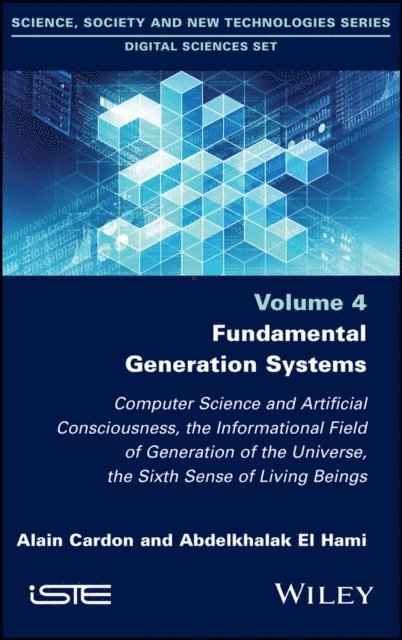
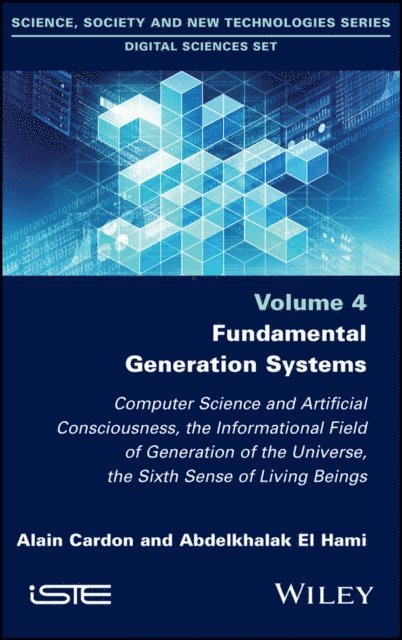
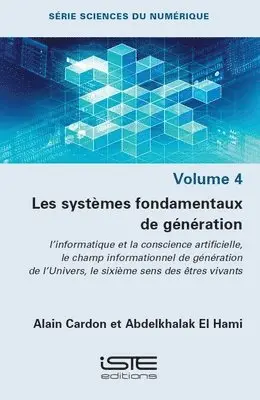
    Fundamental Generation Systems

    Computer Science and Artificial Consciousness, the Informational Field of Generation of the Universe, the Sixth Sense of Living Beings

    AvAlain Cardon,Abdelkhalak El Hami

    Inbunden, Engelska, 2023

    1 723 kr

    Beställningsvara. Skickas inom 5-8 vardagar. Fri frakt över 249 kr.

    Beskrivning

    There are many different ways of generating representations. This includes representations generated by living beings while comprehending reality in order to act; representations generated by the Universe during its extensive unfolding, creating physical elements and living beings; and the direct representation of elements through an animal’s sixth sense. To this list we must now add the creation of artificial consciousness, which generates representations that resemble the mental representations of humans. These representations allow robotic systems to communicate directly with each other.Fundamental Generation Systems develops a theory which presents, from the beginning, the function of this sixth sense called the “sense of informational comprehension”. This sense is understood as an ability to use the informational foundations of the Universe via a dedicated cerebral domain found in every animal.

    Produktinformation

    • Utgivningsdatum:2023-08-03
    • Mått:161 x 240 x 17 mm
    • Vikt:599 g
    • Format:Inbunden
    • Språk:Engelska
    • Antal sidor:224
    • Förlag:ISTE Ltd and John Wiley & Sons Inc
    • ISBN:9781786308733

    Utforska kategorier

    • Elektronik och kommunikationer inom Naturvetenskap och teknik
    • Artificiell intelligens inom Data och IT

    Mer om författaren

    Alain Cardon is a researcher at INSA-Rouen-Normandie, France. He is a specialist in artificial intelligence and artificial consciousness.Abdelkhalak El Hami is Full Professor of Universities at INSARouen-Normandie, France. He is a specialist in problems of optimization, reliability and artificial intelligence in multi-physical systems.

    Innehållsförteckning

    • Preface xiIntroduction xvChapter 1 Systems and their Designs 11.1 System modeling 11.1.1 Traditional systems 21.1.2 Complex systems 21.1.3 Systems of systems 31.2 Autonomous systems 41.3 Multi-agent systems 61.4 Organizations and systems 71.5 The problem of modeling an autonomous system 81.6 Agents and multi-agent systems 91.6.1 The weak notion of an agent 101.6.2 The strong notion of an agent 111.6.3 Cognitive agents and reactive agents 111.6.4 Multi-agent systems 131.6.5 MAS with reactive agents 141.6.6 MAS with cognitive agents 14Chapter 2 Reliability of Autonomous Systems 172.1 Introduction 172.2 Dependability of a system 182.2.1 General concepts 182.2.2 Failure and repair rates 212.2.3 Average estimators 242.2.4 Some methodological tools 272.3 Reliability diagram 282.3.1 Series system 292.3.2 Parallel system 302.3.3 Mixed system 312.3.4 More complex systems 322.3.5 Fault tree 332.4 Reliability networks 342.4.1 Partial graph associated with a subset of components 342.4.2 Reliability network and structure function 352.4.3 Properties of reliability networks 352.4.4 Length and width of a reliability network 362.4.5. Equivalence between structure function and reliability network .. 362.4.6 Construction and simplification of reliability networks 36Chapter 3 Artificial Intelligence, Communication Systems and Artificial Consciousness 393.1 Introduction 393.2 Evolution of computer science 393.3 Evolution of artificial intelligence 433.4 Radical evolution of computing and AI towards fully communicating systems 473.5 The computer representation of an artificial consciousness 53Chapter 4 The Informational Substrate of the Universe and the Organizational Law 634.1 Introduction 634.2 The fundamental principles of the informational model of generation of the Universe 634.2.1 First fundamental concept: the foundation of the Universe by a generative information system 644.2.2 Second fundamental concept: informational character of the Universe with its substrate 654.2.3 Third fundamental concept: the organizational law of generation of the Universe 674.2.4 Fourth fundamental concept: the informational energy of the substrate of the Universe 694.3 The notion of generating information in the Universe 714.3.1 The information field of a component 724.3.2 The informational activity component and its information envelope 734.3.3 Fifth fundamental concept: self-control in the organization of the Universe 744.3.4 Generative information 754.3.5 Organizational tendency of the Universe and informational envelopes 76Chapter 5 The Informational Interpretation of Living Things 815.1 Introduction 815.2 Origin of living things with bifurcation of the organizational law 825.2.1 Sixth fundamental concept: the production of living things on Earth 825.2.2 Bifurcation of the organizational law 835.2.3 Seventh fundamental concept: the central rule of organizational law in living things 845.2.4 The principle of action of the organizational law for the generation of living things 855.2.5 The life span of a living organism 875.2.6. The unification of the informational envelope with the membrane 885.2.7 The creation of sexual reproduction 895.2.8 Reasons for the production of new organisms 905.3 The informational action of reproduction of living things 915.3.1 The fundamental rule of the organizational law that formed living beings 935.3.2 Morphological patterns 945.3.3 The influence of an external morphological pattern on a living organism 955.3.4 Brain formation and sensory comprehension 975.3.5 The external organizational attractors hypothesis 995.3.6 The possibility of predicting the future of any situation in progress 995.4 The human species in the organizational evolution of living things 1005.4.1 Creation of Homo sapiens as a result of very strong evolution 1015.4.2 Organizational action of the formation of the human brain 1015.4.3. The importance of informational links between groups of humans 1035.4.4 Power of group participation in humans 104Chapter 6 The Interpretation of Neuronal Aggregates 1076.1 Introduction 1076.1.1 Form of a thought 1086.1.2. Constructivist definition of the notion of mental representation 1086.2 The systemic layer and the regulators including the informational regulator 1126.2.1 Systemic layer of the psychic system 1126.2.2 Regulators 1136.2.3. The voluntary choice of the operated aim in the psychic system 1136.2.4 The aggregate–regulator rule of co-activity 1146.2.5 Morphological role of regulators 1166.2.6 Process of intentionally producing a representation on a desired theme 1216.2.7 The organizational immersion regulator in an informational state 124Chapter 7 The Sense of Informational Comprehension of Living Organisms: The Sixth Sense 1257.1 Introduction 1257.2 The five usual senses and the use of the informational substrate 1267.2.1 The case of animals 1277.2.2 The case of plants 1287.3 The sense of informational comprehension or the sixth sense 1297.3.1 The implicit communication process of the sixth sense 1307.3.2 The voluntary process of informational communication 1317.3.3 The solicitation of the sixth sense and the comprehension of the informational substrate 1357.3.4 The cognitive and sensitive interpretation of the information forms received 1397.4 Common use of the sixth sense 1427.4.1 Common use of the sixth sense in animals and humans 1427.4.2 The action of the sixth sense for hypnosis, the power of magnetism and meditation 1477.4.3 The notion of premonition and the sixth sense 1517.4.4 Thoughts and the safeguarding of the world 153Conclusion 155Appendices 157Appendix 1 Binomial Distribution 159Appendix 2 Geometric Distribution 161Appendix 3 Poisson Distribution 163Appendix 4 Exponential Distribution 165Appendix 5 Normal Distribution 167Appendix 6 Lognormal Distribution 171Appendix 7 Weibull Distribution 175Appendix 8 Pareto Distribution 179Appendix 9 Distribution of Extreme Values 183Appendix 10 Asymptotic Distributions 185References 191Index 195