• Fri frakt över 249 kr
  • •
  • Snabba leveranser
  • •
  • Billiga böcker
Kundservice

Du är på sajten för privatpersoner.

Företag, bibliotek eller offentlig verksamhet?

Du handlar på classic.bokus.com, där alla dina funktioner finns intakta.
Till classic.bokus.com
Bokus logotyp. Gå till startsidan.
  • Erbjudanden
  • Nyheter
  • Student
  • Topplistor
  • Barn & ungdom
  • Bokus Play
  • E-böcker
  • Pocketböcker
  • Spel & pussel

10% rabatt på allt med kod: NYSTART10 →

Sidfot

Mina sidor

    Hjälp

    • Kundservice
    • Vanliga frågor och svar
    • Frakt och leverans
    • Retur vid ångerrätt
    • Reklamera vara
    • Betalning
    • Köpvillkor
    • Allmänna villkor
    • Information om webbplatsens tillgänglighet

    Om Bokus

    • Om oss
    • Pressrum
    • För studenter
    • För företag
    • För bibliotek och offentlig verksamhet
    • För leverantörer
    • Hållbarhet

    Populärt

    • Aktuella erbjudanden
    • Presentkort
    • Studentlitteratur
    • Nya böcker
    • Topplistor
    • Signerade böcker
    • Engelska böcker

    Inspiration

    • Boktips
    • BookTok
    • Populära bokserier
    • Barnbokskaraktärer
    • Populära författare
    Logotyp för Bokus
    Följ oss på Facebook (extern länk)Följ oss på Instagram (extern länk)Följ oss på YouTube (extern länk)Följ oss på TikTok (extern länk)
    bokus @ CookiesAnpassa cookiesIntegritetspolicyKöpvillkor
    Till Citymail hemsida (extern länk)Till Budbee hemsida (extern länk)Till Postnord hemsida (extern länk)Till Schenker hemsida (extern länk)Till Early Bird hemsida (extern länk)Till Walleys hemsida (extern länk)
    1. Historia och arkeologi
    2. Historia
    3. Historia: särskilda händelser och ämnen
    4. Kalla krig och ombudskrig

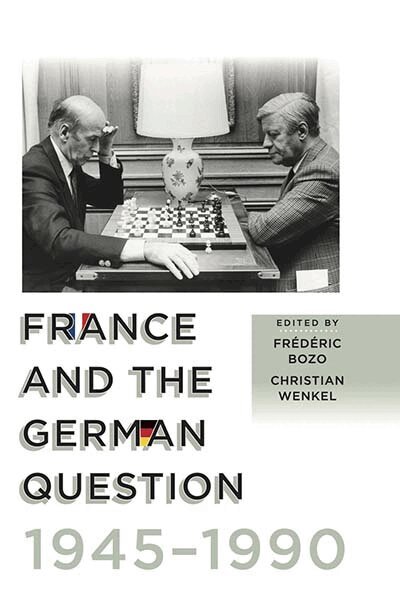
    France and the German Question, 1945–1990

    AvFrédéric Bozo,Christian Wenkel

    Häftad, Engelska, 2023

    526 kr

    Beställningsvara. Skickas inom 5-8 vardagar. Fri frakt över 249 kr.

    Beskrivning

    In the immediate aftermath of World War Two, the victors were unable to agree on Germany’s fate, and the separation of the country—the result of the nascent Cold War—emerged as a de facto, if provisional, settlement. Yet East and West Germany would exist apart for half a century, making the "German question" a central foreign policy issue—and given the war-torn history between the two countries, this was felt no more keenly than in France. Drawing on the most recent historiography and previously untapped archival sources, this volume shows how France’s approach to the German question was, for the duration of the Cold War, both more constructive and consequential than has been previously acknowledged.

    Produktinformation

    • Utgivningsdatum:2023-07-14
    • Mått:152 x 229 x 19 mm
    • Vikt:452 g
    • Format:Häftad
    • Språk:Engelska
    • Antal sidor:308
    • Förlag:Berghahn Books
    • ISBN:9781800739185

    Utforska kategorier

    • Kalla krig och ombudskrig inom Historia och arkeologi
    • Internationella relationer inom Samhälle och politik

    Mer om författaren

    Frédéric Bozo is Professor of Contemporary History at the Sorbonne Nouvelle, University of Paris III, Institute of European Studies. He is the author of numerous books, including Mitterrand, the End of the Cold War, and German Unification (2009) and French Foreign Policy since 1945 (2016), and the editor of such collections as Europe and the End of the Cold War: A Reappraisal (2008).

    Recensioner i media

    “These impressively researched chapters persuasively demonstrate that France was a leader in addressing postwar concerns with West Germany. Furthermore, the authors argue that France sought a constructive relationship with West Germany as early as 1945. From the economic rebuilding of the 1950s through de Gaulle’s desire to transform the continent and negotiations with the Eastern bloc following Ostpolitik to Mitterand’s support for German reunification within a European framework, this collection makes clear that the fates of the two countries were often inextricably linked. Highly Recommended.” • Choice“This volume is an unmissable reference work for all those interested in French foreign politics and the German question. Concise and exhaustive, it offers an overview of the subject and a perspective that is useful as well as necessary regarding current research but remaining accessible to the larger public at the same time. One has to conclude that this publication attests to the scholarly vitality of a topic that is ever-evolving.” • Francia“This is a valuable collection of articles that illuminates French policy towards Germany, a key issue in Cold War European and transatlantic politics. The goal of emphasizing France’s influential role is certainly to be welcomed.”  • H-France“The editors have assembled an excellent team of internationally established and renowned historians for the purposes of this book. Its central focus and arguments remain in view throughout – no mean feat amongst fifteen chapters in six parts – and the cohesion o the collection is maintained from start to end. At the same time, and of crucial importance, the contributions are of uniformly high quality… The result is an impressive and authoritative collection offering an original perspective on an under-investigated topic. Into the bargain, it is a pleasure to read… Without doubt, it is a significant work which should be widely read, and the editors should be commended for its clarity and perspective.” • Diplomacy & Statecraft“This volume can be seen as a handbook that is warmly recommended to whoever would like to work on the book’s basic topic.”  • Sehepunkte“Finally, this book also presents problematic issues more rarely analysed, but rich in information, like the Franco-German differences about a possible common currency in the 1970s, or as well the relationships and exchanges between François Mitterrand and Willy Brandt. For an understanding of all the dimensions of French attitudes regarding the German issue, the work of Frédéric Bozo and Christian Wenkel is indispensable.” • Politique étrangère“This volume is written by accomplished scholars and intended for university audiences. It offers new interpretations of French policy vis-a-vis Germany based on the latest available archival evidence. As such, it is essential reading for professional academics and students interested in European politics and the dynamics of European integration during the Cold War.” • History: Reviews of New Books“France and the German Question is an outstanding, superbly edited volume with contributions by leading scholars in the field. For anyone interested in an up-to-date history of the Franco-German relationship, this is now the go-to volume.” • Christian Ostermann, Woodrow Wilson Center

    Innehållsförteckning

    • List of AbbreviationsIntroductionFrédéric Bozo and Christian WenkelPART I: FROM CAPITULATION TO COOPERATIONChapter 1. France and the German Question, 1945–1949: On the interdependence of Historiography, Methodology, and InterpretationsRainer HudemannChapter 2. Economic and Industrial Issues in France’s Approach to the German Question in the Postwar PeriodFrançoise BergerPART II: THE EMERGENCE OF THE BLOC SYSTEMChapter 3. France, German Rearmament, and the German Question, 1945–1955Michael H. CreswellChapter 4. Impossible Allies? Soviet Views of France and the German Question in the 1950s  Geoffrey RobertsPART III: THE DE GAULLE FACTORChapter 5. An Arbiter between the Superpowers: De Gaulle and the German Question, 1958–1969Garret J. MartinChapter 6. The German Question in the Eastern Policies of France and Germany in the 1960sBenedikt SchoenbornPART IV: THE ERA OF OSTPOLITIKChapter 7. Perceptions of Ostpolitik: French-West German Relations and the Evolving German Question under Willy Brandt and Georges PompidouGottfried NiedhartChapter 8.  France, the Conference on Security and Cooperation in Europe, and the German QuestionNicolas BadalassiChapter 9. The Economic and Monetary Dimensions of the German Question: A French Perspective, 1969–1979Guido ThiemeyerPART V: THE END GAMEChapter 10. The French ‘Obsession’ with the German Question: Willy Brandt, François Mitterrand, the German Question and German Unification, 1981–1990Bernd RotherChapter 11. All about Europe? France, Great Britain and the Question of German Unification, 1989–90Ilaria PoggioliniChapter 12. Franco-Soviet Relations, German Unification, and the End of the Cold WarFrédéric BozoPART VI: ENDURING CONCERNS: ANSCHLUSS, BORDERS, AND THE TWO GERMANYSChapter 13. Towards a New Anschluss? France and the German and the Austrian Questions, 1945–55Thomas AngererChapter 14. France, Poland, and Germany's Eastern Border, 1945–1990. The Recurrent Issue of the German Question in French-Polish RelationsPierre-Frédéric WeberChapter 15. A Surprising Continuity: The French Attitude and Policy Towards the German Democratic Republic, 1949–1990Christian WenkelIndex