• Fri frakt över 249 kr
  • •
  • Snabba leveranser
  • •
  • Billiga böcker
Kundservice

Du är på sajten för privatpersoner.

Företag, bibliotek eller offentlig verksamhet?

Du handlar på classic.bokus.com, där alla dina funktioner finns intakta.
Till classic.bokus.com
Bokus logotyp. Gå till startsidan.
  • Erbjudanden
  • Student
  • Topplistor
  • Barn & ungdom
  • Bokus Play
  • E-böcker
  • Ljudböcker
  • Pocketböcker
  • Spel & pussel

Upp till 25% på utvalda nyheter →

Sidfot

Mina sidor

    Hjälp

    • Kundservice
    • Vanliga frågor och svar
    • Frakt och leverans
    • Retur vid ångerrätt
    • Reklamera vara
    • Betalning
    • Köpvillkor
    • Allmänna villkor
    • Information om webbplatsens tillgänglighet

    Om Bokus

    • Om oss
    • Pressrum
    • För studenter
    • För företag
    • För bibliotek och offentlig verksamhet
    • För leverantörer
    • Hållbarhet

    Populärt

    • Aktuella erbjudanden
    • Presentkort
    • Studentlitteratur
    • Nya böcker
    • Topplistor
    • Signerade böcker
    • Engelska böcker

    Inspiration

    • Boktips
    • BookTok
    • Populära bokserier
    • Barnbokskaraktärer
    • Populära författare
    Logotyp för Bokus
    Följ oss på Facebook (extern länk)Följ oss på Instagram (extern länk)Följ oss på YouTube (extern länk)Följ oss på TikTok (extern länk)
    bokus @ CookiesAnpassa cookiesIntegritetspolicyKöpvillkor
    Till Citymail hemsida (extern länk)Till Budbee hemsida (extern länk)Till Postnord hemsida (extern länk)Till Schenker hemsida (extern länk)Till Early Bird hemsida (extern länk)Till Walleys hemsida (extern länk)
    1. Ekonomi och Ledarskap
    2. Företagsekonomi
    3. Organisation och ägarskap

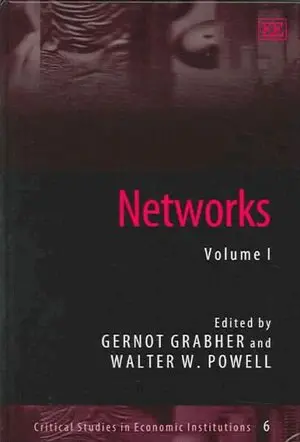
    Networks

    AvGernot Grabher,Walter W. Powell

    Inbunden, Engelska, 2004

    Del 6 i serien Critical Studies in Economic Institutions series

    11 110 kr

    Beställningsvara. Skickas inom 5-8 vardagar. Fri frakt över 249 kr.

    Beskrivning

    This major two-volume collection presents a comprehensive overview of the scholarly literature exploring the emergence, functioning and forms of networks, focusing on their role in the economy. The collection draws from a broad range of disciplinary backgrounds to combine key writings that have defined the field with more recent contributions in emerging areas of network research.Volume I introduces networks as a distinctive governance structure. The collection explores critical antecedents and social exchange conditions of networks such as trust, reputation, power, and cohesion and also examines the vulnerability of networks. Volume II features pivotal network processes and dynamics such as access, learning and innovation, mobilization and recombination, and diffusion. The collection covers the spectrum of various network forms and elucidates the key features of regional, informal, business and project networks.These insightful volumes will be an essential source of reference for students and researchers alike.

    Produktinformation

    • Utgivningsdatum:2004-11-26
    • Mått:169 x 244 x undefined mm
    • Format:Inbunden
    • Språk:Engelska
    • Serie:Critical Studies in Economic Institutions series
    • Förlag:Edward Elgar Publishing Ltd
    • ISBN:9781843760351

    Utforska kategorier

    • Organisation och ägarskap inom Ekonomi och Ledarskap

    Mer om författaren

    Edited by Gernot Grabher, HafenCity University, Germany and Walter W. Powell, Professor of Education, Organizational Behavior and Sociology, Stanford University, US

    Recensioner i media

    'Overall, this two-volume collection is a useful and authoritative resource for scholars who are concerned with the institutional organization of socioeconomic life in economic geography and related fields, providing a one-stop shop of major contributions that have spawned and developed this diverse and complex field of research.'

    Innehållsförteckning

    • Contents:Volume IAcknowledgementsIntroduction Gernot Grabher and Walter W. PowellPART INETWORKS AS GOVERNANCE STRUCTURES 1. G.B. Richardson (1972), ‘The Organisation of Industry’2. Ian R. Macneil (1978), ‘Contracts: Adjustment of Long-Term Economic Relations Under Classical, Neoclassical, and Relational Contract Law’3. Walter W. Powell (1990), ‘Neither Market Nor Hierarchy: Network Forms of Organization’4. Oliver E. Williamson (1991), ‘Comparative Economic Organization: The Analysis of Discrete Structural Alternatives’5. Bengt Holmström and John Roberts (1998), ‘The Boundaries of the Firm Revisited’PART IIGOVERNANCE OF NETWORKS AEmbeddedness6. K. Polanyi (1968), ‘Our Obsolete Market Mentality’7. Mark Granovetter (1985), ‘Economic Action and Social Structure: The Problem of Embeddedness’BTrust 8. Diego Gambetta (1988), ‘Mafia: The Price of Distrust’9. Mari Sako and Susan Helper (1998), ‘Determinants of Trust in Supplier Relations: Evidence from the Automotive Industry in Japan and the United States’CIdentity and Reputation10. Yoram Ben-Porath (1980), ‘The F-Connection: Families, Friends, and Firms and the Organization of Exchange’11. Ronald Dore (1983), ‘Goodwill and the Spirit of Market Capitalism’12. Joel M. Podolny (2001), ‘Networks as the Pipes and Prisms of the Market’DPower and Control13. Peter V. Marsden (1983), ‘Restricted Access in Networks and Models of Power’14. Harrison C. White (1993), ‘Markets, Networks and Control’15. John F. Padgett and Christopher K. Ansell (1993), ‘Robust Action and the Rise of the Medici, 1400–1434’ECohesion16. Jeffrey Travers and Stanley Milgram (1969), ‘An Experimental Study of the Small World Problem’17. Mark S. Granovetter (1973), ‘The Strength of Weak Ties’18. Duncan J. Watts (1999), ‘Networks, Dynamics, and the Small-World Phenomenon’FLock-in and Vulnerability 19. Gernot Grabher (1993), ‘The Weakness of Strong Ties: The Lock-in of Regional Development in the Ruhr Area’20. Brian Uzzi (1997), ‘Social Structure and Competition in Interfirm Networks: The Paradox of Embeddedness’21. Réka Albert, Hawoong Jeong and Albert-László Barabási (2000), ‘Error and Attack Tolerance of Complex Networks’Name IndexVolume IIAcknowledgementsAn introduction by the editors to both volumes appears in Volume IPART INETWORK DYNAMICS AAccess and Leverage1. Scott A. Boorman (1975), ‘A Combinatorial Optimization Model for Transmission of Job Information Through Contact Networks’ 2. Herminia Ibarra (1992), ‘Homophily and Differential Returns: Sex Differences in Network Structure and Access in an Advertising Firm’3. Ronald S. Burt (1993), ‘The Social Structure of Competition’BLearning and Innovation4. John Seely Brown and Paul Duguid (1991), ‘Organizational Learning and Communities-of-Practice: Toward a Unified View of Working, Learning, and Innovation’5. Walter W. Powell, Kenneth W. Koput and Laurel Smith-Doerr (1996), ‘Interorganizational Collaboration and the Locus of Innovation: Networks of Learning in Biotechnology’6. Gautam Ahuja (2000), ‘Collaboration Networks, Structural Holes, and Innovation: A Longitudinal Study’CMobilisation and Recombination7. Michel Callon (1986), ‘The Sociology of an Actor-Network: The Case of the Electric Vehicle’8. David Lane and Robert Maxfield (1996), ‘Strategy under Complexity: Fostering Generative Relationships’9. David Stark (1996), ‘Recombinant Property in East European Capitalism’DDiffusion10. James Coleman, Elihu Katz and Herbert Menzel (1957), ‘The Diffusion of an Innovation among Physicians’11. Ronald S. Burt (1987), ‘Social Contagion and Innovation: Cohesion versus Structural Equivalence’12. Gerald F. Davis and Henrich R. Greve (1997), ‘Corporate Elite Networks and Governance Changes in the 1980s’PART IIVARIETIES OF NETWORK FORMS AInformal Networks13. Melville Dalton (1959), ‘Power Struggles in the Line’14. Clifford Geertz (1978), ‘The Bazaar Economy: Information and Search in Peasant Marketing’15. Wayne E. Baker and Robert R. Faulkner (1993), ‘The Social Organization of Conspiracy: Illegal Networks in the Heavy Electrical Equipment Industry’BProject Networks16. Robert G. Eccles (1981), ‘The Quasifirm in the Construction Industry’17. Robert R. Faulkner and Andy B. Anderson (1987), ‘Short-Term Projects and Emergent Careers: Evidence from Hollywood’18. Debra Meyerson, Karl E. Weick and Roderick M. Kramer (1996), ‘Swift Trust and Temporary Groups’CRegional Networks19. AnnaLee Saxenian (1990), ‘Regional Networks and the Resurgence of Silicon Valley’20. Ash Amin and Nigel Thrift (1992), ‘Neo-Marshallian Nodes in Global Networks’21. Anders Malmberg and Peter Maskell (2002), ‘The Elusive Concept of Localization Economies: Towards a Knowledge-Based Theory of Spatial Clustering’DBusiness Networks22. Håken Håkansson and Jan Johanson (1988), ‘Formal and Informal Cooperation Strategies in International Industrial Networks’23. Sumantra Ghoshal and Christopher A. Bartlett (1990), ‘The Multinational Corporation as an Interorganizational Network’24. James R. Lincoln, Michael L. Gerlach and Peggy Takahashi (1992), ‘Keiretsu Networks in the Japanese Economy: A Dyad Analysis of Intercorporate Ties’25. John Hagedoorn (2002), ‘Inter-firm R&D Partnerships – An Overview of Major Trends and Patterns Since 1960’Name Index