• Fri frakt över 249 kr
  • •
  • Snabba leveranser
  • •
  • Billiga böcker
Kundservice

Du är på sajten för privatpersoner.

Företag, bibliotek eller offentlig verksamhet?

Du handlar på classic.bokus.com, där alla dina funktioner finns intakta.
Till classic.bokus.com
Bokus logotyp. Gå till startsidan.
  • Erbjudanden
  • Student
  • Topplistor
  • Barn & ungdom
  • Bokus Play
  • E-böcker
  • Ljudböcker
  • Pocketböcker
  • Spel och pussel

Pocketfynda! Hundratals böcker för 49 kr/st →

Sidfot

Mina sidor

    Hjälp

    • Kundservice
    • Vanliga frågor och svar
    • Frakt och leverans
    • Retur vid ångerrätt
    • Reklamera vara
    • Betalning
    • Köpvillkor
    • Allmänna villkor
    • Information om webbplatsens tillgänglighet

    Om Bokus

    • Om oss
    • Pressrum
    • För studenter
    • För företag
    • För bibliotek och offentlig verksamhet
    • För leverantörer
    • Hållbarhet

    Populärt

    • Aktuella erbjudanden
    • Presentkort
    • Studentlitteratur
    • Nya böcker
    • Topplistor
    • Signerade böcker
    • Engelska böcker

    Inspiration

    • Boktips
    • BookTok
    • Barnbokskaraktärer
    • Populära författare
    Logotyp för Bokus
    Följ oss på Facebook (extern länk)Följ oss på Instagram (extern länk)Följ oss på YouTube (extern länk)Följ oss på TikTok (extern länk)
    bokus @ CookiesAnpassa cookiesIntegritetspolicyKöpvillkor
    Till Citymail hemsida (extern länk)Till Budbee hemsida (extern länk)Till Postnord hemsida (extern länk)Till Schenker hemsida (extern länk)Till Early Bird hemsida (extern länk)Till Walleys hemsida (extern länk)
    1. Naturvetenskap och teknik
    2. Matematik och naturvetenskap
    3. Matematik
    4. Tillämpad matematik

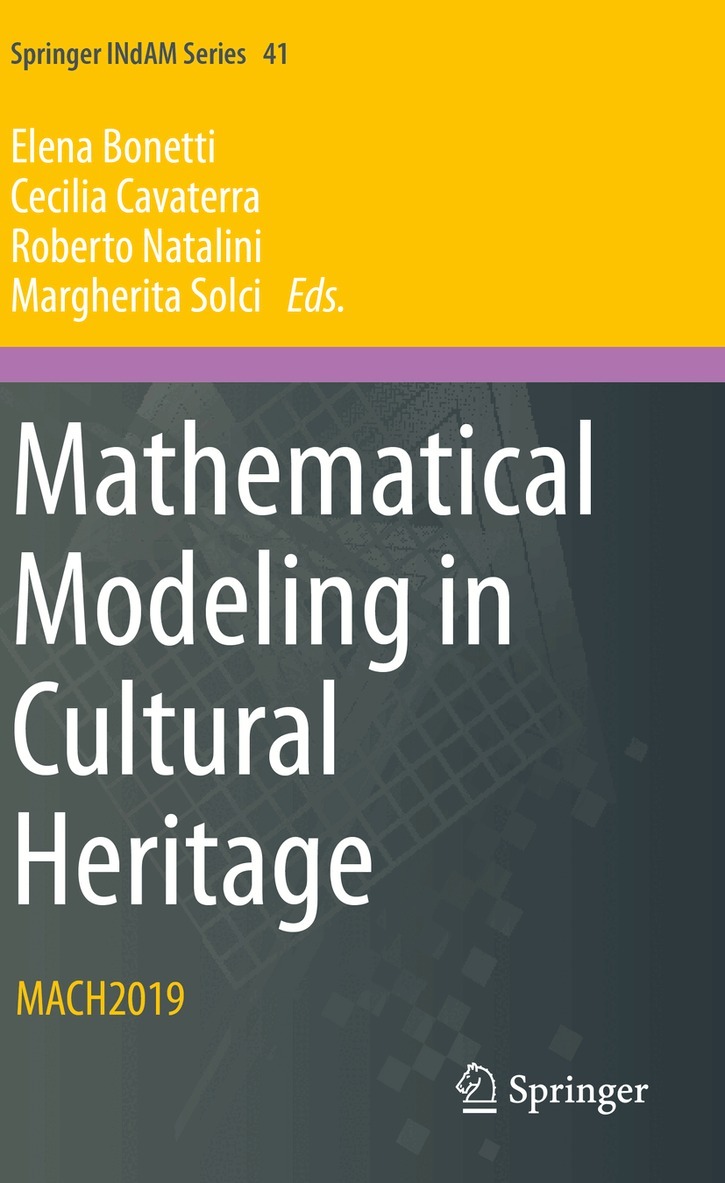
    Mathematical Modeling in Cultural Heritage

    MACH2019

    AvElena Bonetti,Cecilia Cavaterra

    Häftad, Engelska, 2022

    Del 41 i serien Springer INdAM Series

    1 078 kr

    Beställningsvara. Skickas inom 10-15 vardagar. Fri frakt över 249 kr.

    Beskrivning

    This work collects the contributions presented at the INdAM Workshop “Mathematical modeling and Analysis of degradation and restoration in Cultural Heritage – MACH2019” held in Rome in March 2019. The book is focused on mathematical modeling and simulation techniques with the aim of improving the current strategies of conservation and restoration in cultural heritage, sharing different experiences and approaches. The main topics are: corrosion and sulphation of materials, damage and fractures, stress in thermomechanical systems, contact and adhesion problems, phase transitions and reaction-diffusion models, restoration techniques, additive manufacturing. The final goal is to build a permanent bridge between the experts in cultural heritage and the mathematical community. The work is addressed to experts in cultural heritage and to mathematicians.

    Produktinformation

    • Utgivningsdatum:2022-02-04
    • Mått:155 x 235 x 10 mm
    • Vikt:309 g
    • Format:Häftad
    • Språk:Engelska
    • Serie:Springer INdAM Series
    • Antal sidor:164
    • Förlag:Springer Nature Switzerland AG
    • ISBN:9783030580797

    Utforska kategorier

    • Tillämpad matematik inom Naturvetenskap och teknik
    • Teknik: allmänt inom Naturvetenskap och teknik
    • Beräkning och matematisk analys inom Naturvetenskap och teknik

    Mer om författaren

    Elena Bonetti is associate professor of Mathematical Analysis at Università degli Studi di Milano, where she got her  Ph.D. in Mathematics. Her research activity focuses on systems of nonlinear partial differential equations with applications to phase transitions and separations phenomena, non-smooth thermo-mechanical models, smart materials behaviour, adhesion and damage problems. Recently, she analysed new models for restoration and conservation of monumental stones in cultural heritage subject to chemical and mechanical degradation.Cecilia Cavaterra is currently associate professor of Mathematical Analysis at Università degli Studi di Milano. She got a Ph.D. in Mathematics at Alma Mater Studiorum - Università di Bologna. Her main research interests concern nonlinear partial differential equations, dynamical systems, inverse and control problems. Her recent works are related to the mathematical analysis of models describing the chemical and mechanical degradation of monumental stones in cultural heritage.Roberto Natalini is a Director of research at the IAC-CNR, where he is also the Director of Institute since 2014. He studies evolutionary partial differential equations with applications to fluid dynamics, biology, car traffic and problems in conservation of cultural heritage. He published more than 120 papers on International peer-review journals. Since 2018 he is Delegate for CNR in the Steering Committee of the Regional District for Cultural Heritage in Latium (Italy).Margherita Solci is associate professor of Mathematical Analysis at Università degli Studi di Sassari. She got a Ph.D. in Mathematics at Università di Pavia. Her research activity focuses on Calculus of Variations, Gamma-convergence, homogenization, analysis of discrete-to-continuum models via variational convergence. Recently, she worked on evolution problems for structural damage in archaeological buildings.

    Innehållsförteckning

    • 1 Azzena, G. and Busonera, R., To know without destroying?.- 2 Bilotta, A. et al., Representative Volume Elements for the analysis of concrete like materials by computational homogenization.- 3 Bonetti, E. et al., A new nonlocal temperature-dependent model for adhesive contact.- 4 Bonetti, E. et al., Chemomechanical degradation of monumental stones: preliminary results.- 5 Bretti, G. et al., Modelling the efects of protectve treatments in porous.- 6 Caruso, G. et al., Mathematical models for infrared analysis applied to cultural.- 7 Coco, A. et al., Numerical simulations of marble sulfation.- 8 Comite, V. and Fermo, P., The damage induced by atmospheric pollution on stone surfaces: the chemical characterization of black crus.- 9 Conti, M. et al., Aging of viscoelastic materials: a mathematical model.- 10 Negri, M., A quasi-static model for craquelure patterns