• Fri frakt över 249 kr
  • •
  • Snabba leveranser
  • •
  • Billiga böcker
Kundservice

Du är på sajten för privatpersoner.

Företag, bibliotek eller offentlig verksamhet?

Du handlar på classic.bokus.com, där alla dina funktioner finns intakta.
Till classic.bokus.com
Bokus logotyp. Gå till startsidan.
  • Erbjudanden
  • Student
  • Topplistor
  • Barn & ungdom
  • Bokus Play
  • E-böcker
  • Ljudböcker
  • Pocketböcker
  • Spel och pussel

Pocketfynda! Hundratals böcker för 49 kr/st →

Sidfot

Mina sidor

    Hjälp

    • Kundservice
    • Vanliga frågor och svar
    • Frakt och leverans
    • Retur vid ångerrätt
    • Reklamera vara
    • Betalning
    • Köpvillkor
    • Allmänna villkor
    • Information om webbplatsens tillgänglighet

    Om Bokus

    • Om oss
    • Pressrum
    • För studenter
    • För företag
    • För bibliotek och offentlig verksamhet
    • För leverantörer
    • Hållbarhet

    Populärt

    • Aktuella erbjudanden
    • Presentkort
    • Studentlitteratur
    • Nya böcker
    • Topplistor
    • Signerade böcker
    • Engelska böcker

    Inspiration

    • Boktips
    • BookTok
    • Barnbokskaraktärer
    • Populära författare
    Logotyp för Bokus
    Följ oss på Facebook (extern länk)Följ oss på Instagram (extern länk)Följ oss på YouTube (extern länk)Följ oss på TikTok (extern länk)
    bokus @ CookiesAnpassa cookiesIntegritetspolicyKöpvillkor
    Till Citymail hemsida (extern länk)Till Budbee hemsida (extern länk)Till Postnord hemsida (extern länk)Till Schenker hemsida (extern länk)Till Early Bird hemsida (extern länk)Till Walleys hemsida (extern länk)
    1. Naturvetenskap och teknik
    2. Matematik och naturvetenskap
    3. Biologi
    4. Djurens beteende

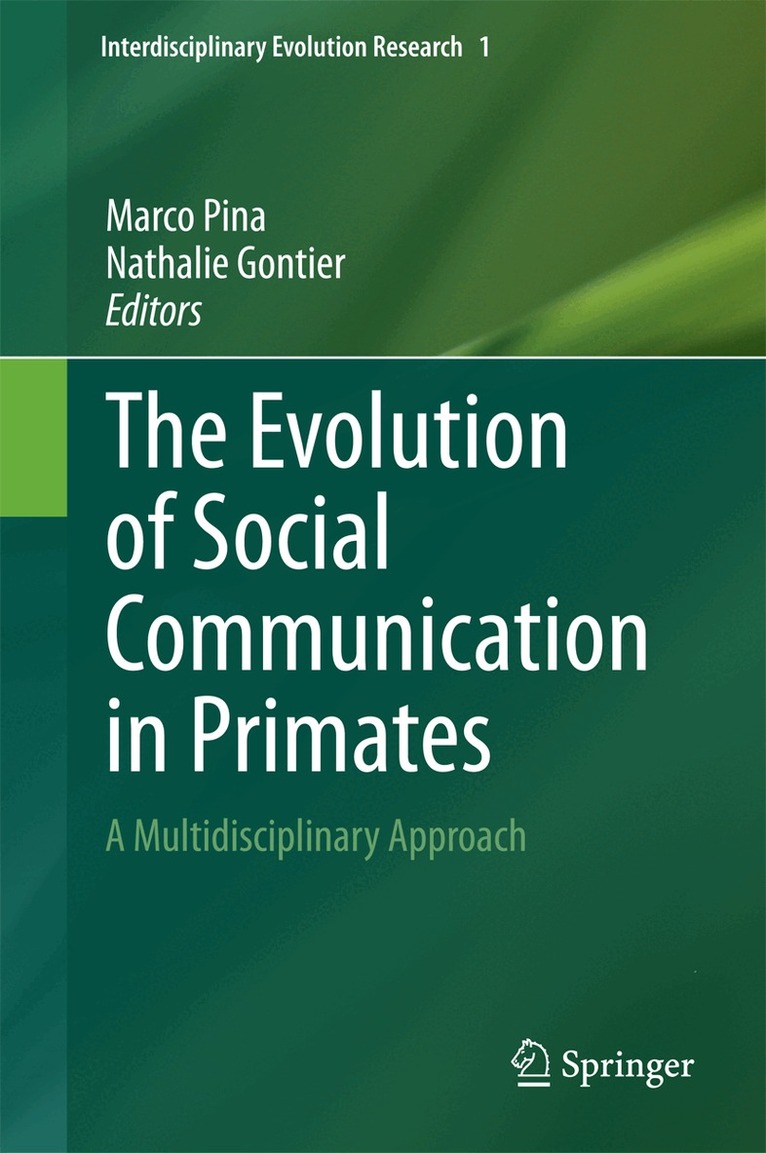
    Evolution of Social Communication in Primates

    A Multidisciplinary Approach

    AvMarco Pina,Nathalie Gontier

    Inbunden, Engelska, 2014

    Del 1 i serien Interdisciplinary Evolution Research

    1 613 kr

    Beställningsvara. Skickas inom 10-15 vardagar. Fri frakt över 249 kr.

    Beskrivning

    How did social communication evolve in primates? In this volume, primatologists, linguists, anthropologists, cognitive scientists and philosophers of science systematically analyze how their specific disciplines demarcate the research questions and methodologies involved in the study of the evolutionary origins of social communication in primates in general and in humans in particular. In the first part of the book, historians and philosophers of science address how the epistemological frameworks associated with primate communication and language evolution studies have changed over time and how these conceptual changes affect our current studies on the subject matter. In the second part, scholars provide cutting-edge insights into the various means through which primates communicate socially in both natural and experimental settings. They examine the behavioral building blocks by which primates communicate and they analyze what the cognitive requirements are for displaying communicative acts. Chapters highlight cross-fostering and language experiments with primates, primate mother-infant communication, the display of emotions and expressions, manual gestures and vocal signals, joint attention, intentionality and theory of mind. The primary focus of the third part is on how these various types of communicative behavior possibly evolved and how they can be understood as evolutionary precursors to human language. Leading scholars analyze how both manual and vocal gestures gave way to mimetic and imitational protolanguage and how the latter possibly transitioned into human language. In the final part, we turn to the hominin lineage, and anthropologists, archeologists and linguists investigate what the necessary neurocognitive, anatomical and behavioral features are in order for human language to evolve and how language differs from other forms of primate communication.

    Produktinformation

    • Utgivningsdatum:2014-06-13
    • Mått:155 x 235 x 24 mm
    • Vikt:670 g
    • Format:Inbunden
    • Språk:Engelska
    • Serie:Interdisciplinary Evolution Research
    • Antal sidor:326
    • Upplaga:2014
    • Förlag:Springer International Publishing AG
    • ISBN:9783319026688

    Utforska kategorier

    • Djurens beteende inom Naturvetenskap och teknik
    • Språkvetenskap och lingvistik inom Språk och ordböcker
    • Biovetenskap inom Naturvetenskap och teknik

    Mer om författaren

    MarcoPina has a background in medicine which he applies to topics in philosophy ofbiology and philosophy of medicine. He is currently preparing a doctoraldissertation on the development of the mind-brain dyad in the context of thenature/nurture debate, which is funded by the Portuguese Fund for Science andTechnology and executed at the Faculty of Science of the Portuguese Universityof Lisbon. Previously, as a scientific collaborator for the Centre forPhilosophy of Science of the University of Lisbon as well as its AppliedEvolutionary Epistemology Lab, he has edited several books on evolutionarytheory, language evolution, and the evolution of man.NathalieGontier is a philosopher of science and an anthropologist. Her main researchinterests lie in evolutionary epistemology and non-Darwinian evolutionarytheories, how the latter differ from the Modern Synthesis and how they can beimplemented into the linguistic sciences and the overall sociocultural domain.As the founding director of the Lisbon Applied Evolutionary Epistemology Lab,she is affiliated to the Centre for Philosophy of Science at the Faculty ofScience of the University of Lisbon, and financed by the Portuguese Fund forScience and Technology. Previous appointments were held at the Dutch FreeUniversity of Brussels (Belgium), the Konrad Lorenz Institute (Austria), andthe American Museum of Natural History (USA). Her research has been sponsoredby the American John Templeton Foundation, the European Marie Curie Actions andthe Belgian Fund for Scientific Research Flanders. She is the founder andeditor-in-chief of the Springer book series Interdisciplinary EvolutionResearch.

    Recensioner i media

    "This volume provides a review of some of the many theoretical frameworks proposed to investigate the evolution of social communication in primates and in particular language in humans. ... a rich, thought-provoking, and multidisciplinary book that would appeal to any scholar interested in the origins and evolution of language and communication." (Roberta Salmi, The Quarterly Review of Biology, Vol. 90, September, 2015) "This edited volume aims to provide a ... series of reviews and critiques of most currently available methodological and theoretical frameworks that guide research on the mechanisms and evolution of primate social communication and human language. ... Summing Up: Recommended. Graduate students and researchers/faculty." (J. B. Leca, Choice, Vol. 52 (6), February, 2015)

    Innehållsförteckning

    • Introduction.- PART I: Philosophical and Historical Roots of Social Communication Studies.- Lord Monboddo’s Ourang Outang and the Origin and Progress of Language.- Ferality and Morality; The Politics of the “Forbidden Experiment” in the Twentieth Century.- PART II: The Elements of Social Communication in Primates and Humans.- Experimental Conversations: Sign Language Studies with Chimpanzees.- How Primate Mothers and Infants Communicate: Characterizing Interaction in Mother-Infant Studies.- On Prototypical Facial Expressions vs. Variation in Facial Behavior: What Have We Learned on the “Visibility” of Emotions from Measuring Facial Actions in Humans and Apes.- The Evolution of Joint Attention: A Review and Critique.- Describing Mental States: From Brain Science to a Science of Mind Reading.- PART III: Evolutionary Transitions from Social Communication Systems to Language.- Bodily Mimesis and the Transition to Speech.- From Grasping to Grooming to Gossip: Innovative Use of ChimpanzeeSignals in Novel Environments Supports both Vocal and Gestural Theories of Language Origins.- Reevaluating Chimpanzee Vocal Signals from the Ground Up.- PART IV: Evolutionary Origins of Human Language.- Communication and Human Uniqueness.- How did Humans Become Behaviorally Modern? Revisiting the ‘Art First’ Hypothesis.- Experiments and Simulations Can Inform Evolutionary Theories of the Cultural Evolution of Language.- The Emergence of Modern Communication in Primates: a Computational Approach.- What Can an Extended Synthesis do for Bio linguistics: On the Need and Benefits of the Eco-evo-devo Program.