Häftad, Engelska, 2018
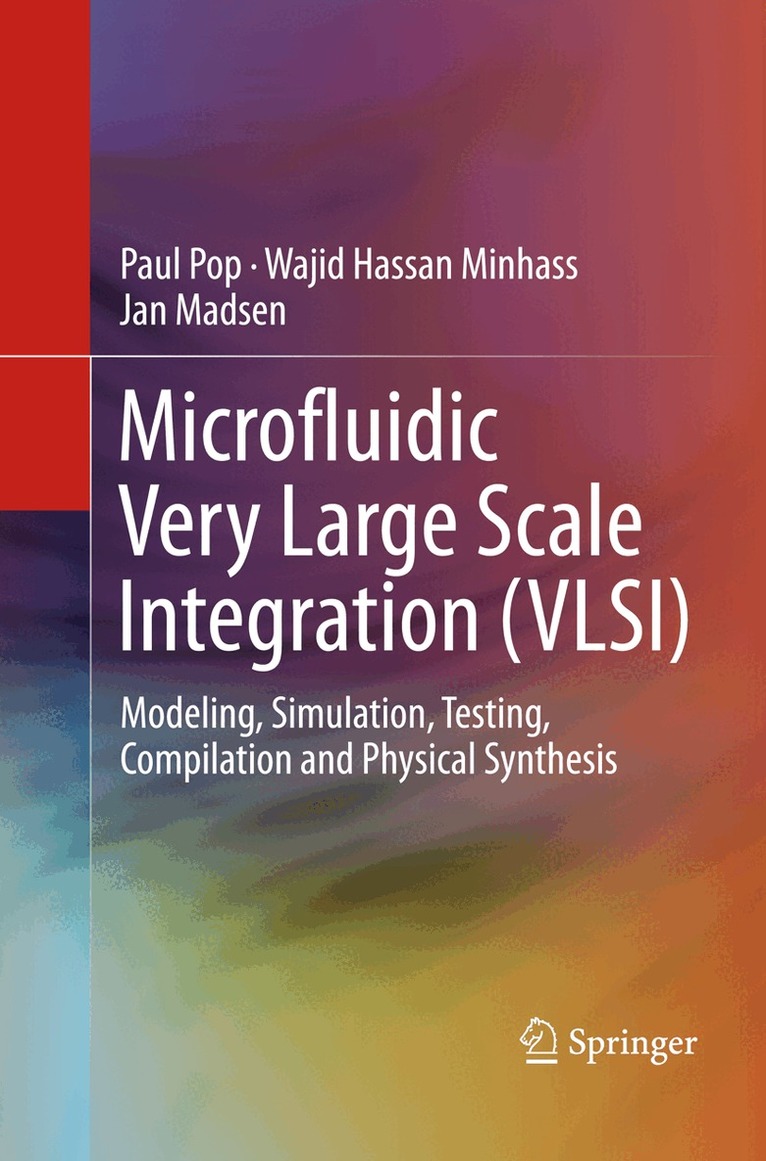
Microfluidic Very Large Scale Integration (VLSI)
Av Paul Pop, Wajid Hassan Minhass, Jan Madsen
1129 kr
Beställningsvara. Skickas inom 10-15 vardagar. Fri frakt över 249 kr.
Beskrivning
This book presents the state-of-the-art techniques for the modeling, simulation, testing, compilation and physical synthesis of mVLSI biochips. The authors describe a top-down modeling and synthesis methodology for the mVLSI biochips, inspired by microelectronics VLSI methodologies. They introduce a modeling framework for the components and the biochip architecture, and a high-level microfluidic protocol language. Coverage includes a topology graph-based model for the biochip architecture, and a sequencing graph to model for biochemical application, showing how the application model can be obtained from the protocol language. The techniques described facilitate programmability and automation, enabling developers in the emerging, large biochip market.
Produktinformation
- Utgivningsdatum: 2018-03-30
- Mått: 155 x 235 x 16 mm
- Vikt: 441 g
- Format: Häftad
- Språk: Engelska
- Antal sidor: 270
- Förlag: Springer International Publishing AG
- ISBN: 9783319806051
Utforska kategorier
Betyg & recensioner
0 recensioner
Inga recensioner tillgängliga.