• Fri frakt över 249 kr
  • •
  • Snabba leveranser
  • •
  • Billiga böcker
Kundservice

Du är på sajten för privatpersoner.

Företag, bibliotek eller offentlig verksamhet?

Du handlar på classic.bokus.com, där alla dina funktioner finns intakta.
Till classic.bokus.com
Bokus logotyp. Gå till startsidan.
  • Erbjudanden
  • Student
  • Topplistor
  • Barn & ungdom
  • Bokus Play
  • E-böcker
  • Ljudböcker
  • Pocketböcker
  • Spel och pussel

Skapa nya rutiner – hälsoböcker upp till 50% →

Sidfot

Mina sidor

    Hjälp

    • Kundservice
    • Vanliga frågor och svar
    • Frakt och leverans
    • Retur vid ångerrätt
    • Reklamera vara
    • Betalning
    • Köpvillkor
    • Allmänna villkor
    • Information om webbplatsens tillgänglighet

    Om Bokus

    • Om oss
    • Pressrum
    • För studenter
    • För företag
    • För bibliotek och offentlig verksamhet
    • För leverantörer
    • Hållbarhet

    Populärt

    • Aktuella erbjudanden
    • Presentkort
    • Studentlitteratur
    • Nya böcker
    • Topplistor
    • Signerade böcker
    • Engelska böcker

    Inspiration

    • Boktips
    • BookTok
    • Barnbokskaraktärer
    • Populära författare
    Logotyp för Bokus
    Följ oss på Facebook (extern länk)Följ oss på Instagram (extern länk)Följ oss på YouTube (extern länk)Följ oss på TikTok (extern länk)
    bokus @ CookiesAnpassa cookiesIntegritetspolicyKöpvillkor
    Till Citymail hemsida (extern länk)Till Budbee hemsida (extern länk)Till Postnord hemsida (extern länk)Till Schenker hemsida (extern länk)Till Early Bird hemsida (extern länk)Till Walleys hemsida (extern länk)
    1. Naturvetenskap och teknik
    2. Geovetenskap
    3. Geovetenskap

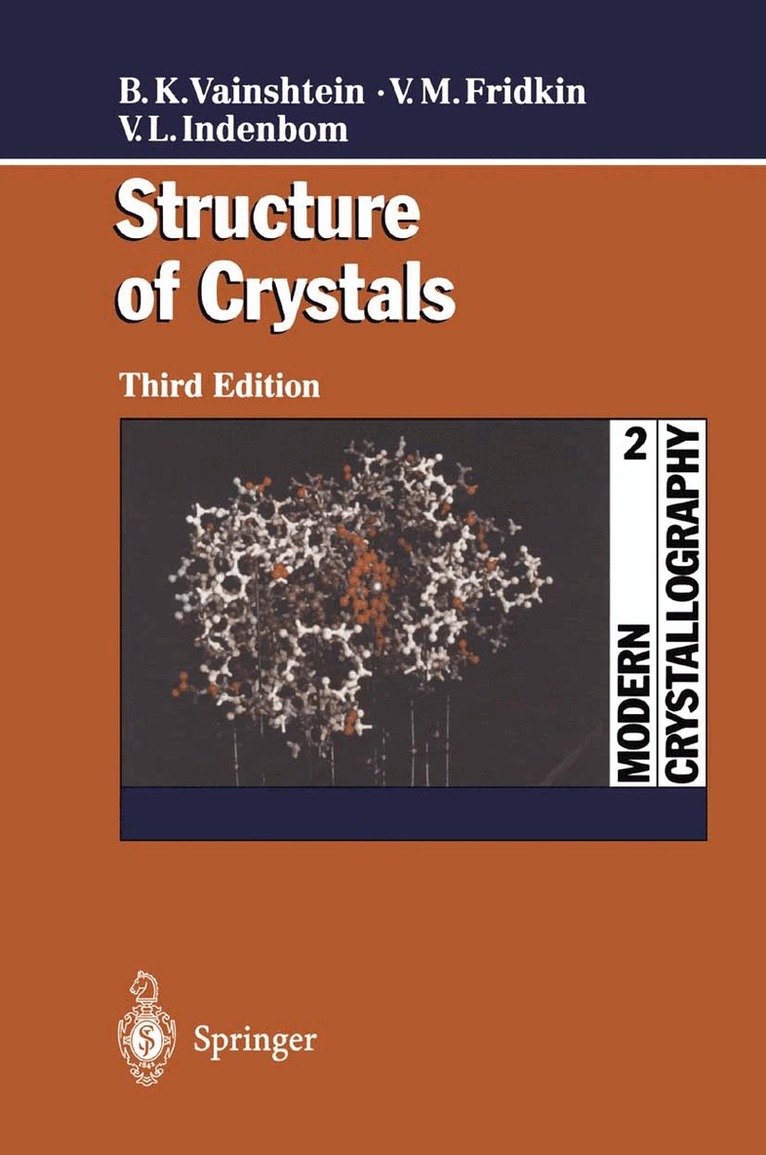
    Modern Crystallography II

    Structure of Crystals

    AvBoris K. Vainshtein,V.M. Fridkin

    Häftad, Engelska, 2012

    Del 21 i serien Springer Series in Solid-State Sciences

    1 078 kr

    Beställningsvara. Skickas inom 10-15 vardagar. Fri frakt över 249 kr.
    Beskrivning

    Early in this century, the newly discovered x-ray diffraction by crystals made a complete change in crystallography and in the whole science of the atomic structure of matter, thus giving a new impetus to the development of solid-state physics. Crystallographic methods, pri­ marily x-ray diffraction analysis, penetrated into materials sciences, mol­ ecular physics, and chemistry, and also into many other branches of science. Later, electron and neutron diffraction structure analyses be­ came important since they not only complement x-ray data, but also supply new information on the atomic and the real structure of crystals. Electron microscopy and other modern methods of investigating mat­ ter-optical, electronic paramagnetic, nuclear magnetic, and other res­ onance techniques-yield a large amount of information on the atomic, electronic, and real crystal structures. Crystal physics has also undergone vigorous development. Many re­ markable phenomena have been discovered in crystals and then found various practical applications. Other important factors promoting the development of crystallog­ raphy were the elaboration of the theory of crystal growth (which brought crystallography closer to thermodynamics and physical chem­ istry) and the development of the various methods of growing synthetic crystals dictated by practical needs. Man-made crystals became increas­ ingly important for physical investigations, and they rapidly invaded technology. The production of synthetic crystals made a tremendous impact on the traditional branches: the mechanical treatment of mate­ rials, precision instrument making, and the jewelry industry.

    Produktinformation

    • Utgivningsdatum:2012-01-19
    • Mått:152 x 229 x 25 mm
    • Vikt:656 g
    • Format:Häftad
    • Språk:Engelska
    • Serie:Springer Series in Solid-State Sciences
    • Antal sidor:436
    • Upplaga:1982
    • Förlag:Springer-Verlag Berlin and Heidelberg GmbH & Co. KG
    • ISBN:9783642966217

    Utforska kategorier

    • Geovetenskap inom Naturvetenskap och teknik
    • Maskinteknik och material inom Naturvetenskap och teknik
    • Oorganisk kemi inom Naturvetenskap och teknik

    Innehållsförteckning

    • 1. Principles of Formation of the Atomic Structure of Crystals.- 1.1 The Structure of Atoms.- 1.2 Chemical Bonding Between Atoms.- 1.3 Energy of the Crystal Lattice.- 1.4 Crystallochemical Radii Systems.- 1.5 Geometric Regularities in the Atomic Structure of Crystals.- 1.6 Solid Solutions and Isomorphism.- 2. Principal Types of Crystal Structures.- 2.1 Crystal Structures of Elements.- 2.2 Intermetallic Structures.- 2.3 Structures with Bonds of Ionic Nature.- 2.4 Covalent Structures.- 2.5 Structure of Complex and Related Compounds.- 2.6 Principles of Organic Crystal Chemistry.- 2.7 Structure of High-Polymer Substances.- 2.8 Structure of Liquid Crystals.- 2.9 Structures of Substances of Biological Origin.- 3. Band Energy Structure of Crystals.- 3.1 Electron Motion in the Ideal Crystal.- 3.2 Brillouin Zones.- 3.3 Isoenergetic Surfaces. Fermi Surface and Band Structure.- 4. Lattice Dynamics and Phase Transitions.- 4.1 Atomic Vibrations in a Crystal.- 4.2 Heat Capacity, Thermal Expansion, and Thermal Conductivity of Crystals.- 4.3 Polymorphism. Phase Transitions.- 4.4 Atomic Vibrations and Polymorphous Transitions.- 4.5 Ordering-Type Phase Transitions.- 4.6 Phase Transitions and Electron—Phonon Interaction.- 4.7 Debye’s Equation of State and Grüneisen’s Formula.- 4.8 Phase Transitions and Crystal Symmetry.- 5. The Structure of Real Crystals.- 5.1 Classification of Crystal Lattice Defects.- 5.2 Point Defects of the Crystal Lattice.- 5.3 Dislocations.- 5.4 Stacking Faults and Partial Dislocations.- 5.5 Continuum Description of Dislocations.- 5.6 Subgrain Boundaries (Mosaic Structures) in Crystals.- 5.6 3 Subgrain Boundary Energy.- 5.7 Twins.- 5.8 Direct Observation of Lattice Defects.- References.