
David Wolff – författare
Visar alla böcker från författaren David Wolff. Handla med fri frakt och snabb leverans.
8 produkter
8 produkter

To the Harbin Station
The Liberal Alternative in Russian Manchuria, 1898-1914
Inbunden, Engelska, 1999
822 kr
Skickas inom 7-10 vardagar
In 1898, near the projected intersection of the Chinese Eastern Railroad (the last leg of the Trans-Siberian) and China's Sungari River, Russian engineers founded the city of Harbin. Between the survey of the site and the profound dislocations of the 1917 revolution, Harbin grew into a bustling multiethnic urban center with over 100,000 inhabitants. In this area of great natural wealth, Russian, Chinese, Japanese, Korean, and American ambitions competed and converged, and sometimes precipitated vicious hostilities.Drawing on the archives, both central and local, of seven countries, this history of Harbin presents multiple perspectives on Imperial Russia's only colony. The Russian authorities at Harbin and their superiors in St. Petersburg intentionally created an urban environment that was tolerant not only toward their Chinese host, but also toward different kinds of "Russians." For example, in no other city of the Russian Empire were Jews and Poles, who were numerous in Harbin, encouraged to participate in municipal government. The book reveals how this liberal Russian policy changed the face and fate of Harbin.As the history of Harbin unfolds, the narrative covers a wide range of historiographic concerns from several national histories. These include: the role of the Russian finance minister Witte, the building of the Trans-Siberian Railroad, the origins of Stolypin's reforms, the development of Siberia and the Russian Far East, the 1905 Revolution, the use of ethnicity as a tool of empire, civil-military conflict, strategic area studies, Chinese nationalism, the Japanese decision for war against the Russians, Korean nationalism in exile, and the rise of the soybean as an international commodity. In all these concerns, Harbin was a vibrant source of creative, unorthodox policy and turbulent economic and political claims.
2 977 kr
Skickas inom 5-8 vardagar
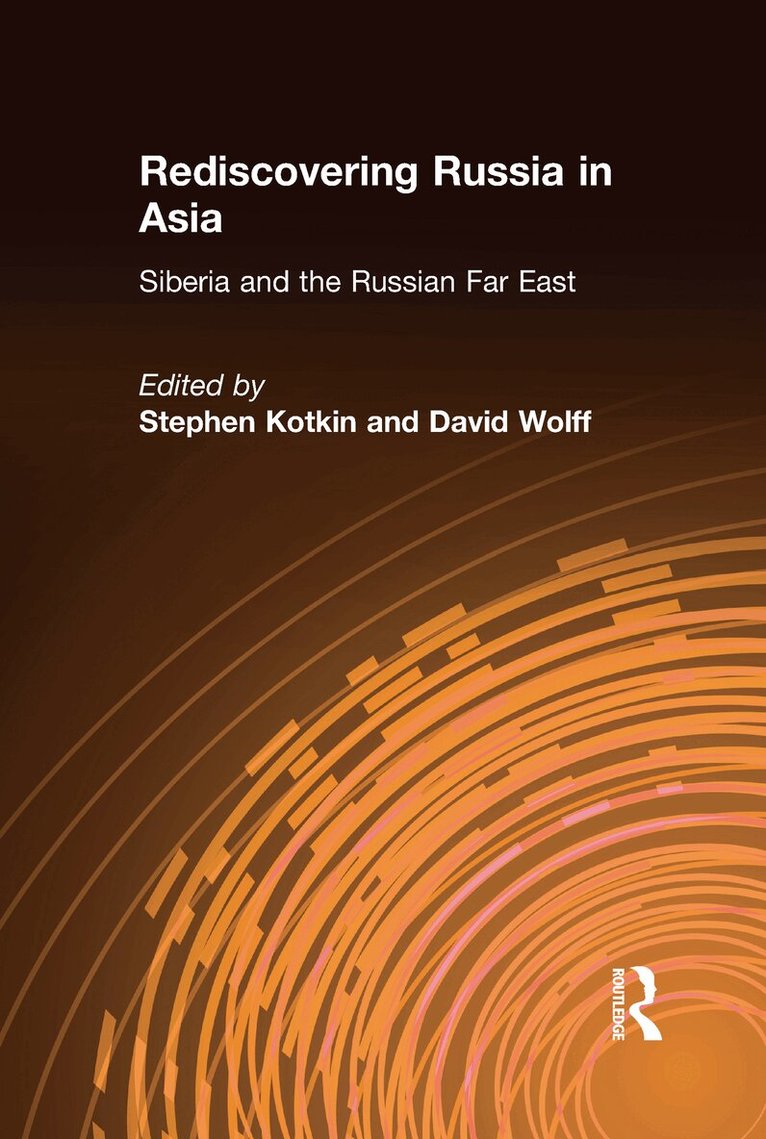
This work presents a trans-Siberian expedition to rediscover the peoples, cultures and riches of Russia's eastern frontiers. It addresses such questions as: who are the people of the region?; have they a distinct culture?; and does the area have a future as part of the Pacific Rim?

578 kr
Skickas inom 10-15 vardagar
This work presents a trans-Siberian expedition to rediscover the peoples, cultures and riches of Russia's eastern frontiers. It addresses such questions as: who are the people of the region?; have they a distinct culture?; and does the area have a future as part of the Pacific Rim?
781 kr
Skickas inom 5-8 vardagar
Acquiring the skills of OpenGL Shading Language is so much easier with this cookbook. You ll be creating graphics rather than learning theory, gaining a high level of capability in modern 3D programming along the way.Key FeaturesDiscover simple and advanced techniques for leveraging modern OpenGL and GLSLLearn how to use the newest features of GLSL including compute shaders, geometry, and tessellation shadersGet to grips with a wide range of techniques for implementing shadows using shadow maps, shadow volumes, and moreClear, easy-to-follow examples with detailed explanations and full, cross-platform source code available from GitHubBook DescriptionOpenGL Shading Language (GLSL) is a programming language used for customizing parts of the OpenGL graphics pipeline that were formerly fixed-function, and are executed directly on the GPU. It provides programmers with unprecedented flexibility for implementing effects and optimizations utilizing the power of modern GPUs. With Version 4, the language has been further refined to provide programmers with greater power and flexibility, with new stages such as tessellation and compute.OpenGL 4 Shading Language Cookbook provides easy-to-follow examples that first walk you through the theory and background behind each technique, and then go on to provide and explain the GLSL and OpenGL code needed to implement it. Beginner level through to advanced techniques are presented including topics such as texturing, screen-space techniques, lighting, shading, tessellation shaders, geometry shaders, compute shaders, and shadows.OpenGL Shading Language 4 Cookbook is a practical guide that takes you from the fundamentals of programming with modern GLSL and OpenGL, through to advanced techniques. The recipes build upon each other and take you quickly from novice to advanced level code.You'll see essential lighting and shading techniques; examples that demonstrate how to make use of textures for a wide variety of effects and as part of other techniques; examples of screen-space techniques including HDR rendering, bloom, and blur; shadowing techniques; tessellation, geometry, and compute shaders; how to use noise effectively; and animation with particle systems.OpenGL Shading Language 4 Cookbook provides examples of modern shading techniques that can be used as a starting point for programmers to expand upon to produce modern, interactive, 3D computer graphics applications.What you will learnCompile, debug, and communicate with shader programsUse new features of GLSL 4 such as subroutines, sampler objects, and uniform blocksImplement core lighting and shading techniques such as diffuse and specular shading, per-fragment shading, and spotlightsUse textures for a variety of effects including cube maps for reflection or refractionImplement screen-space techniques such as HDR, bloom, blur filters, order-independent transparency, and deferred shadingUtilize noise in shadersUse shaders for animationMake use of compute shaders for physics, animation, and general computingLearn how to use new OpenGL features such as shader storage buffer objects, and image load/storeWho this book is forThis book is for OpenGL programmers looking to use the modern features of GLSL 4 to create real-time, three-dimensional graphics. Familiarity with OpenGL programming, along with the typical 3D coordinate systems, projections, and transformations is assumed. It can also be useful for experienced GLSL programmers who are looking to implement the techniques that are presented here.
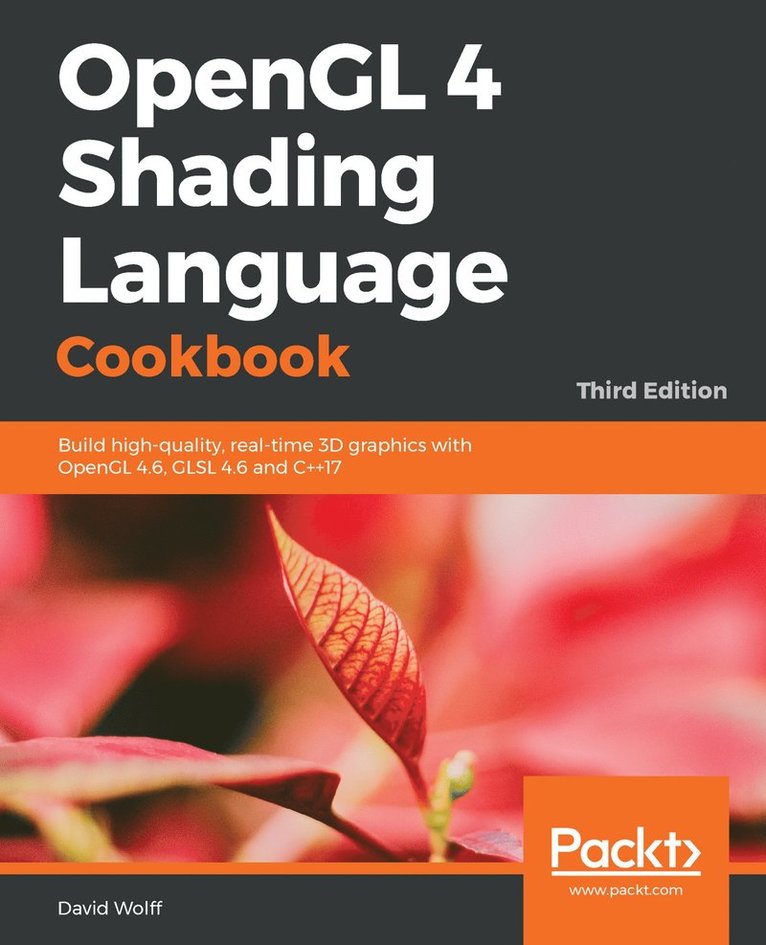
OpenGL 4 Shading Language Cookbook
Build high-quality, real-time 3D graphics with OpenGL 4.6, GLSL 4.6 and C++17
Häftad, Engelska, 2018
637 kr
Skickas inom 5-8 vardagar
Over 70 recipes that cover advanced techniques for 3D programming such as lighting, shading, textures, particle systems, and image processing with OpenGL 4.6Key FeaturesBook DescriptionOpenGL 4 Shading Language Cookbook, Third Edition provides easy-to-follow recipes that first walk you through the theory and background behind each technique, and then proceed to showcase and explain the GLSL and OpenGL code needed to implement them.The book begins by familiarizing you with beginner-level topics such as compiling and linking shader programs, saving and loading shader binaries (including SPIR-V), and using an OpenGL function loader library. We then proceed to cover basic lighting and shading effects. After that, you'll learn to use textures, produce shadows, and use geometry and tessellation shaders. Topics such as particle systems, screen-space ambient occlusion, deferred rendering, depth-based tessellation, and physically based rendering will help you tackle advanced topics.OpenGL 4 Shading Language Cookbook, Third Edition also covers advanced topics such as shadow techniques (including the two of the most common techniques: shadow maps and shadow volumes). You will learn how to use noise in shaders and how to use compute shaders.The book provides examples of modern shading techniques that can be used as a starting point for programmers to expand upon to produce modern, interactive, 3D computer-graphics applications.What you will learnCompile, debug, and communicate with shader programsUse compute shaders for physics, animation, and general computingLearn about features such as shader storage buffer objects and image load/storeUtilize noise in shaders and learn how to use shaders in animationsUse textures for various effects including cube maps for reflection or refractionUnderstand physically based reflection models and the SPIR-V Shader binaryLearn how to create shadows using shadow maps or shadow volumesCreate particle systems that simulate smoke, fire, and other effectsWho this book is forIf you are a graphics programmer looking to learn the GLSL shading language, this book is for you. A basic understanding of 3D graphics and programming experience with C++ are required.
717 kr
Skickas inom 5-8 vardagar

Del 29 - History of Warfare
Russo-Japanese War in Global Perspective
World War Zero, Volume I
Inbunden, Engelska, 2005
3 588 kr
Skickas inom 5-8 vardagar
This volume examines the Russo-Japanese War in its military, diplomatic, social, political, economic, and cultural context. Through the use of research from newly opened Russian and little used Japanese sources the editors assert that the Russo-Japanese War was, in fact, World War Zero, the first global conflict in the 20th century. The contributors demonstrate that the Russo-Japanese War, largely forgotten in the aftermath of World War One, actually was a precursor to the catastrophe that engulfed the world less than a decade after the signing of the Treaty of Portsmouth. This study not only further reveals the weaknesses of Imperial Russia but also exhibits Japan as it entered its fateful 20th century.Contributors: Oleg Rudolfovich Airapetov; Boris Vasilevich Ananich; Michael Auslin; Paul A. Bushkovitch; John Bushnell; Frederick R. Dickinson; Tatiana Aleksandrovna Filippova; David Goldfrank; Antti Kujala; Dominic Lieven; Igor Vladimirovich Lukoianov; Pertti Luntinen; Steven Marks; Yoshihisa Tak Matsusaka; David Maclaren Mcdonald; Bruce W. Menning; Edward S. Miller; Ian Nish ; Dmitrii Ivanovich Oleinikov; Nicholas Papastratigakis; Paul A. Rodell; Norman E. Saul; Charles Schencking; Barry Scherr; David Schimmelpenninck Van Der Oye; Evgenii Iurevich Sergeev; Naoko Shimazu; Yokote Shinji; John W. Steinberg; Richard Stites; James T. Ulak; David Wolff; Don Wright.

Del 40 - History of Warfare
Russo-Japanese War in Global Perspective
World War Zero, Volume II
Inbunden, Engelska, 2006
3 997 kr
Skickas inom 5-8 vardagar
Like Volume one, Volume two of The Russo-Japanese War in Global Perspective examines the Russo-Japanese War in its military, diplomatic, social, political, and cultural context. In this volume East Asian contributors focus on the Asian side of the war to flesh out the assertion that the Russo-Japanese War was, in fact, World War Zero, the first global confl ict of the 20th century. The contributors demonstrate that the Russo-Japanese War, largely forgotten in the aftermath of World War I, actually was a precursor to the catastrophe that engulfed the world less than a decade after the signing of the Treaty of Portsmouth. This study also helps us better understand Japan as it emerged at the beginning of its fateful 20th century.