
Louis Marin - Böcker
Visar alla böcker från författaren Louis Marin. Handla med fri frakt och snabb leverans.
7 produkter
7 produkter

809 kr
Skickas inom 7-10 vardagar
The work of the French cultural critic Louis Marin (1931-1992) is of importance to scholars concerned with issues of representation. This text, first published in France in 1977, presents Marin's theories about the aims of painting in Europe in the 16th and 17th centuries. A meditation on the work of Poussin and Caravaggio and on their milieux, the book explores a number of notions implied by theories of painting and offers insight into the aims and effects of visual representaion.

250 kr
Skickas inom 7-10 vardagar
The work of the French cultural critic Louis Marin (1931-1992) is of importance to scholars concerned with issues of representation. This text, first published in France in 1977, presents Marin's theories about the aims of painting in Europe in the 16th and 17th centuries. A meditation on the work of Poussin and Caravaggio and on their milieux, the book explores a number of notions implied by theories of painting and offers insight into the aims and effects of visual representaion.
428 kr
Skickas inom 7-10 vardagar
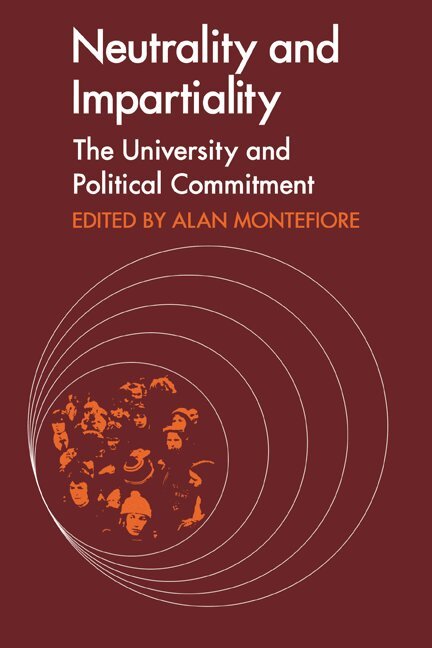
First published in 1975, this is a book of general intellectual interest about the role of the university in contemporary society and that of university teachers in relation to their subjects, their students, and their wider political commitments. Alan Montefiore offers preliminary analyses of the family of concepts most often invoked in discussions of these problems, taking the central dispute to be between those who hold a 'liberal' view of the university and those who regard this notion as illusory, dishonest or undesirable. Six academics, representing, discuss issues of substantive conflict in light of Montefiore's initial distinctions. The volume is of particular interest to students of political and social philosophy, and political and educational theory. It is also intended for a wider readership among those who care about the political status of the universities and recognize the importance and difficulty of the problems involved in this.
373 kr
Skickas inom 7-10 vardagar
"Art history and art theory are inseparable. A history of art can be achieved only through the simultaneous construction of a theory of art." These words of the eminent scholar and critic Louis Marin suggest why he considered the paintings and the writings of Nicolas Poussin (1594-1665), painter and theoretician of painting, an enduring source of inspiration. Poussin was the artist to whom Marin returned most faithfully over the years. Since Marin did not live to write his proposed book on Poussin, the ten major essays in this volume will remain his definitive statement on the painter who inspired his most eloquent and probing commentary.At the center of Marins inquiry into Poussins art are the theory and practice of "reading" paintings. Rather than explicate Poussins work through systematic textual and iconographic analysis, he sets out to explore a cluster of speculative questions about the meaning of pictorial art: Can painting be a discourse? If so, how can that discourse be deciphered? Marins horizon for interpreting Poussin depends more on the concepts of aesthetic philosophy and the insights of cultural history than on an account of the painters career or his relationship with his artistic predecessors. For example, he positions several of Poussins best-known landscapes with respect both to French seventeenth-century debates on the question of the sublime and to the philosophical tradition of reflection on the sublime. Among the topics Marin studies are the tempest as a major figure of the sublime in Poussins work, the presence of ruins in the paintings, Poussins use of the concept of metamorphosis, and the frequent presence of sleeping bodies in the work. The Poussin who emerges in these essays is preeminently a philosopher-artist whose painterly discourse embodies the limits of thought and of representation.
1 724 kr
Skickas inom 10-15 vardagar
At his death in 1992, the eminent philosopher, critic, and theorist Louis Marin left, in addition to a dozen influential books (including Sublime Poussin, Stanford, 1999), a corpus of some three hundred articles and essays published in journals and anthologies. A collection of twenty-two essays that appeared between 1971 and 1992, this book interrogates the theory and practice of representation as it is carried out by both linguistic and graphic signs, and thus the complex relation between language and image, between perception and conception.The essays are grouped in four parts that reflect the continuity and coherence of Marin's interests in semiology, narrative, visuality, and painting. The interdisciplinary horizon of the book draws on multiple scholarly resources—the cultural history of the seventeenth century, the philosophy of language, the tools of discourse analysis, the history of art and aesthetics, the analysis of reception—to address a stunning diversity of subjects ranging from historical painting through cartography to the processes of deciphering texts, interpreting stories, and reading images.Throughout the essays, Marin's reflection on representation is supported and deepened by his brilliant exegesis of graphic art. His analysis of works by Caravaggio, Philippe de Champaigne, Le Brun, and Poussin, among others, provides the armature that allows him to describe both the structural logic of representation and the intricate processes of production and reception that make it dynamic and unstable. Marin demonstrates with consummate rigor why the pursuit of a general theory of representation is experienced by artists and critics alike as an inevitable, yet unattainable objective.
433 kr
Skickas inom 10-15 vardagar
At his death in 1992, the eminent philosopher, critic, and theorist Louis Marin left, in addition to a dozen influential books (including Sublime Poussin, Stanford, 1999), a corpus of some three hundred articles and essays published in journals and anthologies. A collection of twenty-two essays that appeared between 1971 and 1992, this book interrogates the theory and practice of representation as it is carried out by both linguistic and graphic signs, and thus the complex relation between language and image, between perception and conception.The essays are grouped in four parts that reflect the continuity and coherence of Marin's interests in semiology, narrative, visuality, and painting. The interdisciplinary horizon of the book draws on multiple scholarly resources—the cultural history of the seventeenth century, the philosophy of language, the tools of discourse analysis, the history of art and aesthetics, the analysis of reception—to address a stunning diversity of subjects ranging from historical painting through cartography to the processes of deciphering texts, interpreting stories, and reading images.Throughout the essays, Marin's reflection on representation is supported and deepened by his brilliant exegesis of graphic art. His analysis of works by Caravaggio, Philippe de Champaigne, Le Brun, and Poussin, among others, provides the armature that allows him to describe both the structural logic of representation and the intricate processes of production and reception that make it dynamic and unstable. Marin demonstrates with consummate rigor why the pursuit of a general theory of representation is experienced by artists and critics alike as an inevitable, yet unattainable objective.
202 kr
Skickas inom 5-8 vardagar