
Mikhail A. Molchanov - Böcker
Visar alla böcker från författaren Mikhail A. Molchanov. Handla med fri frakt och snabb leverans.
4 produkter
4 produkter
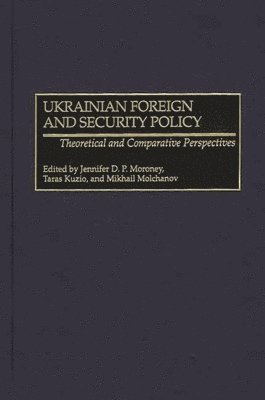
Ukrainian Foreign and Security Policy
Theoretical and Comparative Perspectives
Inbunden, Engelska, 2002
1 009 kr
Skickas inom 10-15 vardagar
A key country for stability and security in Europe, Ukraine is struggling to create consistent foreign and security policies. Political alliances, identity struggles, economic goals, and geopolitical position all pull this newly emergent state in different and often conflicting directions. Due to its dependencies on both the West and Russia, Ukraine's foreign policy is in a state of flux. To ensure stability in this newly-emergent state, the contributors to this volume argue that the West should be more assertive in offering an unambiguous developmental perspective, supporting democracy and the rule of law, and offer E.U. affiliation in the near future.International Relations theory and Ukraine's foreign policy are examined in the first section, followed by chapters exploring civil-military relations. Next comes a look at Ukraine's foreign and security policy orientations in comparative context. The book concludes with chapters focusing on matters of national identity, ideology, and their impact on Ukrainian security policy. Scholars and analysts of contemporary Eastern European politics will be interested in what these well-known scholars and government officials have to say about the contemporary state of affairs in this pivotal nation.
2 298 kr
Skickas inom 10-15 vardagar
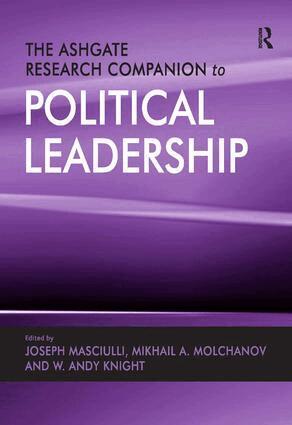
Discussing the major theories of political leadership with a focus on contemporary challenges that political leaders face worldwide, this research companion provides a comprehensive and up-to-date resource for an international readership. The editors combine empirical and normative approaches to emphasize the centrality of political culture, as well as the limits of culture and the universal demands of innovative adaptation. The volume examines: ¢
546 kr
Skickas inom 10-15 vardagar
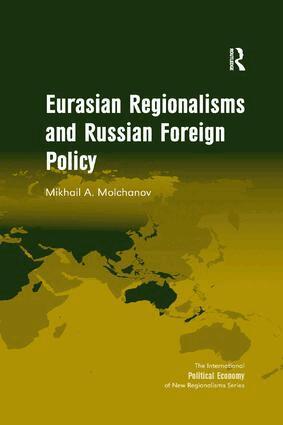
Bridging foreign policy analysis and international political economy, this volume offers a new look at the problem of agency in comparative regional integration studies. It examines evolving regional integration projects in the Eurasian space, defined as the former Soviet Union countries and China, and the impact that Russian foreign policy has had on integration in the region. Mikhail Molchanov argues that new regionalism in Eurasia should be seen as a reactive response to contemporary challenges that these developing states face in the era of globalization. Regional integration in this part of the world treads the unknown waters and may not simply repeat the early steps in the evolution of the European Union. The question of a hegemonic leadership in particular, as exercised by a country that spearheads regional integration efforts, animates much of the discussion offered in the book. Moreover, Eurasian regionalisms are plural phenomena because of complementary and competing projects that engage the same, or partially overlapping, groups of countries. By combining foreign policy studies with an examination of the international political economy of regionalism in Eurasia the author furthers our understanding of new regionalism, both theoretically and empirically.
2 096 kr
Skickas inom 10-15 vardagar
Bridging foreign policy analysis and international political economy, this volume offers a new look at the problem of agency in comparative regional integration studies. It examines evolving regional integration projects in the Eurasian space, defined as the former Soviet Union countries and China, and the impact that Russian foreign policy has had on integration in the region. Mikhail Molchanov argues that new regionalism in Eurasia should be seen as a reactive response to contemporary challenges that these developing states face in the era of globalization. Regional integration in this part of the world treads the unknown waters and may not simply repeat the early steps in the evolution of the European Union. The question of a hegemonic leadership in particular, as exercised by a country that spearheads regional integration efforts, animates much of the discussion offered in the book. Moreover, Eurasian regionalisms are plural phenomena because of complementary and competing projects that engage the same, or partially overlapping, groups of countries. By combining foreign policy studies with an examination of the international political economy of regionalism in Eurasia the author furthers our understanding of new regionalism, both theoretically and empirically.