
British Moral Philosophers - Böcker
Visar alla böcker i serien British Moral Philosophers. Handla med fri frakt och snabb leverans.
9 produkter
9 produkter
371 kr
Skickas inom 5-8 vardagar
The Right and the Good, a classic of twentieth-century philosophy by the great scholar Sir David Ross, is now presented in a new edition. Ross's book, originally published in 1930, is the pinnacle of ethical intuitionism, which was the dominant moral theory in British philosophy for much of the nineteenth and early twentieth century.The central concern of the book is with rightness and goodness, and their relation. Ross argues against notable rival ethical theories. The right act, he held, cannot be derived from the moral value of the motive from which it is done. Furthermore, rightness is not wholly determined by the value of the consequences of one's action, whether this value is some benefit for the agent, or some agent-neutral good. Rather, the right act is determined by a plurality of self-evident prima facie duties. Ross portrayed rightness and goodness as simple non-natural properties.Philip Stratton-Lake, a leading expert on Ross, provides a substantial new Introduction, in which he discusses the central themes of The Right and the Good and clears up some common misunderstandings. A new bibliography and index are also included, along with editorial notes which aim to clarify certain points and indicate where Ross later changed his mind on particular issues. Intuitionism is now enjoying a considerable revival, and this new edition provides the context for a proper understanding of Ross's great work.
1 067 kr
Skickas inom 3-6 vardagar
Essays on Ethics and Method is a selection of the shorter writings of the great nineteenth-century moral philosopher Henry Sidgwick. Sidgwick's monumental work The Methods of Ethics is a classic of philosophy; this new volume is a fascinating complement to it. These essays develop further Sidgwick's ethical ideas, respond to criticism of the Methods, and discuss rival theories. Other aspects of Sidgwick's thought are also illuminated, in particular his interests in method, verification, and proof. The essays show Sidgwick to be a forerunner of twentieth-century analytical philosophy: they illustrate his emphasis on common sense and ordinary language, and exemplify not only his care, clarity, and precision, but also the wit and humour that are not prominent in his longer works. Marcus Singer provides a substantial editorial introduction to Sidgwick and his intellectual context. The volume will be a rich resource for anyone interested in moral philosophy or the development of modern analytical philosophy.
725 kr
Skickas inom 7-10 vardagar
Essays on Ethics and Method is a selection of the shorter writings of the great nineteenth-century moral philosopher Henry Sidgwick. Sidgwick's monumental work The Methods of Ethics is a classic of philosophy; this new volume is a fascinating complement to it. These essays develop further Sidgwick's ethical ideas, respond to criticism of the Methods, and discuss rival theories. Other aspects of Sidgwick's thought are also illuminated, in particular his interests in method, verification, and proof. The essays show Sidgwick to be a forerunner of twentieth-century analytical philosophy: they illustrate his emphasis on common sense and ordinary language, and exemplify not only his care, clarity, and precision, but also the wit and humour that are not prominent in his longer works. Marcus Singer provides a substantial editorial introduction to Sidgwick and his intellectual context. The volume will be a rich resource for anyone interested in moral philosophy or the development of modern analytical philosophy.
686 kr
Skickas inom 5-8 vardagar
to follow
1 844 kr
Skickas inom 5-8 vardagar
"The Right and the Good" is now presented with an introduction by Philip Stratton-Lake. David Ross's book examines ethical intuitionism, which was the dominant moral theory in British philosophy for much of the 19th and early 20th century. Intuitionism is now enjoying a considerable revival, and Stratton-Lake provides the context for an understanding of Ross's work today.
1 150 kr
Skickas inom 3-6 vardagar
A new edition of T.H. Green's "Prolegomena to Ethics" (1883), a classic of modern philosophy, in which Green sets out his perfectionist ethical theory. In addition to the text of the Prolegomena itself, this edition provides an introductory essay, a bibliographical essay and an index. Brink's extended editorial introduction examines the context, themes and significance of Green's work and should be of special interest to readers working on the history of ethics, ethical theory, political philosophy and 19th-century philosophy.
642 kr
Skickas inom 5-8 vardagar
T. H. Green's Prolegomena to Ethics (1883) is a classic of modern philosophy. It begins with Green's idealist attack on empiricist metaphysics and epistemology and develops a perfectionist ethical theory that aims to bring together the best elements in the ancient and modern traditions, and that provides the moral foundations for Green's own distinctive brand of liberalism. David Brink's new edition will restore this great work to prominence, after two decades in which it has been hard to obtain. The present edition uses the text of the fifth edition, accompanied by a new introductory essay, bibliographical essay, and index. Translations are provided for Green's quotations from other languages. Of particular importance is the editor's extended introductory essay, which situates the Prolegomena in its intellectual context, sympathetically but critically engages its main themes, and explains Green's enduring significance for the history of philosophy and contemporary ethical theory. Students and scholars of the history of ethics, ethical theory, political philosophy, and nineteenth century philosophy will find this new edition an invaluable resource.
1 566 kr
Skickas inom 5-8 vardagar
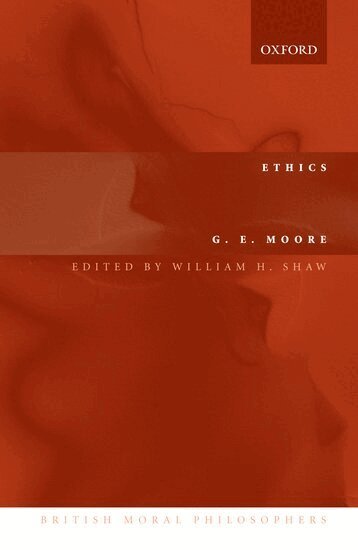
G. E. Moore's 1912 work Ethics has tended to be overshadowed by his famous earlier work Principia Ethica. However, its detailed discussions of utilitarianism, free will, and the objectivity of moral judgements find no real counterpart in Principia, while its account of right and wrong and of the nature of intrinsic value deepen our understanding of Moore's moral philosophy. Moore himself regarded the book highly, writing late in his career, "I myself like [it] better than Principia Ethica, because it seems to me to be much clearer and far less full of confusions and invalid arguments." Short but philosophically rich, and written with impressive precision and intellectual candor, Ethics is a minor classic which repays careful study. This new edition includes Moore's essay "The Nature of Moral Philosophy" as well as editorial notes, an introduction, and a guide to further reading.
469 kr
Skickas inom 3-6 vardagar
G. E. Moore was a central figure in twentieth-century philosophy. Along with Russell and Wittgenstein, he pioneered analytic philosophy, and his Principia Ethica shaped the contours of twentieth-century ethics. Indeed, until the publication of Rawls's A Theory of Justice, no single book in moral philosophy was to equal Principia's influence. Unfortunately, however, Principia Ethica has so dominated critical discussions of Moore's work that even experts on his moral philosophy have tended to ignore his Ethics, which he published eight years later. But Ethics is Moore's only other book on moral philosophy, and one of only a handful of post-Principia publications dealing with ethics. Its detailed discussions of utilitarianism, free will, and the objectivity of moral judgements find no real counterpart in Principia while its account of right and wrong and of the nature of intrinsic value deepen our understanding of his moral philosophy. The republication of Ethics thus rounds out our understanding of Moore's ethical thought. But the book's value goes beyond its historical or scholarly interest. A short but philosophically rich text, Ethics stands independent of Principia and repays careful study in its own right. By raising a number of fundamental questions in ethics, questions that remain live today, by proffering clear, credible, and often innovative answers to them, and by doing so with a philosophical skill that is still impressive, Moore's short book is a minor classic. Almost a century after its original publication, it still amply rewards those who read it.This new edition of Moore's Ethics includes his essay 'The Nature of Moral Philosophy' as well as editorial notes, an introduction, and a guide to further reading.