A. Fried - Böcker
Visar alla böcker från författaren A. Fried. Handla med fri frakt och snabb leverans.
4 produkter
4 produkter
1 039 kr
Skickas inom 10-15 vardagar
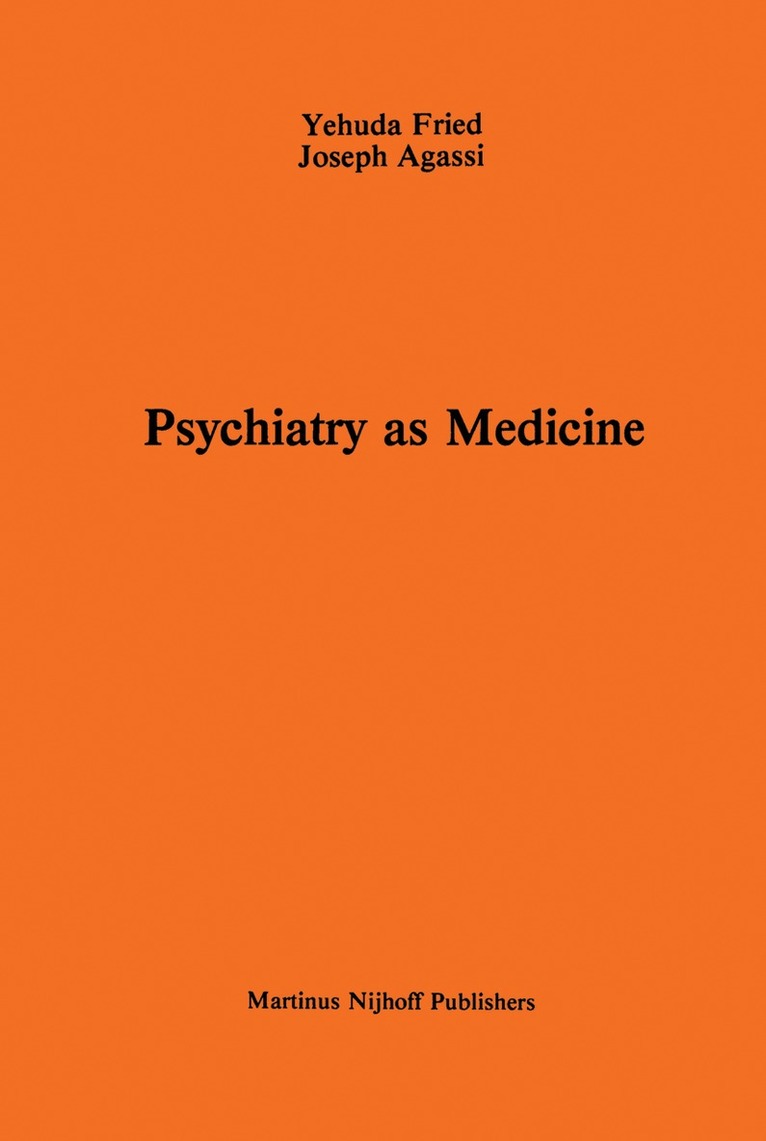
PREFACE This volume is a sequel to yet independent of our Paranoia: A Study in Diagnosis, Reidel, Dordrecht and Boston, 1976. Whereas our first book centered on diagnosis, this centers on treatment. In our first volume, all discussions of nosology (theory of illness) and of treatment was ancillary to our discussion of diagnosis; similarly all discussion of this volume dealing with nosology - there is very little on diagnosis here - is ancillary to our discussion of psychotherapy. It is still our profoundest conviction that to speak of treatment without diagnosis is meaningless, if not irresponsible, since otherwise one does not know what one is talking about. Hence, our present study, though it centers on theories of treatment, links psychotherapy with psychopathology. It is the rationale of psychotherapy which is of importance, and the rationale dwells in this link. We wish our present study to be self-contained and understood by readers who are not familiar with our first book - or with any specific literature. Our discussion of medicine in general, meaning the rationale of therapy in general, helps the uninitiated reader, as well as the initiated, we hope: it certainly has helped us. We did not see how else can we study a branch of medicine; we felt the need for some idea of how medicine is supposed to work.
1 069 kr
Skickas inom 10-15 vardagar
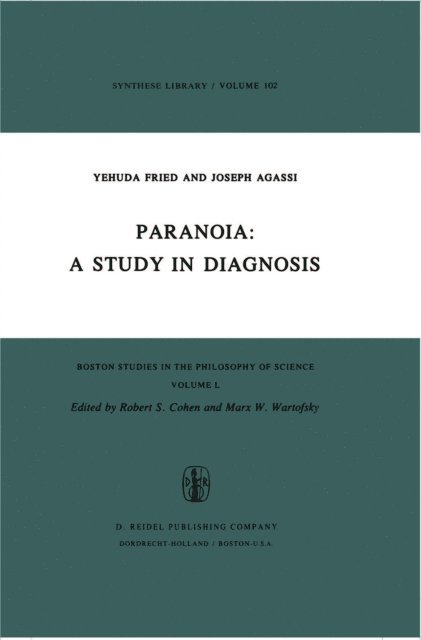
There is a curious parallel between the philosophy of science and psychiatric theory. The so-called demarcation question, which has exercised philosophers of science over the last decades, posed the problem of distinguishing science proper from non-science - in par ticular, from metaphysics, from pseudo-science, from the non rational or irrational, or from the untestable or the empirically meaningless. In psychiatric theory, the demarcation question appears as a problem of distinguishing the sane from the insane, the well from the mentally ill. The parallelism is interesting when the criteria for what fails to be scientific are seen to be congruent with the criteria which define those psychoses which are marked by cognitive failure. In this book Dr Yehuda Fried and Professor Joseph Agassi - a practicing psychiatrist and a philosopher of science, respectivel- focus on an extreme case of psychosis - paranoia - as an essentially intellectual disorder: that is, as one in which there is a systematic and chronic delusion which is sustained by logical means. They write: "Paranoia is an extreme case by the very fact that paranoia is by definition a quirk of the intellectual apparatus, a logical delusion. " (p. 2.
1 069 kr
Skickas inom 10-15 vardagar
There is a curious parallel between the philosophy of science and psychiatric theory. The so-called demarcation question, which has exercised philosophers of science over the last decades, posed the problem of distinguishing science proper from non-science - in par ticular, from metaphysics, from pseudo-science, from the non rational or irrational, or from the untestable or the empirically meaningless. In psychiatric theory, the demarcation question appears as a problem of distinguishing the sane from the insane, the well from the mentally ill. The parallelism is interesting when the criteria for what fails to be scientific are seen to be congruent with the criteria which define those psychoses which are marked by cognitive failure. In this book Dr Yehuda Fried and Professor Joseph Agassi - a practicing psychiatrist and a philosopher of science, respectivel- focus on an extreme case of psychosis - paranoia - as an essentially intellectual disorder: that is, as one in which there is a systematic and chronic delusion which is sustained by logical means. They write: "Paranoia is an extreme case by the very fact that paranoia is by definition a quirk of the intellectual apparatus, a logical delusion. " (p. 2.
1 069 kr
Skickas inom 10-15 vardagar
PREFACE This volume is a sequel to yet independent of our Paranoia: A Study in Diagnosis, Reidel, Dordrecht and Boston, 1976. Whereas our first book centered on diagnosis, this centers on treatment. In our first volume, all discussions of nosology (theory of illness) and of treatment was ancillary to our discussion of diagnosis; similarly all discussion of this volume dealing with nosology - there is very little on diagnosis here - is ancillary to our discussion of psychotherapy. It is still our profoundest conviction that to speak of treatment without diagnosis is meaningless, if not irresponsible, since otherwise one does not know what one is talking about. Hence, our present study, though it centers on theories of treatment, links psychotherapy with psychopathology. It is the rationale of psychotherapy which is of importance, and the rationale dwells in this link. We wish our present study to be self-contained and understood by readers who are not familiar with our first book - or with any specific literature. Our discussion of medicine in general, meaning the rationale of therapy in general, helps the uninitiated reader, as well as the initiated, we hope: it certainly has helped us. We did not see how else can we study a branch of medicine; we felt the need for some idea of how medicine is supposed to work.