A. G. Hamilton - Böcker
Visar alla böcker från författaren A. G. Hamilton. Handla med fri frakt och snabb leverans.
3 produkter
3 produkter
682 kr
Skickas inom 7-10 vardagar
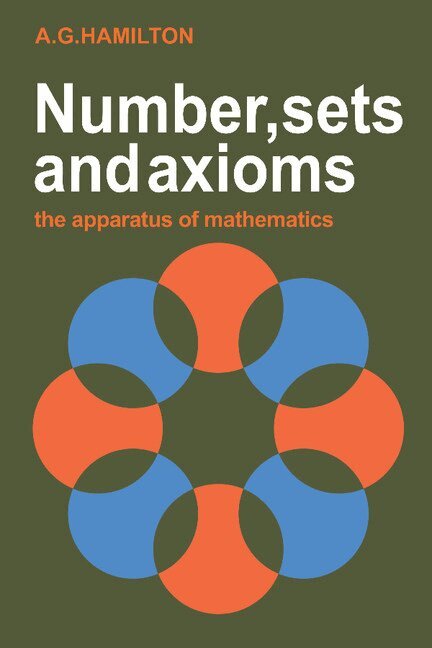
Following the success of Logic for Mathematicians, Dr Hamilton has written a text for mathematicians and students of mathematics that contains a description and discussion of the fundamental conceptual and formal apparatus upon which modern pure mathematics relies. The author's intention is to remove some of the mystery that surrounds the foundations of mathematics. He emphasises the intuitive basis of mathematics; the basic notions are numbers and sets and they are considered both informally and formally. The role of axiom systems is part of the discussion but their limitations are pointed out. Formal set theory has its place in the book but Dr Hamilton recognises that this is a part of mathematics and not the basis on which it rests. Throughout, the abstract ideas are liberally illustrated by examples so this account should be well-suited, both specifically as a course text and, more broadly, as background reading. The reader is presumed to have some mathematical experience but no knowledge of mathematical logic is required.
837 kr
Skickas inom 7-10 vardagar
This book is a readable introduction to linear algebra, starting at an elementary level. It is intended to be useful both for students of pure mathematics who may subsequently pursue more advanced study in this area and for students who require linear algebra and its applications in other subjects. Throughout, stress is placed on applications of the subject in preference to more theoretical aspects. The book has worked examples on every left-hand page concurrently with the text on the right-hand page, which allows the reader to follow the text uninterrupted. The book is intended to be worked through and learned from, and contains numerous exercises with solutions.
773 kr
Skickas inom 7-10 vardagar
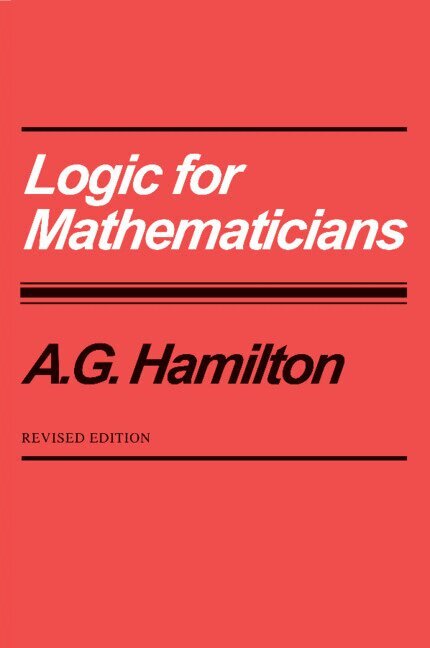
Here is an introductory textbook which is designed to be useful not only to intending logicians but also to mathematicians in general. Based on Dr Hamilton's lectures to third and fourth year undergraduate mathematicians at the University of Stirling it has been written to introduce student or professional mathematicians, whose background need cover no more than a typical first year undergraduate mathematics course, to the techniques and principal results of mathematical logic. In presenting the subject matter without bias towards particular aspects, applications or developments, an attempt has been made to place it in the context of mathematics and to emphasise the relevance of logic to the mathematician. Starting at an elementart level, the text progresses from informal discussion to the precise description and use of formal mathematical and logical systems. The early chapters cover propositional and predicate calculus. The later chapters deal with Gödel's theorem on the incompleteness of arithmetic and with various undecidability and unsolvability results, including a discussion of Turing machines and abstract computability. Each section ends with exercises designed to clarify and consolidate the material in that section. Hints or solutions to many of these are provided at the end of the book. The revision of this very successful textbook includes new sections on Skolemisation and applying well-formed formulas to logic programming. Some corrections have been made and extra exercises added.