A. Keith Turner - Böcker
Visar alla böcker från författaren A. Keith Turner. Handla med fri frakt och snabb leverans.
3 produkter
3 produkter
Del 354 - NATO Science Series C
Three-Dimensional Modeling with Geoscientific Information Systems
Proceedings of the NATO Advanced Research Workshop Held in Santa Barbara, California, U.S.A., December 10-15, 1989
Inbunden, Engelska, 1991
850 kr
Skickas inom 10-15 vardagar
Geoscientific modelling has some unique requirements. Modern geological applications require increasingly quantitative and accurate rock property characerizations within the three-dimensional subsurface environment. this problem differs from that faced by most other fields due to a variety of technocal and economic constriants. Three-dimensional geoscientific modelling often relies on complex stochastic concepts and thus requires the extraction of information from large multiparameter data sets, and the representation and modification of complex, and uncertain geo-objects of interest. The visualization of these three-dimensional features has been a major constraint. The ability to rapidly create and manipulate three-dimensional imgages can materially speed up the geoscientist's understanding of the subsurface environment. The wok is organized arou d four major themes: definition of the problem; description of existing 3-D geoscientific information systems; 3-D data structures and display methods; and applications of 3-D geoscientific modelling.The contributors are drawn from most of the NATO nations, Sweden and Japan, representing national geological surveys, the petroleum, mining, environmental and engineering industries, universities and computer hardware and software companies.
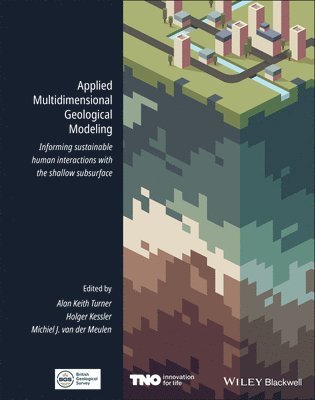
Applied Multidimensional Geological Modeling
Informing Sustainable Human Interactions with the Shallow Subsurface
Inbunden, Engelska, 2021
1 139 kr
Skickas inom 5-8 vardagar
Over the past decades, geological survey organizations have digitized their data handling and holdings, unlocking vast amounts of data and information for computer processing. They have undertaken 3-D modeling alongside, and in some cases instead of, conventional geological mapping and begun delivering both data and interpretations to increasingly diverse stakeholder communities. Applied Multidimensional Geological Modeling provides a citable central source that documents the current capabilities and contributions of leading geological survey organization and other practitioners in industry and academia that are producing multidimensional geological models.This book focuses on applications related to human interactions with conditions in the shallow subsurface, within 100-200 m of the surface. The 26 chapters, developed by 100 contributors associated with 37 organizations, discuss topics relevant to any geologist, scientist, engineer, urban planner, or decision maker whose practice includes assessment or planning of underground space.
534 kr
Skickas inom 10-15 vardagar
A. K. TURNER Department of Geology and Geological Engineering Colorado School of Mines Golden, Colorado 80401 USA Geology deals with three-dimensional data. Geoscientists are concerned with three dimensional spatial observations, measurements, and explanations of a great variety of phenomena. The representation of three-dimensional data has always been a problem. Prior to computers, graphical displays involved specialized maps, cross-sections, fence diagrams, and geometrical constructions such as stereonets. All were designed to portray three-dimensional relationships on two-dimensional paper products, and all were time consuming to develop. Until recently, computers were of little assistance to three-dimensional data handling and representation problems. Memory was too expensive to handle the huge amounts of data required by three-dimensional assessments; computational speeds were too slow to perform the necessary calculations within a reasonable time; and graphical displays had too Iowa resolution or were much too expensive to produce useful visualizations. Much experience was gained with two-dimensional geographic information systems (GIS), which were applied to many land-use management and resource assessment problems. The two-dimensional GIS field matured rapidly in the late 1980's and became widely accepted. The advent of the modern computer workstation, with its enhanced memory and graphical capabilities at ever more affordable prices, has largely overcome these earlier constraints.