A. W. Zurbrugg - Böcker
Visar alla böcker från författaren A. W. Zurbrugg. Handla med fri frakt och snabb leverans.
3 produkter
3 produkter
278 kr
Skickas
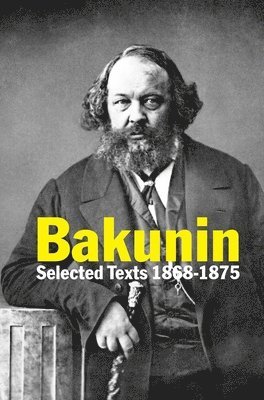
Bakunin was a propagator of Anarchistic Socialism and an active promoter of the International Workers' Association (IWA). He argued for International workers' solidarity, change involving rural and industrial workers, and a Libertarian or Anarchist form of Socialism with federated accountable democratic organisations responsible to the grassroots, rather than hierarchical state structures. He rejected electoral politics that made working people serve the interest of middle- and upper-class professional politicians.This book brings together a selection of texts: letters, a lecture, newspaper articles, finished and unfinished works. The selection begins in 1868, the year Bakunin moved to Geneva and became a member of the local section of the IWA. Bakunin discusses the development of politics in and around the IWA. Many of these texts appear here in English for the first time.
217 kr
Skickas inom 11-20 vardagar
This book – the first in a series of four – brings together a sketch of Anarchist organisation and perspectives in the twentieth century.Anarchists and syndicalists were centre stage in the history of labour movements in much of `Latin’ Europe and in most of Latin America in the first two decades of the twentieth century. Syndicalists and libertarians sought to develop solidarity and workers’ power, rejecting both cautious and conservative trade-unionism and their allied socialist parties. Criticising the chauvinism that engulfed the Second International and its most powerful section, German Social-Democracy, they campaigned for class solidarity across frontiers and worked to subvert the discipline that bound soldiers to imperialist states. The second part of this book describes international and national campaigns against militarism and war.Libertarians investigated democratic, modern and scientific ideas and challenged obscurantist, religious and authoritarian conventions. They sought to focus and organise the strength of working people whose voices could not be registered in parliamentary politics, working at a time when many working people had no right to vote, and also sometimes, challenged patriarchal gender relations. This is the first of four:1.Anarchist Perspectives in Peace and War, 1900 -19182.Anarchist Perspectives: Syndicalism, Revolution and Fascism, 1917-19303.Anarchist Perspectives: Revolution in Spain, 1931-19394.Anarchist Perspectives after the Second World War
444 kr
Skickas inom 3-6 vardagar
The First International was founded with high ideals: ‘every individual or society joining it, will recognise morality, justice and truth as the basis of their conduct toward to all men, without distinction of nationality, creed, or colour.’By September 1873 it had split. Six regional federations supported one congress, a few local sections and a Council in New York, supported another.The congresses, both meeting in Geneva, brought together persons inspired by contrasting forms of organisation, one federalist and mainly based on workplace organisation, the other centralist, supporting national electoral parties. Reports and newspaper articles (some translated for the first time) present rival perspectives, influenced by Bakunin and Marx. These texts review issues of class, gender, authority and ethnicity within labour and progressive movements in Europe and the USA. ‘The congress of Geneva of 1873 has reset our Association on its true path, working people have had enough of chiefs and bosses, they want to take the management of their affairs into their own hands.’