Aaart R. Heesterman - Böcker
Visar alla böcker från författaren Aaart R. Heesterman. Handla med fri frakt och snabb leverans.
4 produkter
4 produkter
1 094 kr
Skickas inom 10-15 vardagar
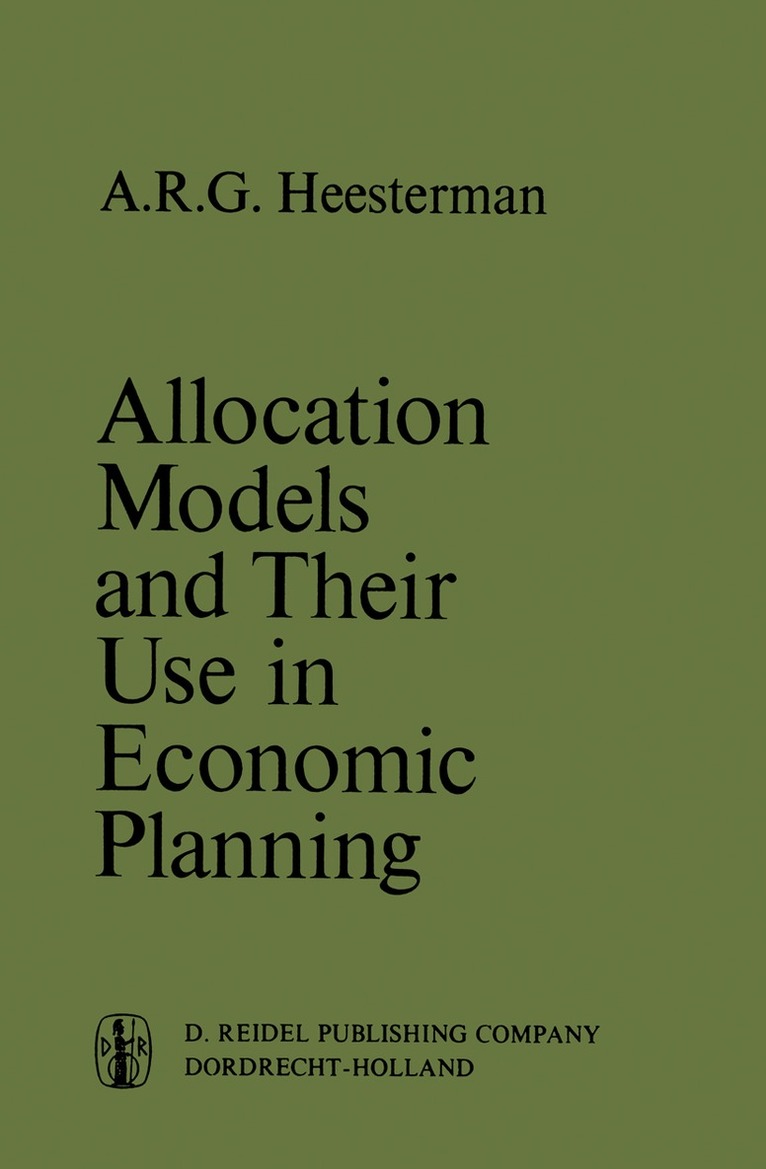
Three different lines of approach have contributed to the theory of optimal planning. One approach considers the problem from the view-point of a national government and its adviser, the econometrician planning speci alist. The government can, if this is thought to be desirable, stimulate investment in certain directions and discourage other economic activities. By various fiscal devices, it can influence both the total level and the distribution of investment funds over different sectors of production. Also, in many countries, a public agency plays some kind of coordinat ing role in the formulation of long-term plans for output by the enter prises sector; this may range from administrative direction in so-called centrally planned economies, to persuasion and advice in 'capitalist' economies. Accordingly, the public planner wishes to know what dis tribution of the nation's resources would be 'optimal'. This leads to the construction of various models which may be described under the general heading 'input-output type models'. This type of model has been largely developed by practitioners, among whom Sandee [B2] is probably the most outstanding and the earliest. A later, well-developed example of a model based on this approach is, for example, the Czech model by Cerny et al. [Bl]. A second approach considers the problem from the point of view of the private entrepreneur and his adviser, the manager and financial accountant.
Matrices and Simplex Algorithms
A Textbook in Mathematical Programming and Its Associated Mathematical Topics
Häftad, Engelska, 2011
550 kr
Skickas inom 10-15 vardagar
This is a textbook devoted to mathematical programming algorithms and the mathematics needed to understand such algorithms. It was mainly written for economists, but the mathematics itself obviously has relevance for other disciplines. It is a textbook as well a~ in parts, a contribution to new knowledge. There is, accordingly, a broad ordering of climbing sophistication, the earlier chapters being purely for the student, the later chapters being more specialist and containing some element of novelty on certain points. The book is edited in five parts. Part I deals with elementary matrix operations, matrix inversion, determinants, etc. Part II is mainly devoted to linear programming. As far as students' readability is concerned, these two parts are elementary undergraduate material. However, I would claim, in particular with respect to linear programming, that I do things more efficiently than the standard textbook approach has it. This refers mainly to the search for a feasible solution i.e. Chapter 9, and to upper and lower limits, i.e. Chapter 10. I have also argued that the standard textbook treatment of degeneracy misses a relevant problem, namely that of accuracy. In short, I would invite anyone who has the task of writing or designing an LP-code, to first acquaint himself with my ideas. viii INTRODUCTION Parts III and IV are concerned with nonlinear programming.
1 062 kr
Skickas inom 10-15 vardagar
Three different lines of approach have contributed to the theory of optimal planning. One approach considers the problem from the view-point of a national government and its adviser, the econometrician planning speci alist. The government can, if this is thought to be desirable, stimulate investment in certain directions and discourage other economic activities. By various fiscal devices, it can influence both the total level and the distribution of investment funds over different sectors of production. Also, in many countries, a public agency plays some kind of coordinat ing role in the formulation of long-term plans for output by the enter prises sector; this may range from administrative direction in so-called centrally planned economies, to persuasion and advice in 'capitalist' economies. Accordingly, the public planner wishes to know what dis tribution of the nation's resources would be 'optimal'. This leads to the construction of various models which may be described under the general heading 'input-output type models'. This type of model has been largely developed by practitioners, among whom Sandee [B2] is probably the most outstanding and the earliest. A later, well-developed example of a model based on this approach is, for example, the Czech model by Cerny et al. [Bl]. A second approach considers the problem from the point of view of the private entrepreneur and his adviser, the manager and financial accountant.
Del 2 - International Studies in Economics and Econometrics
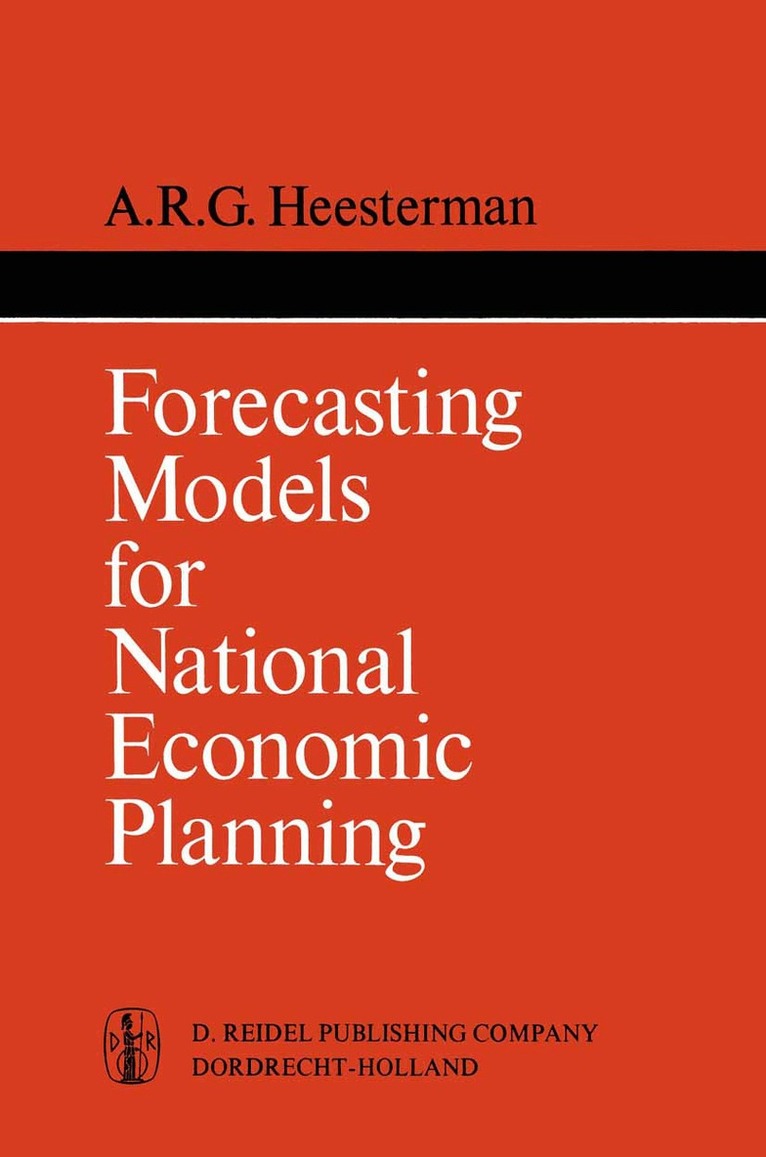
Forecasting Models for National Economic Planning
Häftad, Engelska, 2011
534 kr
Skickas inom 10-15 vardagar
This book is about the specification of linear econometric models, and for this reason some important related fields have been deliberately omitted. I did not want to discuss the problems of parameter-estimation, at least not in any detail, as there are other books on these problems written by specialized statisticians. This book is about the models them selves and macro-economic models in particular. A second related sub ject is the policy decision that can be made with the help of a model. While I did write a chapter on policy decisions, I limited myself to some extent because of my views on planning as such. The logical approach to this problem is in terms of mathematical programming, but our models and our ideas about the policies we want are too crude for its effective utilisation. A realistic formulation of the problem should involve non linearities in an essential way, the models I consider (and most existing models) are linear. At the present state of econometrics, I do not really believe in such a thing as the 'optimal' plan. The possible result of bad planning or no planning at all, for instance massive unemployment, sudden financial crises, unused capital equipment, or the production of unsalable goods is agreed to be undesirable. Programming methods may of course be needed, if only for having a systematic algorithm to find a solution that avoids this kind of 'obvious' non-optimality. However, the main emphasis is on forecasting models.