Aage B. Sorensen - Böcker
Visar alla böcker från författaren Aage B. Sorensen. Handla med fri frakt och snabb leverans.
2 produkter
2 produkter
1 009 kr
Skickas inom 10-15 vardagar
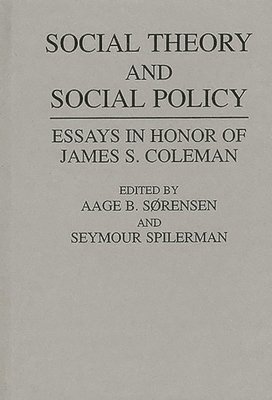
Social Theory and Social Practice is a collection of essays theory and research developments that were advanced by a figure at the forefront of contemporary American and international sociology--James S. Coleman. Themes that run through Coleman's diverse body of work are the subject of this volume. Essays focus on his contributions to social theory (emphasizing formulations which have policy implications) and applications of sociology in public affairs. Coleman's contributions have profoundly influenced and, in several cases, defined the agenda for important sub-fields of sociology: sociological theory and methods, sociology of education, sociology of the family, political sociology, mathematical sociology, communications research, and social stratification.Following an introductory section, Part Two, Policy-Relevant Social Theory, includes essays by some of our most eminent social scientists, including James Buchanan, Arthur Stinchcombe, Raymond Boudon, Gordon Tullock, Benjamin Zablocki, and Gudmund Hernes. Part Three, Sociology of Education contains essays by Senator Daniel Patrick Moynihan, Diane Ravitch, and Sarane Boocock on Coleman's pioneering work in the field. Part Four, Social Structure and Social Policy, discusses the profound influence of Coleman's oeuvre on public affairs. Chapter authors include Seymour Sspilerman, Noah Levin-Epstein and Moshe Semyenov of Tel Aviv University, Michael Hechter and Satoshi Kanazawa, Seymour Martin Lipset, Erik Van Hove, and Henrik Kreutz. Recommended for scholars in the fields of sociology, education, economics, and political science.
1 480 kr
Skickas inom 10-15 vardagar
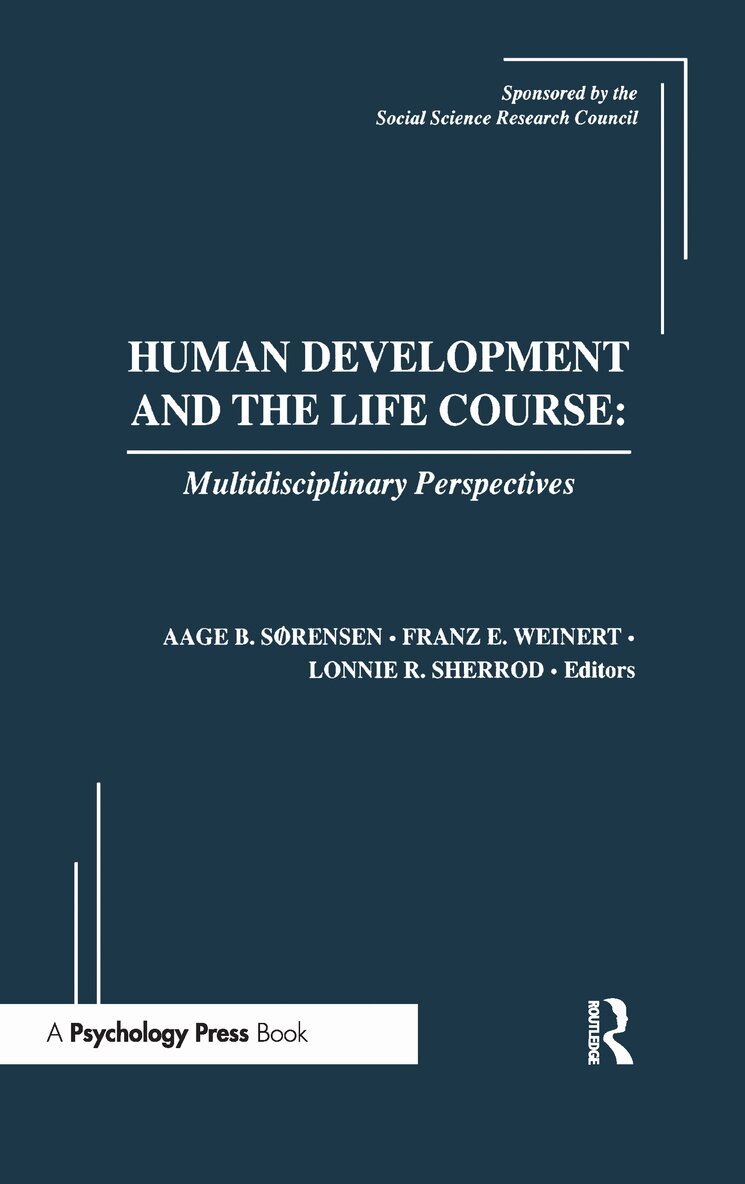
First published in 1986. This volume addresses the strengths and limitations of a life-course perspective on human development. The life-course perspective has been variously described as offering a paradigmatic shift in conceptions of human development or as laying the foundation for a new discipline. More modestly, the perspective has been described as primarily an approach to guide research rather than a theory containing specific propositions.