A.B. Sossinsky – Författare
Visar alla böcker från författaren A.B. Sossinsky. Handla med fri frakt och snabb leverans.
4 produkter
4 produkter
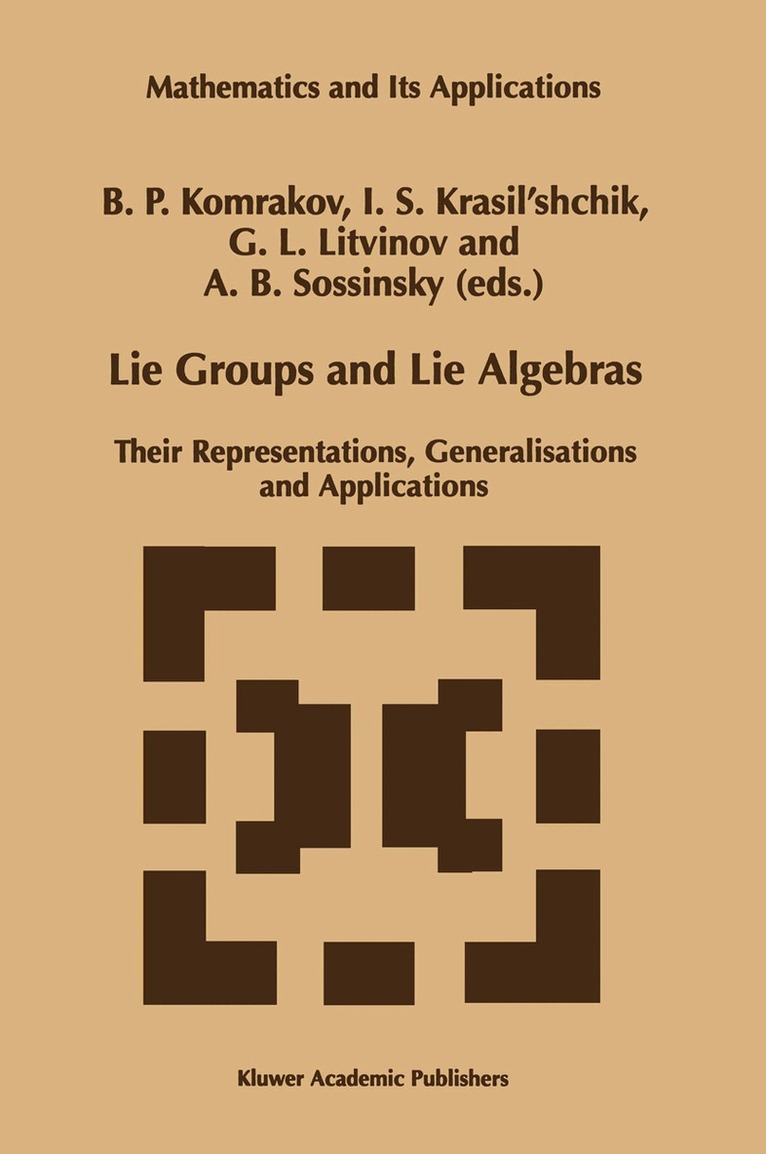
Lie Groups and Lie Algebras
Their Representations, Generalisations and Applications
Inbunden, Engelska, 1998
1 062 kr
Skickas inom 10-15 vardagar
This collection brings together papers related to the classical ideas of Sophus Lie. The work reflects the interests of scientists associated with the International Sophus Lie Center, and provides current results in Lie groups and Lie algebras, quantum mathematics, hypergroups, homogeneous spaces, Lie superalgebras, the theory of representations and applications to differential equations and integrable systems. Among the topics that are treated are quantization of Poisson structures, applications of multivalued groups, noncommutative aspects of hypergroups, homology invariants of homogeneous spaces, generalisations of the Godbillon-Vey invariant, relations between classical problems of linear analysis and representation theory and the geometry of current groups. The text should be of interest to mathematicians and physicists specialising in the theory and applications of Lie groups and Lie algebras, quantum groups, hypergroups and homogeneous spaces.
Knots, Links, Braids and 3-manifolds
An Introduction to the New Invariants in Low-Dimensional Topology
Häftad, Engelska, 1996
1 866 kr
Skickas inom 7-10 vardagar
This book is an introduction to the remarkable work of Vaughan Jones and Victor Vassiliev on knot and link invariants and its recent modifications and generalizations, including a mathematical treatment of Jones-Witten invariants. It emphasizes the geometric aspects of the theory and treats topics such as braids, homeomorphisms of surfaces, surgery of 3-manifolds (Kirby calculus), and branched coverings. This attractive geometric material, interesting in itself yet not previously gathered in book form, constitutes the basis of the last two chapters, where the Jones-Witten invariants are constructed via the rigorous skein algebra approach (mainly due to the Saint Petersburg school). Unlike several recent monographs, where all of these invariants are introduced by using the sophisticated abstract algebra of quantum groups and representation theory, the mathematical prerequisites are minimal in this book. Numerous figures and problems make it suitable as a course text and for self-study.
679 kr
Skickas inom 7-10 vardagar
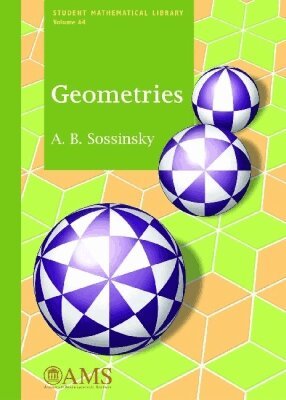
The book is an innovative modern exposition of geometry, or rather, of geometries; it is the first textbook in which Felix Klein's Erlangen Program (the action of transformation groups) is systematically used as the basis for defining various geometries. The course of study presented is dedicated to the proposition that all geometries are created equal--although some, of course, remain more equal than others. The author concentrates on several of the more distinguished and beautiful ones, which include what he terms ``toy geometries'', the geometries of Platonic bodies, discrete geometries, and classical continuous geometries. The text is based on first-year semester course lectures delivered at the Independent University of Moscow in 2003 and 2006. It is by no means a formal algebraic or analytic treatment of geometric topics, but rather, a highly visual exposition containing upwards of 200 illustrations. The reader is expected to possess a familiarity with elementary Euclidean geometry, albeit those lacking this knowledge may refer to a compendium in Chapter 0. Per the author's predilection, the book contains very little regarding the axiomatic approach to geometry (save for a single chapter on the history of non-Euclidean geometry), but two Appendices provide a detailed treatment of Euclid's and Hilbert's axiomatics. Perhaps the most important aspect of this course is the problems, which appear at the end of each chapter and are supplemented with answers at the conclusion of the text. By analyzing and solving these problems, the reader will become capable of thinking and working geometrically, much more so than by simply learning the theory. Ultimately, the author makes the distinction between concrete mathematical objects called ``geometries'' and the singular ``geometry'', which he understands as a way of thinking about mathematics. Although the book does not address branches of mathematics and mathematical physics such as Riemannian and Kahler manifolds or, say, differentiable manifolds and conformal field theories, the ideology of category language and transformation groups on which the book is based prepares the reader for the study of, and eventually, research in these important and rapidly developing areas of contemporary mathematics.
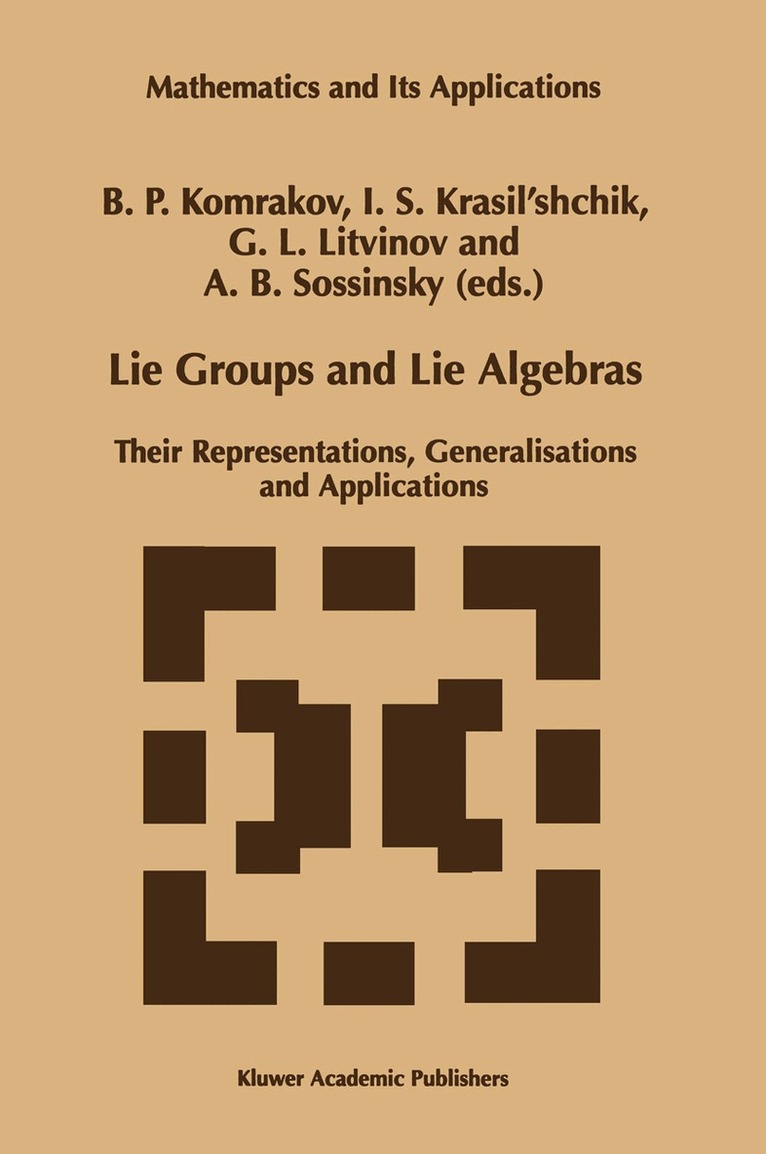
Lie Groups and Lie Algebras
Their Representations, Generalisations and Applications
Häftad, Engelska, 2012
1 062 kr
Skickas inom 10-15 vardagar
This collection contains papers conceptually related to the classical ideas of Sophus Lie (i.e., to Lie groups and Lie algebras). Obviously, it is impos sible to embrace all such topics in a book of reasonable size. The contents of this one reflect the scientific interests of those authors whose activities, to some extent at least, are associated with the International Sophus Lie Center. We have divided the book into five parts in accordance with the basic topics of the papers (although it can be easily seen that some of them may be attributed to several parts simultaneously). The first part (quantum mathematics) combines the papers related to the methods generated by the concepts of quantization and quantum group. The second part is devoted to the theory of hypergroups and Lie hypergroups, which is one of the most important generalizations of the classical concept of locally compact group and of Lie group. A natural harmonic analysis arises on hypergroups, while any abstract transformation of Fourier type is gen erated by some hypergroup (commutative or not). Part III contains papers on the geometry of homogeneous spaces, Lie algebras and Lie superalgebras. Classical problems of the representation theory for Lie groups, as well as for topological groups and semigroups, are discussed in the papers of Part IV. Finally, the last part of the collection relates to applications of the ideas of Sophus Lie to differential equations.