Abdourahman A. Waberi - Böcker
Visar alla böcker från författaren Abdourahman A. Waberi. Handla med fri frakt och snabb leverans.
10 produkter
10 produkter
153 kr
Skickas inom 7-10 vardagar
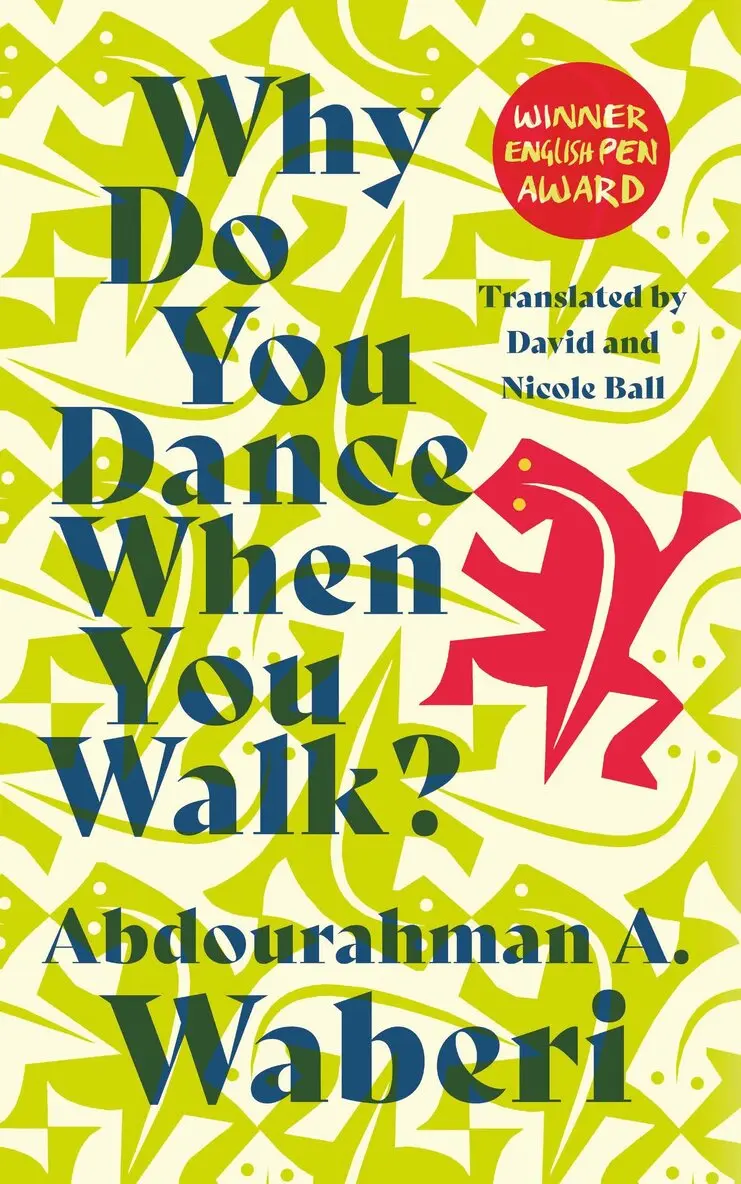
'Papa, why do you dance when you walk?' When Aden's 8-year-old daughter asks him this one morning in Paris, he is taken aback. The question is innocent, but the answer is not so simple. Unable to resist Bea's inquisitive spirit, he moves silkily between memories of his childhood: from his silent, mysterious mother and the shanty roofs of his neighbourhood to the malicious attack that changed his life forever and the ensuing struggle that made him a man. Anchoring his memories is a Djibouti on the cusp of independence; a land of shifting deserts and immense heat, French-from-France ex-pats, and one lonely and sick boy finding solace in books. Why Do You Dance When You Walk is a poignant and timeless story of the complexity of family, the value of poetry and freedom, and the ripple effect of the traumas that stalk our movement.
174 kr
Skickas inom 7-10 vardagar
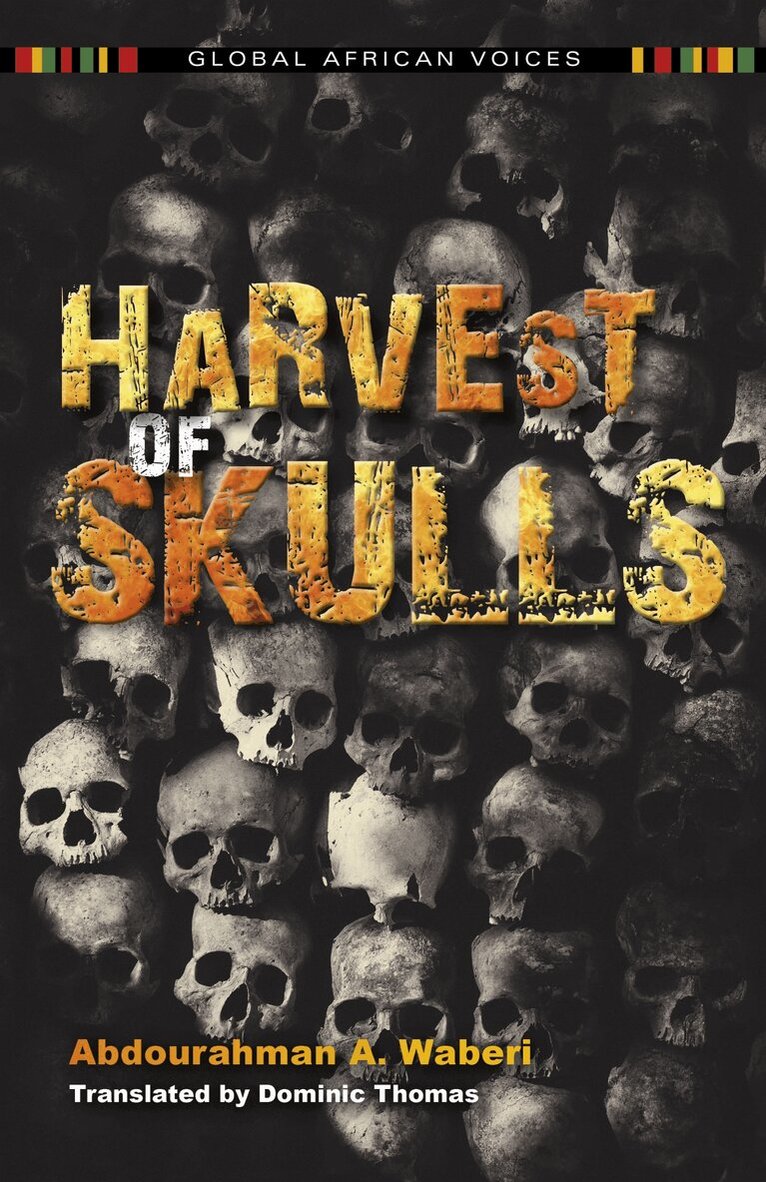
In 1994, the akazu, Rwandan's political elite, planned the genocidal mass slaughter of 500,000 to 1,000,000 Tutsi and Hutu who lived in the country. Given the failure of the international community to acknowledge the genocide, in 1998, ten African authors visited Rwanda in a writing initiative that was an attempt to make partial amends. In this multidimensional novel, Abdourahman A. Waberi claims, "Language remains inadequate in accounting for the world and all its turpitudes, words can never be more than unstable crutches, staggering along . . . And yet, if we want to hold on to a glimmer of hope in the world, the only miraculous weapons we have at our disposal are these same clumsy supports." Shaped by the author's own experiences in Rwanda and by the stories shared by survivors, Harvest of Skulls stands twenty years after the genocide as an indisputable resource for discussions on testimony and witnessing, the complex relationship between victims and perpetrators, the power of the moral imagination, and how survivors can rebuild a society haunted by the ghost of its history.
287 kr
Skickas inom 3-6 vardagar
In a literary reversal as deadly serious as it is wickedly satiric, this novel by the acclaimed French-speaking African writer Abdourahman A. Waberi turns the fortunes of the world upside down. On this reimagined globe a stream of sorry humanity flows from the West, from the slums of America and the squalor of Europe, to escape poverty and desperation in the prosperous United States of Africa. It is in this world that an African doctor on a humanitarian mission to France adopts a child. Now a young artist, this girl, Malaïka, travels to the troubled land of her birth in hope of finding her mother—and perhaps something of her lost self. Her search, at times funny and strange, is also deeply poignant, reminding us at every moment of the turns of fate we call truth.
714 kr
Skickas inom 10-15 vardagar
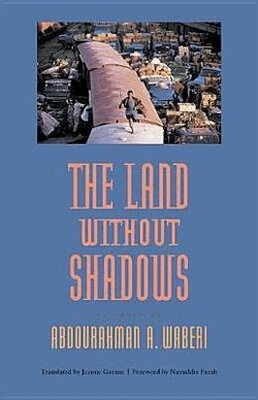
One of the first literary works to portray Djiboutians from their own point of view, ""The Land without Shadows"" is a collection of seventeen short stories. The author, Abdourahman A. Waberi, one of a handful of francophone writers of fiction to have emerged in the twentieth century from the ""confetti-sized state"" of Djibouti, has already won international recognition and prizes in African literature for his stories and novels. Because his writing is linked to immigration and exile, his native Djibouti occupies center stage in his work. Drawing on the Somali/Djiboutian oral tradition to weave pieces of legend, proverbs, music, poetry, and history together with references to writers as diverse as Soyinka, Shakespeare, Djebar, Baudelaire, Cesaire, Waugh, Senghor, and Beckett, Waberi succeeds in bringing his country into a context that reaches well beyond the Horn of Africa. Originally published in France in 1994 as ""Le Pays sans ombre"", this newly translated collection presents stories about the precolonial and colonial past of Djibouti alongside those set in the postcolonial era. With irony and humor, these short stories portray madmen, poets, artists, French colonists, pseudointellectuals, young women, aspiring politicians, famished refugees, khat chewers, nomads struggling to survive in Djibouti's ruthless natural environment, or tramps living (and dying) in Balbala, the shantytown that stretches to the south of the capital. Waberi's complex web of allusions locates his tales at an intersection between history and ethnography, politics and literature. While written in a narrative prose, these stories nevertheless call on an indigenous literary tradition that elevates poetry to the highest standing. By juxtaposing the present with the past, the individual with the collective, the colonized with the colonizer, the local with the global, ""The Land without Shadows"" composes an image of Djibouti that is at times both kaleidoscopic and cinematographic. Here the art of the short story offers partial but brilliantly illuminated scenes of the Djiboutian urban and rural landscape, its people, and its history.
250 kr
Skickas inom 7-10 vardagar
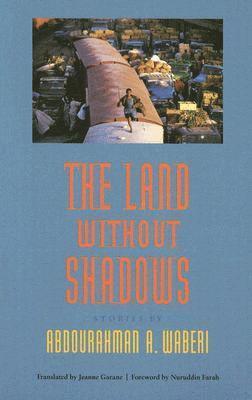
One of the first literary works to portray Djiboutians from their own point of view, ""The Land without Shadows"" is a collection of seventeen short stories. The author, Abdourahman A. Waberi, one of a handful of francophone writers of fiction to have emerged in the twentieth century from the ""confetti-sized state"" of Djibouti, has already won international recognition and prizes in African literature for his stories and novels. Because his writing is linked to immigration and exile, his native Djibouti occupies center stage in his work. Drawing on the Somali/Djiboutian oral tradition to weave pieces of legend, proverbs, music, poetry, and history together with references to writers as diverse as Soyinka, Shakespeare, Djebar, Baudelaire, Cesaire, Waugh, Senghor, and Beckett, Waberi succeeds in bringing his country into a context that reaches well beyond the Horn of Africa. Originally published in France in 1994 as ""Le Pays sans ombre"", this newly translated collection presents stories about the precolonial and colonial past of Djibouti alongside those set in the postcolonial era. With irony and humor, these short stories portray madmen, poets, artists, French colonists, pseudointellectuals, young women, aspiring politicians, famished refugees, khat chewers, nomads struggling to survive in Djibouti's ruthless natural environment, or tramps living (and dying) in Balbala, the shantytown that stretches to the south of the capital. Waberi's complex web of allusions locates his tales at an intersection between history and ethnography, politics and literature. While written in a narrative prose, these stories nevertheless call on an indigenous literary tradition that elevates poetry to the highest standing. By juxtaposing the present with the past, the individual with the collective, the colonized with the colonizer, the local with the global, ""The Land without Shadows"" composes an image of Djibouti that is at times both kaleidoscopic and cinematographic. Here the art of the short story offers partial but brilliantly illuminated scenes of the Djiboutian urban and rural landscape, its people, and its history.
203 kr
Skickas inom 7-10 vardagar
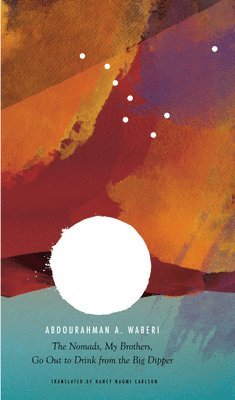
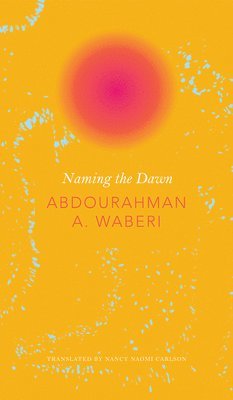
Few of us have had the opportunity to visit Djibouti, the small crook of a country strategically located in the Horn of Africa, which makes The Nomads, My Brothers, Go Out to Drink from the Big Dipper all the more seductive. In his first collection of poetry, the critically acclaimed writer Abdourahman A. Waberi writes passionately about his country's landscape, drawing for us pictures of "desert furrows of fire" and a "yellow chameleon sky." Waberi's poems take us to unexpected spaces-in exile, in the muezzin's call, and where morning dew is "sucked up by the eye of the sun-black often, pink from time to time." Translated by Nancy Naomi Carlson, Waberi's voice is intelligent, at times ironic, and always appealing. His poems strongly condemn the civil wars that have plagued East Africa and advocate tolerance and peace. In this compact volume, such ideas live side by side as a rosary for the treasures of Timbuktu, destroyed by Islamic extremists, and a poem dedicated to Edmond Jabes, the Jewish writer and poet born in Cairo.
185 kr
Skickas inom 7-10 vardagar
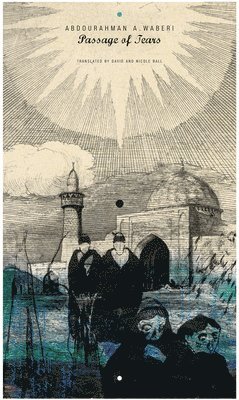
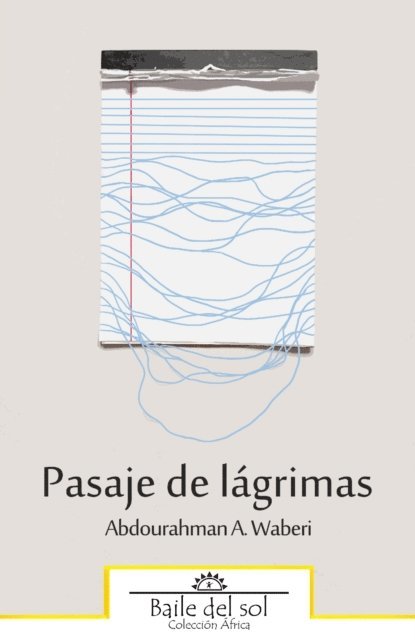
Passage of Tears cleverly mixes many genres and forms of writing--spy novel, political thriller, diary (replete with childhood memories), travel notebook, legends, parables, incantations, and prayers. Djibril's reminiscences provide a sense of Djibouti's past and its people, while a satire of Muslim fundamentalism is unwittingly delivered through the other Djiboutian voice. Waberi's inventive parody is a lesson in tolerance, while his poetic observations reveal his love and concern for his homeland.
167 kr
Skickas inom 7-10 vardagar
The poems in this new volume by Abdourahman A. Waberi are introspective and inquisitive, reflecting a deep spiritual bond—with words, with the history of Islam and its great poets, with the landscapes those poets walked, among which Waberi grew up. The sage yearns here for the simplicity of each individual moment to somehow become eternal, for the histories and people that are part of him—his mother, his wife, his unborn child, the sacred texts that ground his being—to come together harmoniously within him, and to emerge through his words. Lyrical and personal, but with powerful historical and cultural resonances, these poems are the work of a master at the height of his powers.
191 kr
Skickas inom 7-10 vardagar
“Everything starts with a song and everything ends with another song,” says the narrator of The Divine Song. Paris is an old Sufi cat who keeps watch over his brilliant yet pathetic master, Sammy Kamau-Williams, the Enchanter. In Sammy, we recognize the African American singer-composer, poet, and novelist Gil Scott-Heron who is best known for his song “The Revolution Will Not Be Televised.” The Divine Song takes us from the shores of Africa to Sammy’s ancestors’ arrival in the Americas in the hold of the slave ships. From there, Abdourahman A. Waberi takes the characters from Tennessee—under the tutelage of Lili Williams, Sammy’s beloved African-born grandmother—to New York and the concert halls of Paris and Berlin, wherever blues and jazz find an enchanted audience. African tales, religious practices, segregation, the civil rights movement, addiction, and jail—Sammy’s life comes to encompass the whole of the African American experience. At a time when social and racial divisions have yet again come into sharp relief, this lyrical novel by one of African literature’s rising stars is necessary reading for anyone who celebrates the resilience of art.
223 kr
Skickas inom 10-15 vardagar
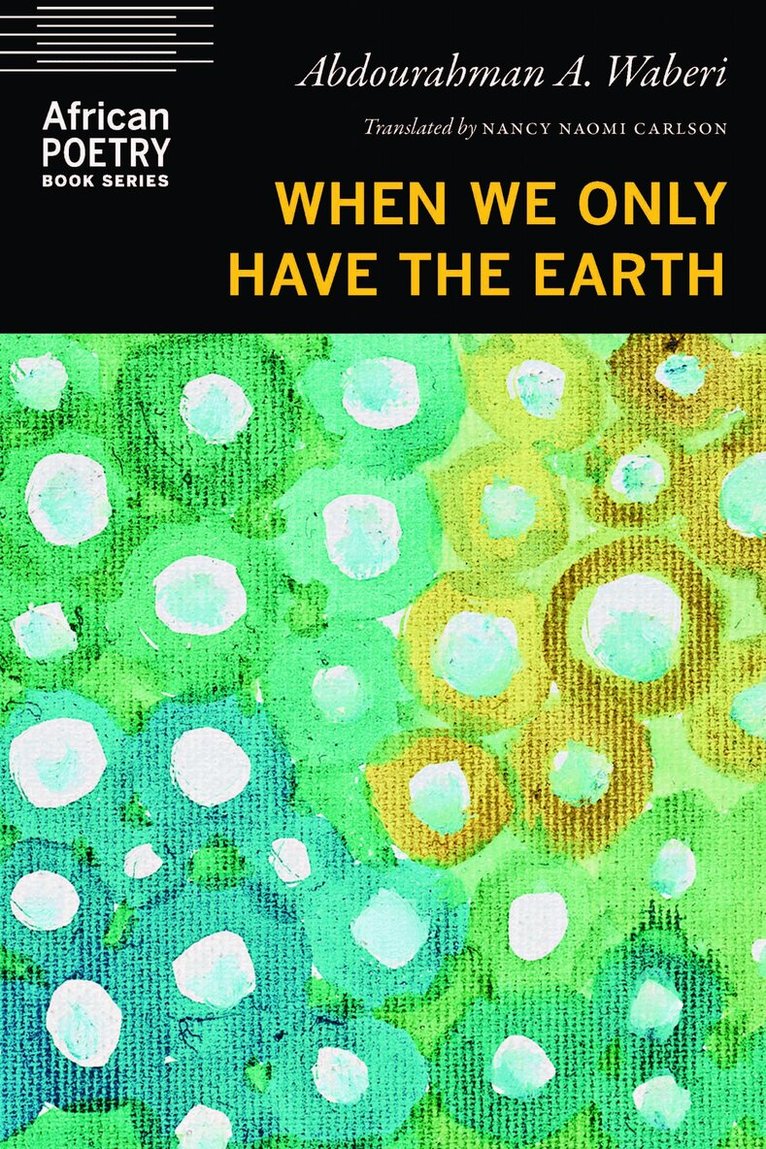
In this ode to the earth and all its living creatures, French Djiboutian poet, novelist, and essayist Abdourahman A. Waberi sounds the alarm about our imperiled planet, where “the Sahel rises in you, in me / the Red Sea boils in you, in me / Nunvut is melting in you, in me.” This translation by Nancy Naomi Carlson preserves the rich musicality of the original French, as well as its frequent use of wordplay and often unusual word choice.Waberi, a nomad at heart, takes us on a whirlwind tour across North America, Africa, and Europe, daring us to love the earth “beyond all rational thought” and to “turn into earth, both literally and figuratively,” as we “turn from vanity, fears, and other pointless rustling.” These lyrical, playful, and moving poems urge us to look for the truth and beauty hidden in our daily lives, singing of Waberi’s own enduring love for our endangered planet and also, more forcefully, exhorting us to join him in the collective fight to save our planet from destruction.