Abraham A. Singer - Böcker
Visar alla böcker från författaren Abraham A. Singer. Handla med fri frakt och snabb leverans.
4 produkter
4 produkter
938 kr
Skickas inom 5-8 vardagar
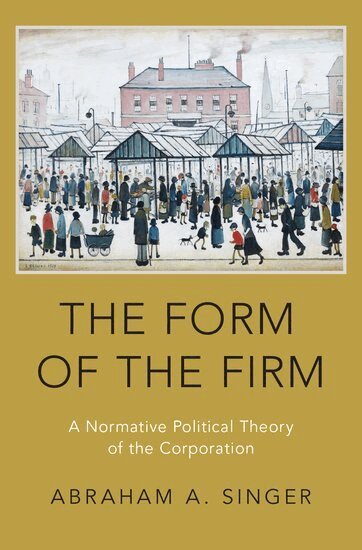
Contemporary discussions of the corporation tend to divide into one of two camps: On one side are scholars who treat the firm as a purely economic and contractual entity, while another set of scholars look at corporations in purely political terms. Therefore, the corporation is not merely an economic endeavor; it is a political institution and must therefore serve social ends and not merely profit. In The Form of the Firm, Abraham Singer contends that both of these approaches overstate their cases dramatically, resulting in two wrongheaded, influential accounts of the corporation. He offers a third way that sees the corporation as being both economic and political. First, it is true that corporations exist primarily to increase economic efficiency. However, they do this in ways that distinguish them from the markets in which they operate. Corporations are not natural outgrowths of the free market, but institutions that we have developed to correct market inefficiencies through mechanisms normally associated with politics. Corporations use social power, norms, and state-sanctioned authority to establish economic cooperation in ways that markets cannot. But, Singer argues that they also have an obligation to uphold the norms of liberal democracy that enable their existence and smooth-running in the first place. A profound rethinking of what a corporation actually is and how power within it ought to be structured and exercised, The Form of the Firm will reshape our understanding of corporate governance, corporate law, and business ethics.
572 kr
Skickas inom 3-6 vardagar
The Form of the Firm unveils the nature of the corporation as it exists in modern liberal societies. What are we to make of the power that corporations wield over people in modern society? Is such power legitimate? Many think so. To many businessmen and economists, as well as the general public, firms are purely private and economic entities, justified in using all legal means to maximize profit. In The Form of the Firm, Abraham Singer contends that such a view rests on a theoretical foundation that, while quite subtle, is deeply flawed. Contrary to the conventional wisdom, corporations are not natural outgrowths of the free market. Instead, Singer invites us to see corporations as political institutions that correct market inefficiencies through mechanisms normally associated with government -hierarchy, power, and state-sanctioned authority. Corporations exist primarily to increase economic efficiency, but they do this in ways that distinguish them from the markets in which they operate. Corporations serve economic ends, but through political means. Because of this, Singer argues that they also must be structured and obliged to uphold the social and political values that enable their existence and smooth-running in the first place: individual autonomy, moral and social equality, and democratic norms and institutions.A profound and timely rethinking of what a corporation actually is and how power within it ought to be structured and exercised, The Form of the Firm will reshape our understanding of political theory, corporate governance, corporate law, and business ethics.
939 kr
Skickas inom 7-10 vardagar
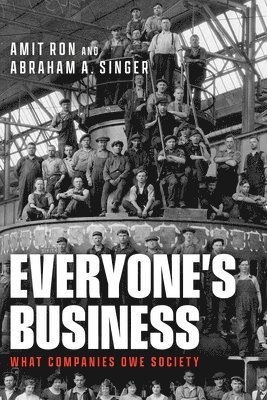
Business is political. What are the ethics of it?Businesses are political actors. They not only fund political campaigns, take stances on social issues, and wave the flags of identity groups – they also affect politics in their everyday hiring and investment decisions. As a highly polarized public demands political alignment from the powerful businesses they deal with, what’s a company to do? Amit Ron and Abraham Singer show that the unavoidably political role of companies in modern life is both the fundamental problem and inescapable fact of business ethics: corporate power makes business ethics necessary, and business ethics must strive to mitigate corporate power. Because of its economic and social influence, Ron and Singer forcefully argue that modern business’s primary social responsibility is to democracy. Businesses must work to avoid wielding their power in ways that undermine key democratic practices like elections, public debate, and social movements. Pragmatic and urgent, Everyone’s Business offers an essential new framework for how we pursue profit—and democracy—in our increasingly divided world.
291 kr
Skickas inom 7-10 vardagar
Business is political. What are the ethics of it?Businesses are political actors. They not only fund political campaigns, take stances on social issues, and wave the flags of identity groups – they also affect politics in their everyday hiring and investment decisions. As a highly polarized public demands political alignment from the powerful businesses they deal with, what’s a company to do? Amit Ron and Abraham Singer show that the unavoidably political role of companies in modern life is both the fundamental problem and inescapable fact of business ethics: corporate power makes business ethics necessary, and business ethics must strive to mitigate corporate power. Because of its economic and social influence, Ron and Singer forcefully argue that modern business’s primary social responsibility is to democracy. Businesses must work to avoid wielding their power in ways that undermine key democratic practices like elections, public debate, and social movements. Pragmatic and urgent, Everyone’s Business offers an essential new framework for how we pursue profit—and democracy—in our increasingly divided world.