• Fri frakt över 249 kr
  • •
  • Snabba leveranser
  • •
  • Billiga böcker
Kundservice

Du är på sajten för privatpersoner.

Företag, bibliotek eller offentlig verksamhet?

Du handlar på classic.bokus.com, där alla dina funktioner finns intakta.
Till classic.bokus.com
Bokus logotyp. Gå till startsidan.
  • Erbjudanden
  • Nyheter
  • Student
  • Topplistor
  • Barn & ungdom
  • Bokus Play
  • E-böcker
  • Pocketböcker
  • Spel & pussel

10% rabatt på allt med kod NYSTART10 →

Sidfot

Mina sidor

    Hjälp

    • Kundservice
    • Vanliga frågor och svar
    • Frakt och leverans
    • Retur vid ångerrätt
    • Reklamera vara
    • Betalning
    • Köpvillkor
    • Allmänna villkor
    • Information om webbplatsens tillgänglighet

    Om Bokus

    • Om oss
    • Pressrum
    • För studenter
    • För företag
    • För bibliotek och offentlig verksamhet
    • För leverantörer
    • Hållbarhet

    Populärt

    • Aktuella erbjudanden
    • Presentkort
    • Studentlitteratur
    • Nya böcker
    • Topplistor
    • Signerade böcker
    • Engelska böcker

    Inspiration

    • Boktips
    • BookTok
    • Populära bokserier
    • Barnbokskaraktärer
    • Populära författare
    Logotyp för Bokus
    Följ oss på Facebook (extern länk)Följ oss på Instagram (extern länk)Följ oss på YouTube (extern länk)Följ oss på TikTok (extern länk)
    bokus @ CookiesAnpassa cookiesIntegritetspolicyKöpvillkor
    Till Citymail hemsida (extern länk)Till Budbee hemsida (extern länk)Till Postnord hemsida (extern länk)Till Schenker hemsida (extern länk)Till Early Bird hemsida (extern länk)Till Walleys hemsida (extern länk)
    1. Ekonomi och Ledarskap
    2. Företagsekonomi
    3. Affärsetik

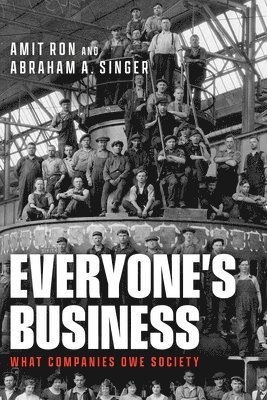
    Everyone's Business

    What Companies Owe Society

    AvAmit Ron,Abraham A. Singer

    Häftad, Engelska, 2024

    301 kr

    Beställningsvara. Skickas inom 5-8 vardagar. Fri frakt över 249 kr.

    Fler format och utgåvor

    Inbunden

    971 kr

    Beskrivning

    Business is political. What are the ethics of it?Businesses are political actors. They not only fund political campaigns, take stances on social issues, and wave the flags of identity groups – they also affect politics in their everyday hiring and investment decisions. As a highly polarized public demands political alignment from the powerful businesses they deal with, what’s a company to do? Amit Ron and Abraham Singer show that the unavoidably political role of companies in modern life is both the fundamental problem and inescapable fact of business ethics: corporate power makes business ethics necessary, and business ethics must strive to mitigate corporate power. Because of its economic and social influence, Ron and Singer forcefully argue that modern business’s primary social responsibility is to democracy. Businesses must work to avoid wielding their power in ways that undermine key democratic practices like elections, public debate, and social movements. Pragmatic and urgent, Everyone’s Business offers an essential new framework for how we pursue profit—and democracy—in our increasingly divided world.

    Produktinformation

    • Utgivningsdatum:2024-12-10
    • Mått:152 x 229 x 15 mm
    • Vikt:399 g
    • Format:Häftad
    • Språk:Engelska
    • Antal sidor:256
    • Förlag:The University of Chicago Press
    • ISBN:9780226819839

    Utforska kategorier

    • Affärsetik inom Ekonomi och Ledarskap

    Mer om författaren

    Amit Ron is associate professor of political science at Arizona State University. Abraham Singer is assistant professor of business at Loyola University Chicago. He is the author of The Form of the Firm: A Normative Political Theory of the Corporation.

    Recensioner i media

    "Ron and Singer [consider] businesses’ democratic obligations, promoting the argument that businesses have an overarching responsibility to avoid corrupting and unduly influencing democratic procedures and principles."

    Innehållsförteckning

    • Introduction1. Business Ethics Is Political2. Democracy and Business Ethics3. The Rule of Law and Ethical Obligation4. Lobbying and Democratic Corruption5. Marketing and Democratic Deliberation6. The Bottom Line and the Picket Line7. Democratic Relations and the Workplace8. Exit, Voice, and Business Investment DecisionsConclusionsAcknowledgmentsNotesBibliographyIndex