Adam K. Webb - Böcker
Visar alla böcker från författaren Adam K. Webb. Handla med fri frakt och snabb leverans.
6 produkter
6 produkter
2 290 kr
Skickas inom 10-15 vardagar
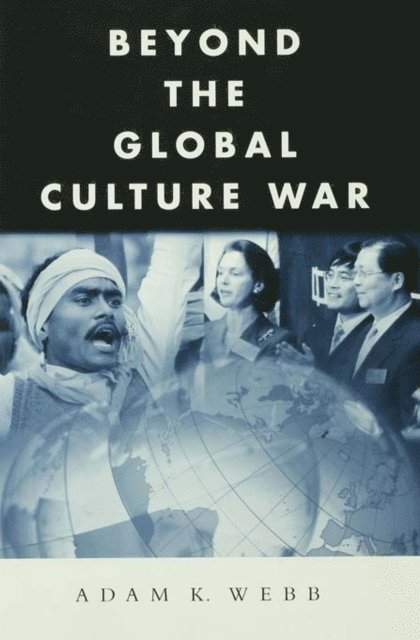
"Beyond the Global Culture War" presents a cross-cultural critique of global liberalism and argues for a broad-based challenge that can meet it on its own scale. Adam Webb is one of our most exciting and original young scholars, and this book is certain to generate many new debates. This timely volume probes many of the key challenges we face in the new millennium. This is essential reading for all students of politics and globalization.
807 kr
Skickas inom 10-15 vardagar
"Beyond the Global Culture War" presents a cross-cultural critique of global liberalism and argues for a broad-based challenge that can meet it on its own scale. Adam Webb is one of our most exciting and original young scholars, and this book is certain to generate many new debates. This timely volume probes many of the key challenges we face in the new millennium. This is essential reading for all students of politics and globalization.
1 930 kr
Skickas inom 10-15 vardagar
Global governance is tightening and foreshadows that world state formation will become a live political issue in this century. Some observers treat it as inevitable amid the urgency of global issues. They foresee a technocratic scaling up of the model of state authority that has prevailed at the national level for over two hundred years. Many critics and members of the public around the world look askance at that prospect. They rightly fear a moral vacuum of authority disconnected from the world’s traditions, and a concentration of power that would be damaging to liberty or even dystopian in its upshot. Still, they often merely aim to stand athwart the scaling up of political institutions, rather than actively trying to shape an alternative that can seize the global horizon.The World’s Constitution: Spheres of Liberty in the Future Global Order offers a radically different vision of future world order that could work in a global space while shifting the balance of power from state back to society. It draws on older resources in political thought, both Western and non-Western, to upend mainstream notions of statehood and sovereignty that have been taken for granted for too long in the modern era. It offers an original ‘sphere pluralist’ framework that can reconcile liberty, tradition, and cosmopolitanism. As a book rooted in the past but mindful of future constitutional and policy challenges, it bridges ideas and real-world implications, with insights that cut across a wide range of topics from migration and social welfare to personal law systems and channels of representation. It opens an exciting debate about global constitutional futures that is likely to become more salient over the next couple of generations.The Open Access version of this book, available at http://www.taylorfrancis.com, has been made available under a Creative Commons Attribution-Non Commercial-No Derivatives (CC-BY-NC-ND) 4.0 license.
621 kr
Kommande
Global governance is tightening and foreshadows that world state formation will become a live political issue in this century. Some observers treat it as inevitable amid the urgency of global issues. They foresee a technocratic scaling up of the model of state authority that has prevailed at the national level for over two hundred years. Many critics and members of the public around the world look askance at that prospect. They rightly fear a moral vacuum of authority disconnected from the world’s traditions, and a concentration of power that would be damaging to liberty or even dystopian in its upshot. Still, they often merely aim to stand athwart the scaling up of political institutions, rather than actively trying to shape an alternative that can seize the global horizon.The World’s Constitution: Spheres of Liberty in the Future Global Order offers a radically different vision of future world order that could work in a global space while shifting the balance of power from state back to society. It draws on older resources in political thought, both Western and non-Western, to upend mainstream notions of statehood and sovereignty that have been taken for granted for too long in the modern era. It offers an original ‘sphere pluralist’ framework that can reconcile liberty, tradition, and cosmopolitanism. As a book rooted in the past but mindful of future constitutional and policy challenges, it bridges ideas and real-world implications, with insights that cut across a wide range of topics from migration and social welfare to personal law systems and channels of representation. It opens an exciting debate about global constitutional futures that is likely to become more salient over the next couple of generations.The Open Access version of this book, available at http://www.taylorfrancis.com, has been made available under a Creative Commons Attribution-Non Commercial-No Derivatives (CC-BY-NC-ND) 4.0 license.
674 kr
Skickas inom 10-15 vardagar
Too often, observers of globalization take for granted that the common ground across cultures is a thin layer of consumerism and perhaps human rights. If so, then anything deeper and more traditional would be placebound, and probably destined for the dustbin of history. But must this be so? Must we assume--as both liberals and traditionalists now tend to do--that one cannot be a cosmopolitan and take traditions seriously at the same time? This book offers a radically different argument about how traditions and global citizenship can meet, and suggests some important lessons for the contours of globalization in our own time.Adam K. Webb argues that if we look back before modernity, we find a very different line of thinking about what it means to take the whole world as one’s horizon. Digging into some fascinating currents of thought and practice in the ancient world, the Middle Ages, and the early modern period, across all major civilizations, Webb is able to reveal patterns of "deep cosmopolitanism", with its logic quite unlike that of liberal globalization today. In their more cosmopolitan moments, everyone from clerics to pilgrims to empire-builders was inclined to look for deep ethical parallels—points of contact—among civilizations and traditions. Once modernity swept aside the old civilizations, however, that promise was largely forgotten. We now have an impoverished view of what it means to embrace a tradition and even what kinds of conversations across traditions are possible. In part two, Webb draws out the lessons of deep cosmopolitanism for our own time. If revived, it has something to say about everything from the rise of new non-Western powers like China and India and what they offer the world, to religious tolerance, to global civil society, to cross-border migration. Deep Cosmopolis traces an alternative strand of cosmopolitan thinking that cuts across centuries and civilizations. It advances a new perspective on world history, and a distinctive vision of globalization for this century which has the real potential to resonate with us all.
2 165 kr
Skickas inom 10-15 vardagar
Too often, observers of globalization take for granted that the common ground across cultures is a thin layer of consumerism and perhaps human rights. If so, then anything deeper and more traditional would be placebound, and probably destined for the dustbin of history. But must this be so? Must we assume--as both liberals and traditionalists now tend to do--that one cannot be a cosmopolitan and take traditions seriously at the same time? This book offers a radically different argument about how traditions and global citizenship can meet, and suggests some important lessons for the contours of globalization in our own time.Adam K. Webb argues that if we look back before modernity, we find a very different line of thinking about what it means to take the whole world as one’s horizon. Digging into some fascinating currents of thought and practice in the ancient world, the Middle Ages, and the early modern period, across all major civilizations, Webb is able to reveal patterns of "deep cosmopolitanism", with its logic quite unlike that of liberal globalization today. In their more cosmopolitan moments, everyone from clerics to pilgrims to empire-builders was inclined to look for deep ethical parallels—points of contact—among civilizations and traditions. Once modernity swept aside the old civilizations, however, that promise was largely forgotten. We now have an impoverished view of what it means to embrace a tradition and even what kinds of conversations across traditions are possible. In part two, Webb draws out the lessons of deep cosmopolitanism for our own time. If revived, it has something to say about everything from the rise of new non-Western powers like China and India and what they offer the world, to religious tolerance, to global civil society, to cross-border migration.Deep Cosmopolis traces an alternative strand of cosmopolitan thinking that cuts across centuries and civilizations. It advances a new perspective on world history, and a distinctive vision of globalization for this century which has the real potential to resonate with us all.The Open Access version of this book, available at http://www.taylorfrancis.com, has been made available under a Creative Commons Attribution-Non Commercial-No Derivatives (CC BY-NC-ND) 4.0 license.