Aharon Layish - Böcker
Visar alla böcker från författaren Aharon Layish. Handla med fri frakt och snabb leverans.
3 produkter
3 produkter
Women and Islamic Law in a Non-Muslim State
A Study Based on Decisions of the Shari'a Courts in Israel
Inbunden, Engelska, 2017
2 103 kr
Skickas inom 10-15 vardagar
This book is methodologically unique in scholarly literature on Muslim society. Its originality lies in the fact that the rich material offered by the shari'a courts is given a thorough analysis with a view to drawing conclusions about the present-day phenomena in Arab society and processes that the society has been undergoing in modern times.Aharon Layish examines every aspect of the social status of Muslim women that finds expression in the shari'a courts: the age of marriage, stipulations inserted in the marriage contract, dower, polygamy, maintenance and obedience, divorce, custody of the children, guardianship, and succession. Each chapter opens with a short legal introduction based on all the sources of law applying in shari'a courts, followed by social analyses and a study of the attitudes and approaches of the qadis, or Muslim religious judges. Layish examines the relationship between shari'a and Israeli legislation: Do shari'a courts have regard to the provisions of Israeli law? What is the relationship between shari'a and social custom, and which is decisive in regard to Israeli Muslim women? To what extent does Israeli law actually affect Israeli Muslim women? What is the attitude of the qadis, toward Israeli legislation?Women and Islamic Law in a Non-Muslim State is an important and original study that will be of interest to students and scholars of Islamic law, comparative law, sociology, and modernization.
Women and Islamic Law in a Non-Muslim State
A Study Based on Decisions of the Shari'a Courts in Israel
Häftad, Engelska, 2006
622 kr
Skickas inom 10-15 vardagar
This book is methodologically unique in scholarly literature on Muslim society. Its originality lies in the fact that the rich material offered by the shari'a courts is given a thorough analysis with a view to drawing conclusions about the present-day phenomena in Arab society and processes that the society has been undergoing in modern times.Aharon Layish examines every aspect of the social status of Muslim women that finds expression in the shari'a courts: the age of marriage, stipulations inserted in the marriage contract, dower, polygamy, maintenance and obedience, divorce, custody of the children, guardianship, and succession. Each chapter opens with a short legal introduction based on all the sources of law applying in shari'a courts, followed by social analyses and a study of the attitudes and approaches of the qadis, or Muslim religious judges. Layish examines the relationship between shari'a and Israeli legislation: Do shari'a courts have regard to the provisions of Israeli law? What is the relationship between shari'a and social custom, and which is decisive in regard to Israeli Muslim women? To what extent does Israeli law actually affect Israeli Muslim women? What is the attitude of the qadis, toward Israeli legislation?Women and Islamic Law in a Non-Muslim State is an important and original study that will be of interest to students and scholars of Islamic law, comparative law, sociology, and modernization.
Del 54 - Studies in Islamic Law and Society
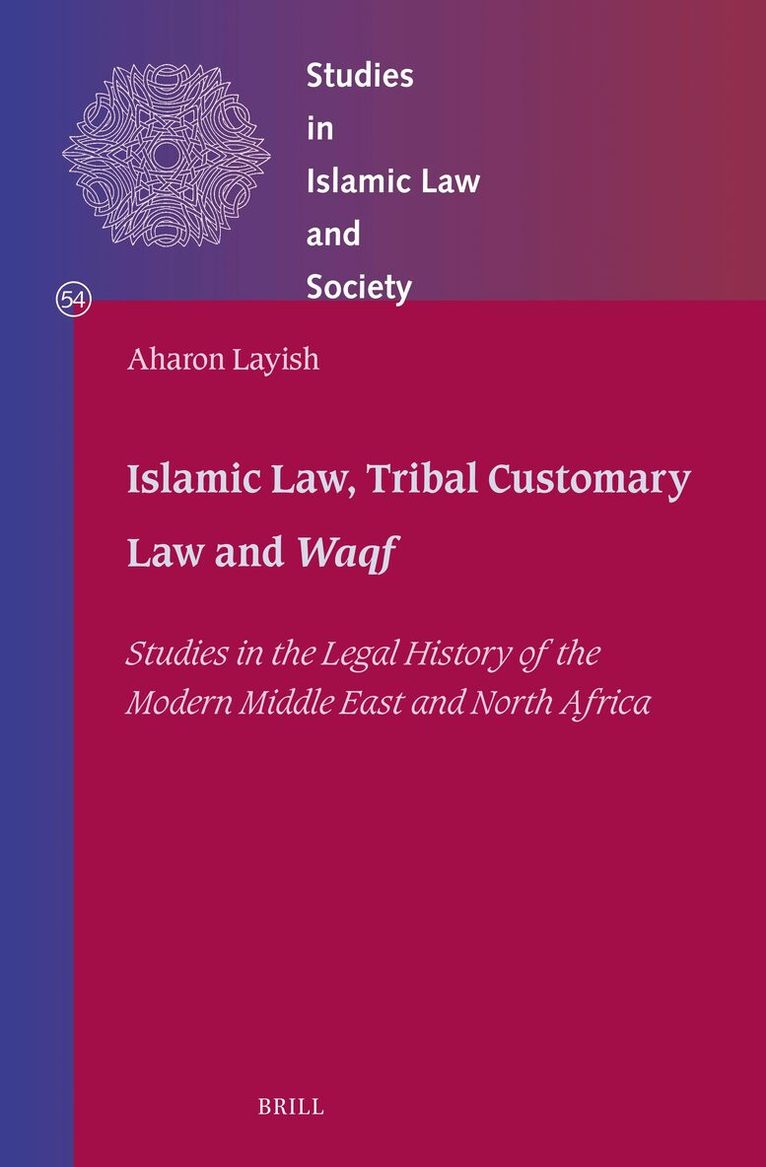
Islamic Law, Tribal Customary Law and Waqf
Studies in the Legal History of the Modern Middle East and North Africa
Inbunden, Arabiska, 2023
2 157 kr
Skickas inom 5-8 vardagar
In this collected volume, Aharon Layish demonstrates that legal documents are an essential source for legal and social history. Since the late nineteenth century, Islamic law has undergone tremendous transformations, some of which have strongly affected the basic features of its nature.The changes include the transformation of Islamic law from a jurists’ law to a statutory law; the abolishment of waqf; the Islamization of tribal customary law; the creation of Sudanese legal methodologies strongly inspired by Ṣūfī and Salafī traditions or Western law, and the emergence of an Israeli version of Islamic law.