Aidan Beatty - Böcker
Visar alla böcker från författaren Aidan Beatty. Handla med fri frakt och snabb leverans.
7 produkter
7 produkter
190 kr
Skickas inom 7-10 vardagar
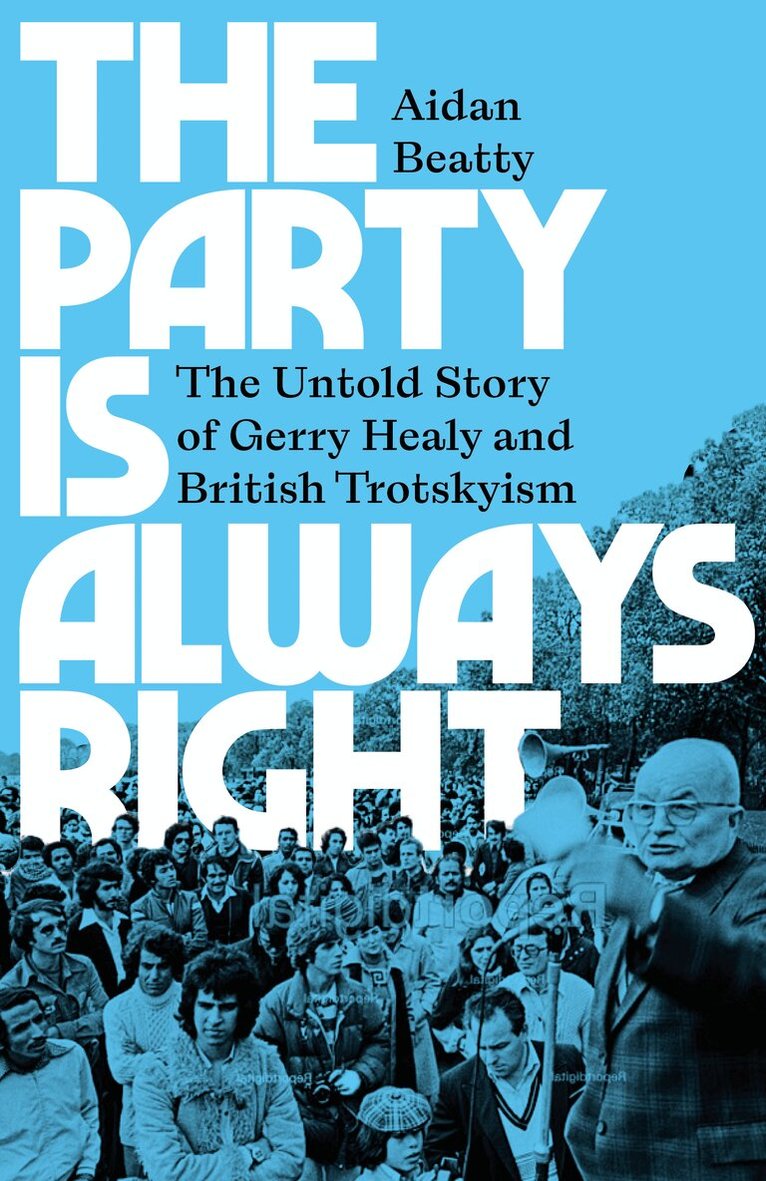
'A very readable and meticulous take-down that will be seen as a must-read source on left-wing politics' - Paul Le Blanc, author of LeninLove it or hate it, it’s hard to deny that British Trotskyism created some fascinating stories. Finding themselves increasingly irrelevant in modern politics, these political sects often became twisted aberrations of Comrade Trotsky’s ideals. Gerry Healy’s Workers Revolutionary Party was no exception.This new biography tells the story of Healy’s life, picking apart fact from fiction, to reveal a man rotten to the core with authoritarian tendencies. Saturating the party with his personality, Healy took advantage of his comrades’ trust and revolutionary zeal, eventually forcing a split in 1985.This is a tragic story in the history of Communism, wracked with accounts of abuse, collaboration with the state and vicious infighting. It also reveals the dangers of male-dominated political movements, secular cults, and celebrity culture, and is an important reminder of what can happen when a working-class movement is betrayed from within.
721 kr
Skickas inom 10-15 vardagar
The Irish and the Jews are two of the classic outliers of modern Europe. Both struggled with their lack of formal political sovereignty in the nineteenth-century. Simultaneously European and not European, both endured a bifurcated status, perceived as racially inferior and yet also seen as a natural part of the European landscape. Both sought to deal with their subaltern status through nationalism; both had a tangled, ambiguous, and sometimes violent relationship with Britain and the British Empire; and both sought to revive ancient languages as part of their drive to create a new identity. The career of Irish politician Robert Briscoe and the travails of Leopold Bloom are just two examples of the delicate balancing of Irish and Jewish identities in the first half of the twentieth century. Irish Questions and Jewish Questions explores these shared histories, covering several centuries of the Jewish experience in Ireland, as well as events in Israel-Palestine and North America. The authors examine the leading figures of both national movements to reveal how each had an active interest in the successes, and failures, of the other. Bringing together leading and emerging scholars from the fields of Irish studies and Jewish studies, this volume captures the most recent scholarship on their comparative history with nuance and remarkable insight.
373 kr
Skickas inom 7-10 vardagar
The Irish and the Jews are two of the classic outliers of modern Europe. Both struggled with their lack of formal political sovereignty in the nineteenth-century. Simultaneously European and not European, both endured a bifurcated status, perceived as racially inferior and yet also seen as a natural part of the European landscape. Both sought to deal with their subaltern status through nationalism; both had a tangled, ambiguous, and sometimes violent relationship with Britain and the British Empire; and both sought to revive ancient languages as part of their drive to create a new identity. The career of Irish politician Robert Briscoe and the travails of Leopold Bloom are just two examples of the delicate balancing of Irish and Jewish identities in the first half of the twentieth century. Irish Questions and Jewish Questions explores these shared histories, covering several centuries of the Jewish experience in Ireland, as well as events in Israel-Palestine and North America. The authors examine the leading figures of both national movements to reveal how each had an active interest in the successes, and failures, of the other. Bringing together leading and emerging scholars from the fields of Irish studies and Jewish studies, this volume captures the most recent scholarship on their comparative history with nuance and remarkable insight.
312 kr
Skickas inom 10-15 vardagar
This book is a comparative study of masculinity and white racial identity in Irish nationalism and Zionism.
1 202 kr
Skickas inom 5-8 vardagar
This is a book about what people imagine it means to live in a world where private property is dominant, and their fears – and sometimes hopes – about living in a future world where private property has disappeared. In the propertied imagination, private property is a fragile thing, an institution beset by terrifying enemies and racialised and gendered mobs: Levellers and Diggers, socialists and anarchists, fervent religious radicals, abolitionists, feminists, and haughty welfare-state bureaucrats. The history of private property is the history of a recurring nightmare that one or another of these groups would storm the castle and take control. That threatened social chaos is the central unifying story of this book.Private property and the fear of social chaos starts by charting the thinkers who laid the foundations for how we understand private property, including Locke, Burke, Marx and Engels. The book looks at how their ideas have been put into practice in ways that continue to shape the modern world, from Harry Truman’s housing policies and the anti-abolitionist George Fitzhugh to Margaret Thatcher and Elon Musk. Arguing that the spectre of ‘the mob’ has been intimately interconnected with the idea of private property throughout capitalist modernity, the book ambitiously narrates this history from the early colonisation of the Americas to Silicon Valley, and the future of human colonisation in space.
356 kr
Skickas
This is a book about what people imagine it means to live in a world where private property is dominant, and their fears – and sometimes hopes – about living in a future world where private property has disappeared. In the propertied imagination, private property is a fragile thing, an institution beset by terrifying enemies and racialised and gendered mobs: Levellers and Diggers, socialists and anarchists, fervent religious radicals, abolitionists, feminists, and haughty welfare-state bureaucrats. The history of private property is the history of a recurring nightmare that one or another of these groups would storm the castle and take control. That threatened social chaos is the central unifying story of this book.Private property and the fear of social chaos starts by charting the thinkers who laid the foundations for how we understand private property, including Locke, Burke, Marx and Engels. The book looks at how their ideas have been put into practice in ways that continue to shape the modern world, from Harry Truman’s housing policies and the anti-abolitionist George Fitzhugh to Margaret Thatcher and Elon Musk. Arguing that the spectre of ‘the mob’ has been intimately interconnected with the idea of private property throughout capitalist modernity, the book ambitiously narrates this history from the early colonisation of the Americas to Silicon Valley, and the future of human colonisation in space.
142 kr
Skickas inom 5-8 vardagar