Aileen Douglas - Böcker
Visar alla böcker från författaren Aileen Douglas. Handla med fri frakt och snabb leverans.
4 produkter
4 produkter
1 180 kr
Skickas inom 7-10 vardagar
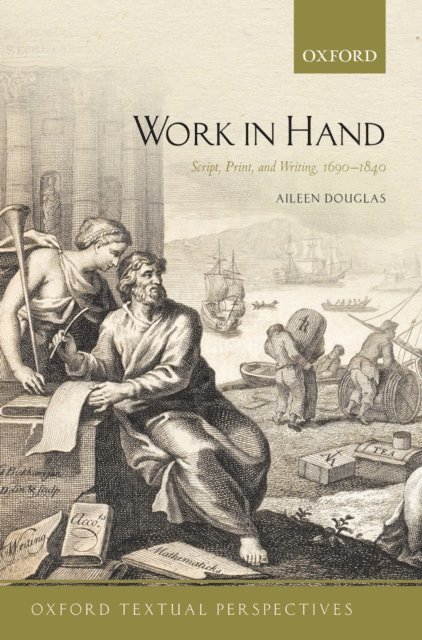
Oxford Textual Perspectives is a new series of informative and provocative studies focused upon literary texts (conceived of in the broadest sense of that term) and the technologies, cultures and communities that produce, inform, and receive them. It provides fresh interpretations of fundamental works and of the vital and challenging issues emerging in English literary studies. By engaging with the materiality of the literary text, its production, and reception history, and frequently testing and exploring the boundaries of the notion of text itself, the volumes in the series question familiar frameworks and provide innovative interpretations of both canonical and less well-known works.Work in Hand: Script, Print, and Writing, 1690-1840 argues that between the late seventeenth and early nineteenth centuries manual writing was a dynamic technology. It examines script in relation to becoming a writer; in constructions of the author; and in emerging ideas of the human. Revising views of print as displacing script, Work in Hand argues that print reproduced script, print generated script; and print shaped understandings of script. In this, the double nature of print, as both moveable type and rolling press, is crucial. During this period, the shapes of letters changed as the multiple hands of the early-modern period gave way to English round hand; the denial of writing to the labouring classes was slowly replaced by acceptance of the desirability of universal writing; understandings of script in relation to copying and discipline came to be accompanied by ideas of the autograph. The work begins by surveying representations of script in letterpress and engraving. It discusses initiation into writing in relation to the copy-books of English writing masters, and in the context of colonial pedagogy in Ireland and India. The middle chapters discuss the physical work of writing, the material dimensions of script, and the autograph, in constructions of the author in the late eighteenth and early nineteenth centuries, and in relation to Samuel Johnson, Alexander Pope, William Blake, Isaac D'Israeli, and Maria Edgeworth. The final chapter considers the emerging association of script with ideas of the human in the work of the Methodist preacher Joseph Barker.
436 kr
Skickas inom 7-10 vardagar
Oxford Textual Perspectives is a new series of informative and provocative studies focused upon literary texts (conceived of in the broadest sense of that term) and the technologies, cultures and communities that produce, inform, and receive them. It provides fresh interpretations of fundamental works and of the vital and challenging issues emerging in English literary studies. By engaging with the materiality of the literary text, its production, and reception history, and frequently testing and exploring the boundaries of the notion of text itself, the volumes in the series question familiar frameworks and provide innovative interpretations of both canonical and less well-known works.Work in Hand: Script, Print, and Writing, 1690-1840 argues that between the late seventeenth and early nineteenth centuries manual writing was a dynamic technology. It examines script in relation to becoming a writer; in constructions of the author; and in emerging ideas of the human. Revising views of print as displacing script, Work in Hand argues that print reproduced script, print generated script; and print shaped understandings of script. In this, the double nature of print, as both moveable type and rolling press, is crucial. During this period, the shapes of letters changed as the multiple hands of the early-modern period gave way to English round hand; the denial of writing to the labouring classes was slowly replaced by acceptance of the desirability of universal writing; understandings of script in relation to copying and discipline came to be accompanied by ideas of the autograph. The work begins by surveying representations of script in letterpress and engraving. It discusses initiation into writing in relation to the copy-books of English writing masters, and in the context of colonial pedagogy in Ireland and India. The middle chapters discuss the physical work of writing, the material dimensions of script, and the autograph, in constructions of the author in the late eighteenth and early nineteenth centuries, and in relation to Samuel Johnson, Alexander Pope, William Blake, Isaac D'Israeli, and Maria Edgeworth. The final chapter considers the emerging association of script with ideas of the human in the work of the Methodist preacher Joseph Barker.
517 kr
Skickas inom 7-10 vardagar
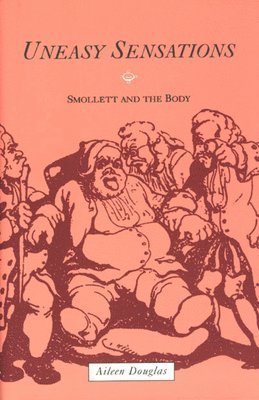
The 18th-century comic novelist Tobias Smollett has often been criticized for the extreme physicality of his writing, which is full of scatological images and graphic depictions of bodily injury and disintegration. The author draws on feminist and other theoretical perspectives to reassess Smollett's body of fiction as well as his classic "Travels through France and Italy". Like many writers of his time, Douglas argues, Smollett was interested in the body and in how accurately it reflects internal disposition. But Smollett's special contribution to the 18th-century novel is his emphasis on sentience, or the sensations of the physical body. Looking at such works as "The Adventures of Roderick Random", "The Expedition of Humphry Clinker", "The Adventures of Peregrine Pickle", and "The History and Adventures of an Atom", Douglas explores the ways Smollett uses representations of sentience - especially torment and pain - in his critique of the social and political order.Trained in medicine, Smollett was especially alert to the ways in which the discourses of medicine, philosophy, and law construct the body as an object of knowledge, and yet his work always returns to the importance of the physical world of the body and its feelings.
1 333 kr
Skickas inom 7-10 vardagar
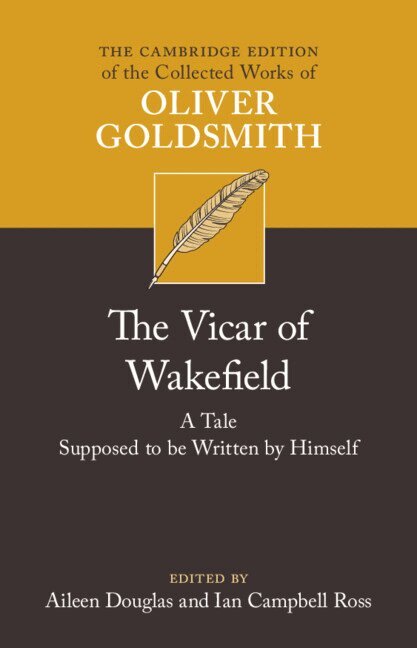
This newly edited critical edition of an enduringly popular tale, one of the most widely reprinted and illustrated works of fiction in English, offers readers an authoritative text along with extensive and helpful annotation. Following the lives of the vicar and his family, and the various calamities which befall them, The Vicar of Wakefield was one of the most popular and beloved works of eighteenth-century fiction. A lively introduction details the reception of Goldsmith's tale, from comments by Frances Burney and Goethe, through Sir Walter Scott, Washington Irving and Henry James, to critics of the twentieth and twenty-first centuries. The volume also includes appendices comprising a wealth of contextual information, enhancing the work for contemporary readers. For scholars of Goldsmith and new readers alike, this edition will prove the authoritative version of a tale that moved generations of readers to laughter and to tears.