Akira Yamazaki - Böcker
Visar alla böcker från författaren Akira Yamazaki. Handla med fri frakt och snabb leverans.
6 produkter
6 produkter
1 064 kr
Skickas inom 10-15 vardagar
A lot of economic problems can be formulated as constrained optimizations and equilibration of their solutions. Various mathematical theories have been supplying economists with indispensable machineries for these problems arising in economic theory. Conversely, mathematicians have been stimulated by various mathematical difficulties raised by economic theories. The series is designed to bring together those mathematicians who are seriously interested in getting new challenging stimuli from economic theories with those economists who are seeking effective mathematical tools for their research. The editorial board of this series comprises the following prominent economists and mathematicians: Managing Editors: S. Kusuoka (Univ. Tokyo), T. Maruyama (Keio Univ.). Editors: R. Anderson (U.C. Berkeley), C. Castaing (Univ. Montpellier), F.H. Clarke (Univ. Lyon I), G. Debreu (U.C. Berkeley), E. Dierker (Univ. Vienna), D. Duffie (Stanford Univ.), L.C. Evans (U.C. Berkeley), T. Fujimoto (Okayama Univ.), J.-M. Grandmont (CREST-CNRS), N. Hirano (Yokohama National Univ.), L. Hurwicz (Univ. of Minnesota), T. Ichiishi (Ohio State Univ.), A. Ioffe (Israel Institute of Technology), S.Iwamoto (Kyushu Univ.), K. Kamiya (Univ. Tokyo), K. Kawamata (Keio Univ.), N. Kikuchi (Keio Univ.), H. Matano (Univ. Tokyo), K. Nishimura (Kyoto Univ.), M.K. Richter (Univ. Minnesota), Y. Takahashi (Kyoto Univ.), M. Valadier (Univ. Montpellier II), A. Yamaguti (Kyoto Univ./Ryukoku Univ.), M. Yano (Keio Univ.).
Del 7 - Advances in Mathematical Economics
Advances in Mathematical Economics Volume 7
Häftad, Engelska, 2014
1 064 kr
Skickas inom 10-15 vardagar
A lot of economic problems can be formulated as constrained optimizations and equilibration of their solutions. Various mathematical theories have been supplying economists with indispensable machineries for these problems arising in economic theory. Conversely, mathematicians have been stimulated by various mathematical difficulties raised by economic theories. The series is designed to bring together those mathematicians who are seriously interested in getting new challenging stimuli from economic theories with those economists who are seeking effective mathematical tools for their research. The editorial board of this series comprises the following prominent economists and mathematicians: Managing Editors: S. Kusuoka (Univ. Tokyo), T. Maruyama (Keio Univ.). Editors: R. Anderson (U.C. Berkeley), C. Castaing (Univ. Montpellier), F.H. Clarke (Univ. Lyon I), G. Debreu (U.C. Berkeley), E. Dierker (Univ. Vienna), D. Duffie (Stanford Univ.), L.C. Evans (U.C. Berkeley), T. Fujimoto (Okayama Univ.), J.-M. Grandmont (CREST-CNRS), N. Hirano (Yokohama National Univ.), L. Hurwicz (Univ. of Minnesota), T. Ichiishi (Ohio State Univ.), A. Ioffe (Israel Institute of Technology), S. Iwamoto (Kyushu Univ.), K. Kamiya (Univ. Tokyo), K. Kawamata (Keio Univ.), N. Kikuchi (Keio Univ.), H. Matano (Univ. Tokyo), K. Nishimura (Kyoto Univ.), M.K. Richter (Univ. Minnesota), Y. Takahashi (Kyoto Univ.), M. Valadier (Univ. Montpellier II), A. Yamaguti (Kyoto Univ./Ryukoku Univ.), M. Yano (Keio Univ.).
Del 11 - Advances in Mathematical Economics
Advances in Mathematical Economics Volume 11
Inbunden, Engelska, 2008
1 640 kr
Skickas inom 10-15 vardagar
A lot of economic problems can formulated as constrained optimizations and equilibration of their solutions. Various mathematical theories have been supplying economists with indispensable machineries for these problems arising in economic theory. Conversely, mathematicians have been stimulated by various mathematical difficulties raised by economic theories. The series is designed to bring together those mathematicians who were seriously interested in getting new challenging stimuli from economic theories with those economists who are seeking for effective mathematical tools for their researchers. Members of the editorial board of this series consists of following prominent economists and mathematicians: Managing Editors: S. Kusuoka (Univ. Tokyo), A. Yamazaki (Hitotsubashi Univ.) - Editors: R. Anderson (U.C.Berkeley), C. Castaing (Univ. Montpellier II), F. H. Clarke (Univ. Lyon I), E. Dierker (Univ. Vienna), D. Duffie (Stanford Univ.), L.C. Evans (U.C. Berkeley), T. Fujimoto (Fukuoka Univ.), J. -M. Grandmont (CREST-CNRS), N. Hirano (Yokohama National Univ.), L. Hurwicz (Univ. of Minnesota), T. Ichiishi (Hitotsubashi Univ.), A. Ioffe (Israel Institute of Technology), S. Iwamoto (Kyushu Univ.), K. Kamiya (Univ. Tokyo), K. Kawamata (Keio Univ.), N. Kikuchi (Keio Univ.), T. Maruyama (Keio Univ.), H. Matano (Univ. Tokyo), K. Nishimura (Kyoto Univ.), M. K. Richter (Univ. Minnesota), Y. Takahashi (Kyoto Univ.), M. Valadier (Univ. Montpellier II), M. Yano (Keio Univ).
Del 11 - Advances in Mathematical Economics
Advances in Mathematical Economics Volume 11
Häftad, Engelska, 2010
1 640 kr
Skickas inom 10-15 vardagar
A lot of economic problems can formulated as constrained optimizations and equilibration of their solutions. Various mathematical theories have been supplying economists with indispensable machineries for these problems arising in economic theory. Conversely, mathematicians have been stimulated by various mathematical difficulties raised by economic theories. The series is designed to bring together those mathematicians who were seriously interested in getting new challenging stimuli from economic theories with those economists who are seeking for effective mathematical tools for their researchers. Members of the editorial board of this series consists of following prominent economists and mathematicians: Managing Editors: S. Kusuoka (Univ. Tokyo), A. Yamazaki (Hitotsubashi Univ.) - Editors: R. Anderson (U.C.Berkeley), C. Castaing (Univ. Montpellier II), F. H. Clarke (Univ. Lyon I), E. Dierker (Univ. Vienna), D. Duffie (Stanford Univ.), L.C. Evans (U.C. Berkeley), T. Fujimoto (Fukuoka Univ.), J. -M. Grandmont (CREST-CNRS), N. Hirano (Yokohama National Univ.), L. Hurwicz (Univ. of Minnesota), T. Ichiishi (Hitotsubashi Univ.), A. Ioffe (Israel Institute of Technology), S. Iwamoto (Kyushu Univ.), K. Kamiya (Univ. Tokyo), K. Kawamata (Keio Univ.), N. Kikuchi (Keio Univ.), T. Maruyama (Keio Univ.), H. Matano (Univ. Tokyo), K. Nishimura (Kyoto Univ.), M. K. Richter (Univ. Minnesota), Y. Takahashi (Kyoto Univ.), M. Valadier (Univ. Montpellier II), M. Yano (Keio Univ).
Del 3 - Series On Mathematical Economics And Game Theory
Cooperative Extensions Of The Bayesian Game
Inbunden, Engelska, 2006
1 962 kr
Skickas inom 5-8 vardagar
This is the very first comprehensive monograph in a burgeoning, new research area — the theory of cooperative game with incomplete information with emphasis on the solution concept of Bayesian incentive compatible strong equilibrium that encompasses the concept of the Bayesian incentive compatible core. Built upon the concepts and techniques in the classical static cooperative game theory and in the non-cooperative Bayesian game theory, the theory constructs and analyzes in part the powerful n-person game-theoretical model characterized by coordinated strategy-choice with individualistic incentives, the influence of outsiders' strategy choice upon the feasibility and implications of coalitional attainability, and incomplete information. The book presents the basic results of this theory. It also presents the research results to date on the simple, but central economic model of Bayesian pure exchange economy, and also on an alternative approach, anonymous coalition formation.The theory presented here points to an important future research direction in economics. In particular, it has the potential to provide game-theoretical foundations of organizational analysis in which organizations (coalitions) as corporations institute a non-market resource allocation mechanism while using the market resource allocation mechanism at the same time.The book provides appraisals of the various concepts, setups and results established to date as well as many discussions on philosophical issues on different approaches in the area, thereby clarifying the applicability and limitations of the current theory. It also contains numerous examples illustrating various concepts and points of discussions.Cooperative Extensions of the Bayesian Game is an essential reference in strategic cooperative game theory, and serves as an informative textbook for PhD courses in advanced economic theory, mathematical economics, game theory, and industrial organization.
Del 8 - Monographs in Mathematical Economics
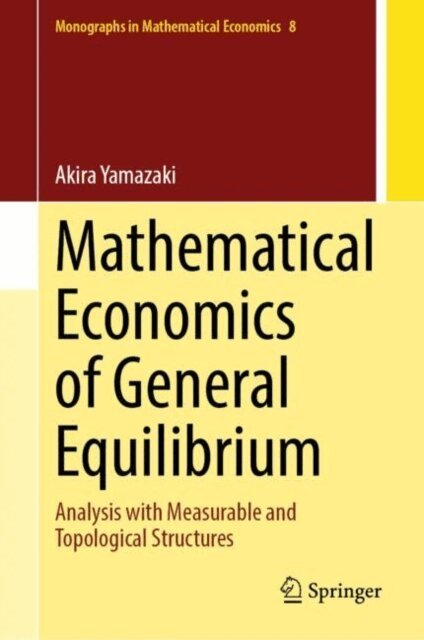
Mathematical Economics of General Equilibrium
Analysis with Measurable and Topological Structures
Inbunden, Engelska, 2025
906 kr
Skickas inom 7-10 vardagar
This book presents a rigorous formulation of the general equilibrium model in economies with topological and measurable mathematical structures. It aims to provide basic tools and analytical methods for advanced graduate students and researchers interested in microeconomic theory and game theory. It is based on lecture notes distributed among advanced graduate students in the advanced mathematical economics course at the Ph.D. level. The book presents a unified treatment of the general equilibrium analysis of economies with perfectly competitive markets based on the Walrasian model. It is divided into Part I and Part II. The mathematical analysis of general equilibrium in perfectly competitive economies begins in Part II. As a mathematical preparation for Part II for most economics students, Part I collects some basic mathematical concepts and facts that are later needed and used in the theoretical economic analysis. Some readers may wish to start the book from Part II and refer back to Part I whenever it is necessary to review mathematical concepts and related well-known mathematical results referred to in the text.The presentation of theoretical economic analysis of general equilibrium theory in Part II is organized chapter by chapter: Basic Concepts of Equilibrium Analysis, Mathematical Structure on the Space of Economic Agents’ Characteristics, Individual Demands, Economies with a Measure Space of Consumers, Walrasian Equilibria of Economies, Production Economies, and Edgeworth Equilibria as the Core of Economies. The mathematical analysis in this book uses topological and measurable structures that are essentially built into the model to provide an appropriate means of expressing the characteristics of economic agents that form a basic part of economies along with commodities in market transactions and market prices for valuation in markets.