Alain Rapaport – författare
Visar alla böcker från författaren Alain Rapaport. Handla med fri frakt och snabb leverans.
8 produkter
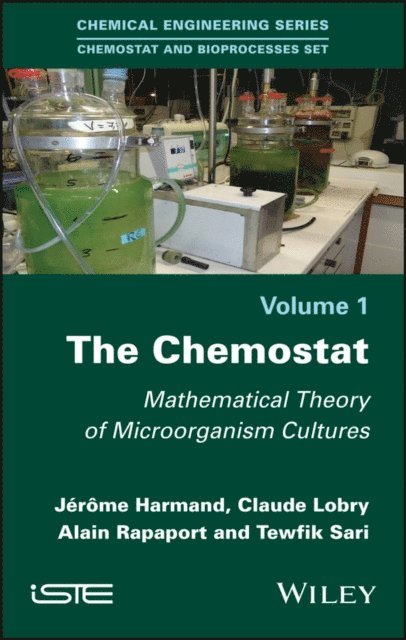
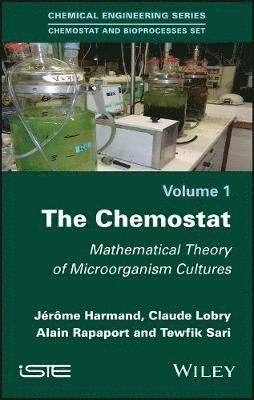
Chemostat
Mathematical Theory of Microorganism Cultures
Av Tewfik Sari, Alain Rapaport m. fl.
E-bok, 2017
2282 kr
Lägg i varukorg
Invented by J. Monod, and independently by A. Novick and L. Szilard, in 1950, the chemostat is both a micro-organism culturing device and an abstracted ecosystem managed by a controlled nutrient flow. This book studies mathematical models of single species growth as well as competition models of …
Chemostat
Mathematical Theory of Microorganism Cultures
Av Tewfik Sari, Alain Rapaport m. fl.
E-bok, 2017
2332 kr
Lägg i varukorg
Invented by J. Monod, and independently by A. Novick and L. Szilard, in 1950, the chemostat is both a micro-organism culturing device and an abstracted ecosystem managed by a controlled nutrient flow. This book studies mathematical models of single species growth as well as competition models of …
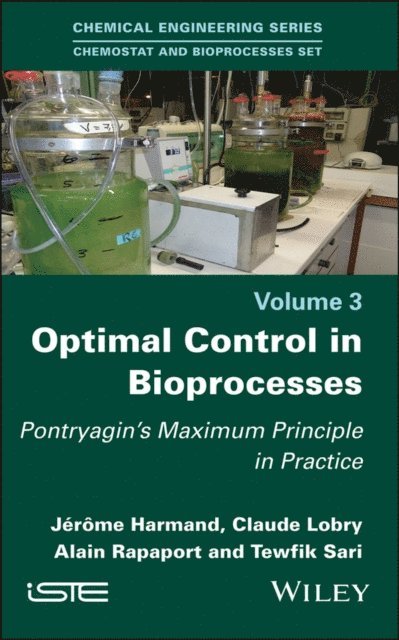
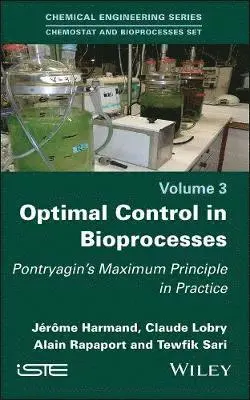
Optimal Control in Bioprocesses
Pontryagin''s Maximum Principle in Practice
Av Tewfik Sari, Alain Rapaport m. fl.
E-bok, 2019
2332 kr
Lägg i varukorg
Optimal control is a branch of applied mathematics that engineers need in order to optimize the operation of systems and production processes. Its application to concrete examples is often considered to be difficult because it requires a large investment to master its subtleties. The purpose of …
Optimal Control in Bioprocesses
Pontryagin''s Maximum Principle in Practice
Av Tewfik Sari, Alain Rapaport m. fl.
E-bok, 2019
2332 kr
Lägg i varukorg
Optimal control is a branch of applied mathematics that engineers need in order to optimize the operation of systems and production processes. Its application to concrete examples is often considered to be difficult because it requires a large investment to master its subtleties. The purpose of …
Chemostat
Mathematical Theory of Microorganism Cultures
Av Jérôme Harmand, Claude Lobry m. fl.
Inbunden, 2017
1889 kr
Lägg i varukorg
Invented by J. Monod, and independently by A. Novick and L. Szilard, in 1950, the chemostat is both a micro-organism culturing device and an abstracted ecosystem managed by a controlled nutrient flow. This book studies mathematical models of single species growth as well as competition models of …
Optimal Control in Bioprocesses
Pontryagin's Maximum Principle in Practice
Av Jérôme Harmand, Claude Lobry m. fl.
Inbunden, 2019
1889 kr
Lägg i varukorg
Optimal control is a branch of applied mathematics that engineers need in order to optimize the operation of systems and production processes. Its application to concrete examples is often considered to be difficult because it requires a large investment to master its subtleties. The purpose of …
Identifiability and Observability in Epidemiological Models
A Primer
Av Nik Cunniffe, Frédéric Hamelin m. fl.
Häftad, 2024
569 kr
Lägg i varukorg
This book introduces the concepts of identifiability and observability in mathematical epidemiology, as well as those of observers’ constructions. It first exposes and illustrates on several examples the mathematical definitions and properties of observability and identifiability. A chapter is …
Identifiability and Observability in Epidemiological Models
A Primer
Av Gauthier Sallet, Alain Rapaport m. fl.
E-bok, 2024
657 kr
Lägg i varukorg
This book introduces the concepts of identifiability and observability in mathematical epidemiology, as well as those of observers’ constructions. It first exposes and illustrates on several examples the mathematical definitions and properties of observability and identifiability. A chapter is …