• Fri frakt över 249 kr
  • •
  • Snabba leveranser
  • •
  • Billiga böcker
Kundservice

Du är på sajten för privatpersoner.

Företag, bibliotek eller offentlig verksamhet?

Du handlar på classic.bokus.com, där alla dina funktioner finns intakta.
Till classic.bokus.com
Bokus logotyp. Gå till startsidan.
  • Erbjudanden
  • Nyheter
  • Student
  • Topplistor
  • Barn & ungdom
  • Bokus Play
  • E-böcker
  • Pocketböcker
  • Spel & pussel

10% rabatt på allt med kod NYSTART10 →

Sidfot

Mina sidor

    Hjälp

    • Kundservice
    • Vanliga frågor och svar
    • Frakt och leverans
    • Retur vid ångerrätt
    • Reklamera vara
    • Betalning
    • Köpvillkor
    • Allmänna villkor
    • Information om webbplatsens tillgänglighet

    Om Bokus

    • Om oss
    • Pressrum
    • För studenter
    • För företag
    • För bibliotek och offentlig verksamhet
    • För leverantörer
    • Hållbarhet

    Populärt

    • Aktuella erbjudanden
    • Presentkort
    • Studentlitteratur
    • Nya böcker
    • Topplistor
    • Signerade böcker
    • Engelska böcker

    Inspiration

    • Boktips
    • BookTok
    • Populära bokserier
    • Barnbokskaraktärer
    • Populära författare
    Logotyp för Bokus
    Följ oss på Facebook (extern länk)Följ oss på Instagram (extern länk)Följ oss på YouTube (extern länk)Följ oss på TikTok (extern länk)
    bokus @ CookiesAnpassa cookiesIntegritetspolicyKöpvillkor
    Till Citymail hemsida (extern länk)Till Budbee hemsida (extern länk)Till Postnord hemsida (extern länk)Till Schenker hemsida (extern länk)Till Early Bird hemsida (extern länk)Till Walleys hemsida (extern länk)
    1. Naturvetenskap och teknik
    2. Teknik och industri
    3. Biokemisk teknik

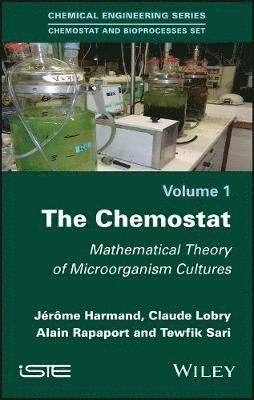
    Chemostat

    Mathematical Theory of Microorganism Cultures

    AvJérôme Harmand,Claude Lobry

    Inbunden, Engelska, 2017

    1 800 kr

    Beställningsvara. Skickas inom 5-8 vardagar. Fri frakt över 249 kr.

    Beskrivning

    Invented by J. Monod, and independently by A. Novick and L. Szilard, in 1950, the chemostat is both a micro-organism culturing device and an abstracted ecosystem managed by a controlled nutrient flow. This book studies mathematical models of single species growth as well as competition models of multiple species by integrating recent work in theoretical ecology and population dynamics. Through a modeling approach, the hypotheses and conclusions drawn from the main mathematical results are analyzed and interpreted from a critical perspective. A large emphasis is placed on numerical simulations of which prudent use is advocated.The Chemostat is aimed at readers possessing degree-level mathematical knowledge and includes a detailed appendix of differential equations relating to specific notions and results used throughout this book.

    Produktinformation

    • Utgivningsdatum:2017-07-14
    • Mått:163 x 236 x 18 mm
    • Vikt:499 g
    • Format:Inbunden
    • Språk:Engelska
    • Antal sidor:240
    • Förlag:ISTE Ltd and John Wiley & Sons Inc
    • ISBN:9781786300430

    Utforska kategorier

    • Biokemisk teknik inom Naturvetenskap och teknik
    • Biologi inom Naturvetenskap och teknik

    Mer om författaren

    Jérôme Harmand is a researcher at the LBE laboratory of INRA in Narbonne, France.Claude Lobry is a former Professor of both the University of Bordeaux and University of Nice in France.Alain Rapaport is a researcher at the Applied Mathematics and Informatics Department of INRA in Montpellier, France.Tewfik Sari is Research Director at the National Research Institute of Science and Technology for Environment and Agriculture (IRSTEA) in Montpellier, France.

    Innehållsförteckning

    • Introduction ixChapter 1 Bioreactors 11.1. Introduction 11.1.1. What is a bioreactor? 11.1.2. Classification of biological reactors 21.1.3. A brief reminder of microbiology 31.2. Modeling of biological reactions 41.2.1. Regarding the state variables of the model 41.2.2. Biological processes and reaction scheme 81.2.3. Chemostat equations 111.2.4. Biological kinetics 141.2.5. The benefits of the chemostat 161.3. Toward “a little more” realism 171.3.1. Extensions 171.3.2. pH and physicochemical equilibria 201.3.3. Spatialization 221.3.4. Recent developments 23Chapter 2 The Growth of a Single Species 252.1. Mathematical properties of the “minimal model” 262.1.1. General properties 262.1.2. The function μ is monotonic and bounded 292.1.3. The function μ is not monotonic 352.1.4. Interpretations 382.2. Simulations 402.2.1. Simulations in the phase space 412.2.2. Transients 432.3. Some extensions of the minimal model 452.3.1. Presence of biomass in the feed 462.3.2. Different dilutions 492.3.3. Density-dependent growth rate and characteristic at equilibrium 522.3.4. Yield depending on the density of the substrate 582.4. Bibliographic notes 61Chapter 3 Competitive Exclusion 633.1. The case of monotonic growth functions 643.1.1. Steady states 643.1.2. Possible steady-states 653.1.3. Local stability of washout steady-state 663.2. Competitive exclusion at steady-state 673.2.1. Statement 683.2.2. Species at steady-state according to the dilution rate 683.2.3. Dynamics of proportions between species 693.2.4. Conclusion 733.3. Global stability 733.3.1. A “graphical” proof for two species 753.3.2. A proof for the general case 763.4. The case of non-monotonic growth functions 803.4.1. Growth set 813.4.2. Study of steady-states 823.4.3. Competitive exclusion 823.4.4. Competition between two species 833.4.5. Illustration and effect of a “bio-augmentation” 843.5. Bibliographic notes 88Chapter 4 Competition: the Density-Dependent Model 934.1. Chapter orientation 934.2. Two-species competition 964.2.1. Behavior of an isolated species 974.2.2. Steady-state of two species in interaction 984.2.3. Steady-state stability 1024.2.4. Simulations 1034.3. N-species competition: exclusive intraspecific competition 1044.3.1. Characteristic at equilibrium and coexistence 1064.3.2. Simulations 1104.4. N-species competition: the general case 1114.4.1. A particular density-dependent model 1124.4.2. Exclusive intraspecific competition 1134.4.3. Dominant intraspecific competition 1134.4.4. Undifferentiated competition 1144.4.5. Dominant intraspecific competition 1174.5. Bibliographic notes 123Chapter 5 More Complex Models 1255.1. Introduction 1255.2. Models with aggregated biomass 1265.2.1. Planktonic biomass versus aggregate biomass 1275.2.2. Coexistence between the two forms 1285.2.3. Coexistence steady-state 1295.2.4. Stability study 1335.2.5. The case of fast attachments/detachments 1345.2.6. Consideration of several species 1385.3. The “predator-prey” relationship in the chemostat 1395.3.1. Introduction 1395.3.2. The substrate-bacteria-predator “chain” 1405.3.3. The substrate-bacteria-predators trophic network 1435.3.4. Comparison to experimental data 1465.4. Bibliographic notes 148Appendices 151Appendix 1 Differential Equations 153Appendix 2 Indications for the Exercises 195Bibliography 217Index 225