Alan B. Bond - Böcker
Visar alla böcker från författaren Alan B. Bond. Handla med fri frakt och snabb leverans.
3 produkter
3 produkter
344 kr
Skickas
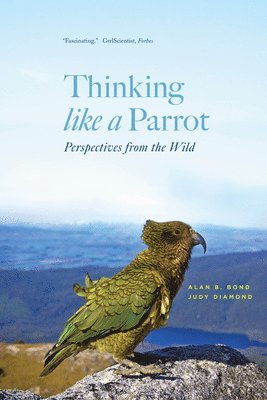
From two experts on wild parrot cognition, a close look at the intelligence, social behavior, and conservation of these widely threatened birds.People form enduring emotional bonds with other animal species, such as dogs, cats, and horses. For the most part, these are domesticated animals, with one notable exception: many people form close and supportive relationships with parrots, even though these amusing and curious birds remain thoroughly wild creatures. What enables this unique group of animals to form social bonds with people, and what does this mean for their survival?In Thinking like a Parrot, Alan B. Bond and Judy Diamond look beyond much of the standard work on captive parrots to the mischievous, inquisitive, and astonishingly vocal parrots of the wild. Focusing on the psychology and ecology of wild parrots, Bond and Diamond document their distinctive social behavior, sophisticated cognition, and extraordinary vocal abilities. Also included are short vignettes—field notes on the natural history and behavior of both rare and widely distributed species, from the neotropical crimson-fronted parakeet to New Zealand’s flightless, ground-dwelling kākāpō. This composite approach makes clear that the behavior of captive parrots is grounded in the birds’ wild ecology and evolution, revealing that parrots’ ability to bond with people is an evolutionary accident, a by-product of the intense sociality and flexible behavior that characterize their lives.Despite their adaptability and intelligence, however, nearly all large parrot species are rare, threatened, or endangered. To successfully manage and restore these wild populations, Bond and Diamond argue, we must develop a fuller understanding of their biology and the complex set of ecological and behavioral traits that has led to their vulnerability. Spanning the global distribution of parrot species, Thinking like a Parrot is rich with surprising insights into parrot intelligence, flexibility, and—even in the face of threats—resilience.
463 kr
Skickas inom 7-10 vardagar
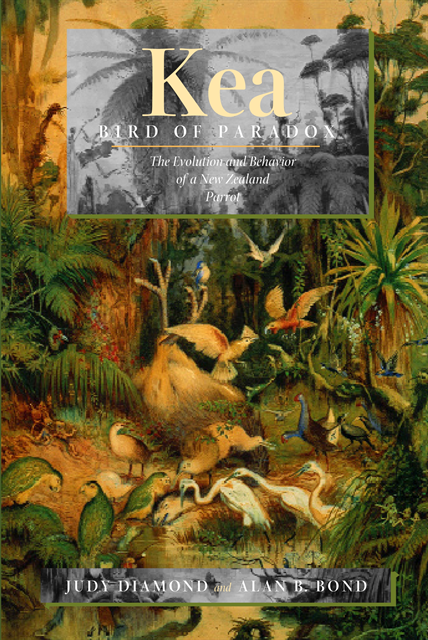
The kea, a crow-sized parrot that lives in the rugged mountains of New Zealand, is considered by some a playful comic and by others a vicious killer. Its true character is a mystery that biologists have debated for more than a century. Judy Diamond and Alan Bond have written a comprehensive account of the kea's contradictory nature, and their conclusions cast new light on the origins of behavioral flexibility and the problem of species survival in human environments everywhere. New Zealand's geological remoteness has made the country home to a bizarre assemblage of plants and animals that are wholly unlike anything found elsewhere. Keas are native only to the South Island, breeding high in the rigorous, unforgiving environment of the Southern Alps. Bold, curious, and ingeniously destructive, keas have a complex social system that includes extensive play behavior. Like coyotes, crows, and humans, keas are 'open-program' animals with an unusual ability to learn and to create new solutions to whatever problems they encounter. Diamond and Bond present the kea's story from historical and contemporary perspectives and include observations from their years of field work.A comparison of the kea's behavior and ecology with that of its closest relative, the kaka of New Zealand's lowland rain forests, yields insights into the origins of the kea's extraordinary adaptability. The authors conclude that the kea's high level of sociality is a key factor in the flexible lifestyle that probably evolved in response to the alpine habitat's unreliable food resources and has allowed the bird to survive the extermination of much of its original ecosystem. But adaptability has its limits, as the authors make clear when describing present-day interactions between keas and humans and the attempts to achieve a peaceful coexistence.
258 kr
Skickas inom 7-10 vardagar
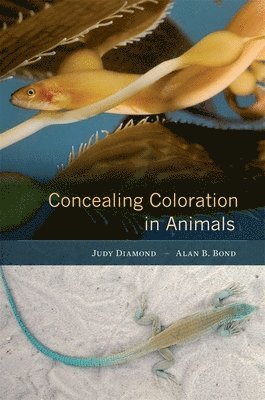
The biological functions of coloration in animals are sometimes surprising. Color can attract mates, intimidate enemies, and distract predators. But color patterns can also conceal animals from detection. Concealing coloration is unusual because it is an adaptation not only to the visual features of the environment but also to the perceptual and cognitive capabilities of other organisms. Judy Diamond and Alan Bond bring to light the many factors at work in the evolution of concealing coloration.Animals that resemble twigs, tree bark, stones, and seaweed may appear to be perfect imitations, but no concealment strategy is without flaws. Amid the clutter of the natural world, predators search for minute, telltale clues that will reveal the identity of their prey. Predators have remarkable abilities to learn to discriminate the fake from the real. But prey have their own range of defensive tactics, evolving multiple appearances or the ability to change color at will. Drawing on modern experimental evidence of the functional significance of animal color strategies, Diamond and Bond offer striking illustrations of how the evolution of features in one organism can be driven by the psychology of others.Concealing Coloration in Animals takes readers on a scientific adventure that explores creatures inside mats of floating seaweed, mice and lizards on desert rocks and sand, and rare parrots in the rainforest of New Zealand. Color photographs extensively document the mind-boggling array of deceptive strategies animals use to blend in, mislead, or vanish from view.