Alan Donagan - Böcker
Visar alla böcker från författaren Alan Donagan. Handla med fri frakt och snabb leverans.
7 produkter
7 produkter
1 975 kr
Skickas inom 5-8 vardagar
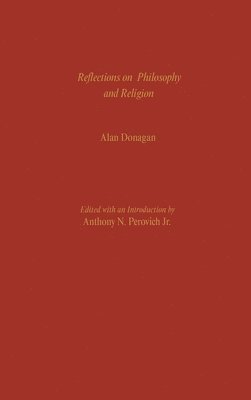
This book contains the collected papers of Alan Donagan on topics in the philosophy of religion. Donagan was respected as a leading figure in American moral philosophy. His untimely death in 1991 prevented him from collecting his philosophical reflections on religion, particularly Christianity, and its relation to ethics and other concerns. This collection, therefore, constitutes the fullest expression of Donagan's thought on Christianity and ethics, in which it is possible to discern the outlines of a coherent, overarching theory. Editor Anthony Perovich has supplied a useful introduction, which brings Donagan's work into focus and brings out the unifying themes in the essays.

274 kr
Skickas inom 7-10 vardagar
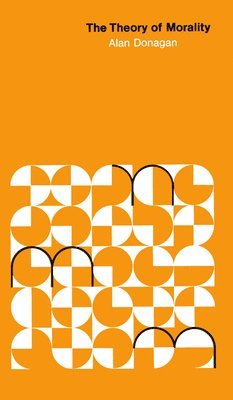
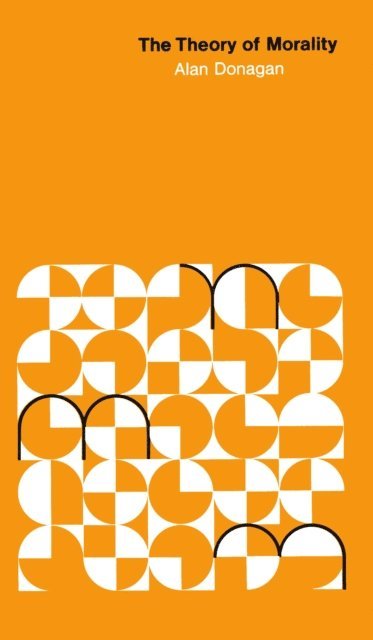
"Let us . . . nominate this the most important theoretical work on ethical or moral theory since John Rawls's Theory of Justice. If you have philosophical inclinations and want a good workout, this conscientious scrutiny of moral assumptions and expressions will be most rewarding. Donagan explores ways of acting in the Hebrew-Christian context, examines them in the light of natural law and rational theories, and proposes that formal patterns for conduct can emerge. All this is tightly reasoned, the argument is packed, but the language is clear."—Christian Century"The man value of this book seems to me to be that it shows the force of the Hebrew-Christian moral tradition in the hands of a creative philosopher. Throughout the book, one cannot but feel that a serious philosopher is trying to come to terms with his religious-moral background and to defend it against the prevailing secular utilitarian position which seems to dominate academic philosophy."—Bernard Gert, Journal of Medicine and Philosophy
1 175 kr
Skickas inom 7-10 vardagar
Alan Donagan is known for his theories on the history of philosophy and the nature of morality. The two volumes of his "Philosophical Papers" collect 28 of Donagan's most important and best-known essays on historical understanding and ethics from 1957 to 1991, including two never-before-published papers on the history of philosophy as a discipline, and on Ryle and Wittgenstein's nature of philosophy. Volume 1 includes papers on Spinoza, Descartes, Bradley, Collingwood, Russell and Moore, and Popper. They are linked by Donagan's commitment to the central importance of history for philosophy and his interest in problems of historical understanding. Volume 2 addresses issues in the philosophy of action and moral theory. With papers on Kant, von Wright, Sellars, and Chisholm, this volume also covers a range of questions in applied ethics - from the morality of Truman's decision to drop atomic bombs on Hiroshima and Nagasaki to ethical questions in medicine and law. Together, these books provide an overview of the major philosophical achievements of an original and sensitive thinker.
513 kr
Skickas inom 3-6 vardagar
372 kr
Skickas inom 3-6 vardagar
1 901 kr
Skickas inom 10-15 vardagar
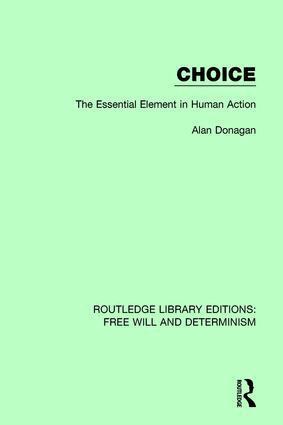
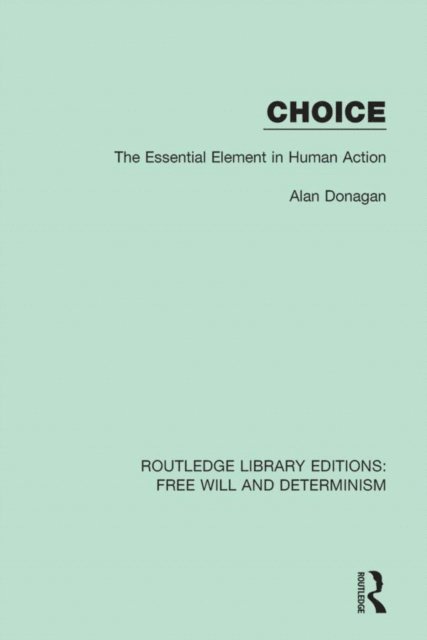
This book, first published in 1987, investigates what distinguishes the part of human behaviour that is action (praxis) from the part that is not. The distinction was clearly drawn by Socrates, and developed by Aristotle and the medievals, but key elements of their work became obscured in modern philosophy, and were not fully recovered when, under Wittgenstein’s influence, the theory of action was revived in analytical philosophy. This study aims to recover those elements, and to analyse them in terms of a defensible semantics on Fregean lines. Among its conclusions: that actions are bodily or mental events that are causally explained by their doers’ propositional attitudes, especially by their choices or fully specific intentions; that choice cannot be reduced to desire and belief, and hence that the traditional concept of will as intellectual appetite must be revived.
494 kr
Skickas inom 10-15 vardagar
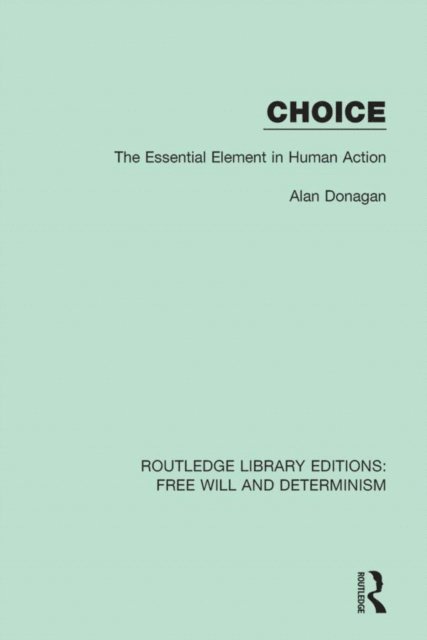
This book, first published in 1987, investigates what distinguishes the part of human behaviour that is action (praxis) from the part that is not. The distinction was clearly drawn by Socrates, and developed by Aristotle and the medievals, but key elements of their work became obscured in modern philosophy, and were not fully recovered when, under Wittgenstein’s influence, the theory of action was revived in analytical philosophy. This study aims to recover those elements, and to analyse them in terms of a defensible semantics on Fregean lines. Among its conclusions: that actions are bodily or mental events that are causally explained by their doers’ propositional attitudes, especially by their choices or fully specific intentions; that choice cannot be reduced to desire and belief, and hence that the traditional concept of will as intellectual appetite must be revived.