Alan Filreis - Böcker
Visar alla böcker från författaren Alan Filreis. Handla med fri frakt och snabb leverans.
4 produkter
4 produkter
Del 79 - Cambridge Studies in American Literature and Culture
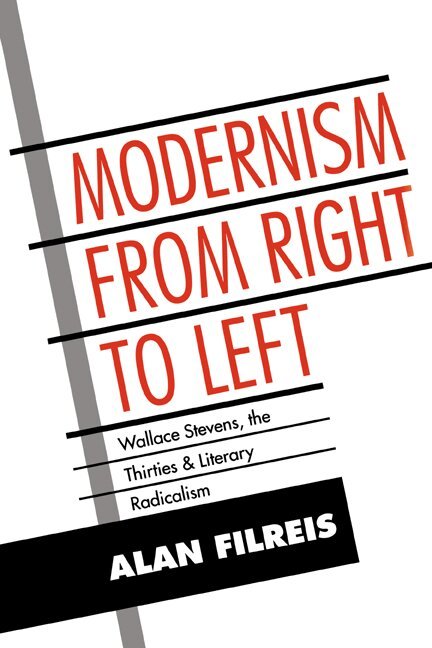
Modernism from Right to Left
Wallace Stevens, the Thirties, & Literary Radicalism
Häftad, Engelska, 2005
493 kr
Skickas inom 7-10 vardagar
Part biography and part literary history, this book is about the experience of the American modernist poet Wallace Stevens in the 1930s. Stevens is generally thought to have antagonised, even engaged, the young literary radicals of the period. Using the archives of many little-known political poets, Alan Filreis offers a detailed description of these battles, in which the very texture of the various positions taken up in the movement between left and right becomes available to us in the language of the participants. Filreis demonstrates that the radicals knew and appreciated modernism more than has been generally recognised, and that Stevens's poetry - as well as that of other then-eminent modernists was significantly influenced by political poets and critics on the left. This book is a contribution to the cultural history of the American 1930s as well as a novel approach to an oft-studied figure.
624 kr
Skickas inom 7-10 vardagar
The work of Wallace Stevens has been read most widely as poetry concerned with poetry, and not with the world in which it was created; deemed utterly singular, it seems to resist being read as the record of a life and times. In this critical biography Alan Filreis presents a detailed challenge to this exceptionalist view as he traces two major periods of Stevens's career from 1939 to 1955, the war years and the postwar years. Portraying Stevens as someone whose alternation between cultural comprehension and ignorance was itself characteristically American, Filreis examines the poet's impulse to disguise and compress the very fact of his debt to the actual world. By actual world Stevens meant historical conditions, often in order to impugn his own interest in such externalities as the last resort of a man whose famous interiority made him feel desperately irrelevant. In light of events ranging from the U.S. entry into World War II to the Cold War, Filreis shows how Stevens was driven to make a "close approach to reality" in an effort to reconcile his poetic language with a cultural language."Wallace Stevens and the Actual World is not only an impressive feat of historical recovery and analysis, but also a pleasure to read. It will be useful to anyone interested in the relationship between American politics and literature during World War II and the Cold War."--Milton J. Bates, Marquette University Originally published in 1991. The Princeton Legacy Library uses the latest print-on-demand technology to again make available previously out-of-print books from the distinguished backlist of Princeton University Press. These editions preserve the original texts of these important books while presenting them in durable paperback and hardcover editions. The goal of the Princeton Legacy Library is to vastly increase access to the rich scholarly heritage found in the thousands of books published by Princeton University Press since its founding in 1905.
2 952 kr
Skickas inom 3-6 vardagar
The work of Wallace Stevens has been read most widely as poetry concerned with poetry, and not with the world in which it was created; deemed utterly singular, it seems to resist being read as the record of a life and times. In this critical biography Alan Filreis presents a detailed challenge to this exceptionalist view as he traces two major periods of Stevens's career from 1939 to 1955, the war years and the postwar years. Portraying Stevens as someone whose alternation between cultural comprehension and ignorance was itself characteristically American, Filreis examines the poet's impulse to disguise and compress the very fact of his debt to the actual world. By actual world Stevens meant historical conditions, often in order to impugn his own interest in such externalities as the last resort of a man whose famous interiority made him feel desperately irrelevant. In light of events ranging from the U.S. entry into World War II to the Cold War, Filreis shows how Stevens was driven to make a "close approach to reality" in an effort to reconcile his poetic language with a cultural language."Wallace Stevens and the Actual World is not only an impressive feat of historical recovery and analysis, but also a pleasure to read. It will be useful to anyone interested in the relationship between American politics and literature during World War II and the Cold War."--Milton J. Bates, Marquette University Originally published in 1991. The Princeton Legacy Library uses the latest print-on-demand technology to again make available previously out-of-print books from the distinguished backlist of Princeton University Press. These editions preserve the original texts of these important books while presenting them in durable paperback and hardcover editions. The goal of the Princeton Legacy Library is to vastly increase access to the rich scholarly heritage found in the thousands of books published by Princeton University Press since its founding in 1905.
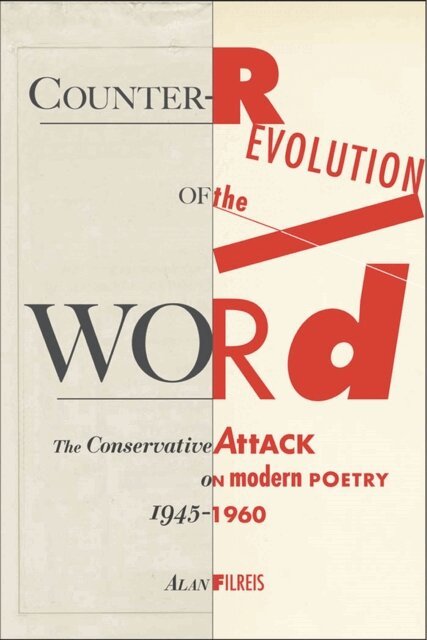
Counter-revolution of the Word
The Conservative Attack on Modern Poetry, 1945-1960
Häftad, Engelska, 2014
590 kr
Skickas inom 10-15 vardagar
During the Cold War an unlikely coalition of poets, editors, and politicians converged in an attempt to discredit--if not destroy--the American modernist avant-garde. Ideologically diverse yet willing to bespeak their hatred of modern poetry through the rhetoric of anticommunism, these ""anticommunist antimodernists,"" as Alan Filreis dubs them, joined associations such as the League for Sanity in Poetry to decry the modernist ""conspiracy"" against form and language. In Counter-revolution of the Word Filreis narrates the story of this movement and assesses its effect on American poetry and poetics.Although the antimodernists expressed their disapproval through ideological language, their hatred of experimental poetry was ultimately not political but aesthetic, Filreis argues. By analyzing correspondence, decoding pseudonyms, drawing new connections through the archives, and conducting interviews, Filreis shows that an informal network of antimodernists was effective in suppressing or distorting the postwar careers of many poets whose work had appeared regularly in the 1930s. Insofar as modernism had consorted with radicalism in the Red Decade, antimodernists in the 1950s worked to sever those connections, fantasized a formal and unpolitical pre-Depression High Modern moment, and assiduously sought to de-radicalize the remnant avant-garde. Filreis's analysis provides new insight into why experimental poetry has aroused such fear and alarm among American conservatives.