Alan M. Olson - Böcker
Visar alla böcker från författaren Alan M. Olson. Handla med fri frakt och snabb leverans.
10 produkter
10 produkter
400 kr
Skickas inom 7-10 vardagar
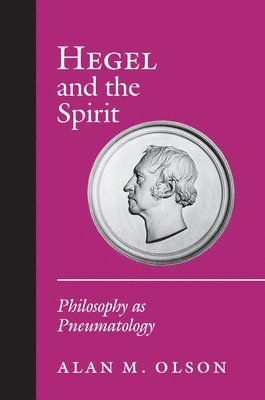
Hegel and the Spirit explores the meaning of Hegel's grand philosophical category, the category of Geist, by way of what Alan Olson terms a pneumatological thesis. Hegel's philosophy of spirit, according to Olson, is a speculative pneumatology that completes what Adolf von Harnack once called the "orphan doctrine" in Christian theology--the doctrine of the Holy Spirit. Olson argues that Hegel's development of philosophy as pneumatology originates out of a deep appreciation of Luther's dialectical understanding of Spirit and that Hegel's doctrine of Spirit is thus deeply interfused with the values of Wurtemberg Pietism. Olson further maintains that Hegel's Enzyklopdie is the post-Enlightenment philosophical equivalent of a Trinitatslehre and that his Rechtsphilosophie is an ecclesiology. Thus Hegel and the Spirit demonstrates the truth of Karl Barth's observation that Hegel is the potential Aquinas of Protestantism.Exploring Hegel's philosophy of spirit in historical, cultural, and personal religious context, the book identifies Hegel's relationship with Holderlin and his response to Holderlin's madness as key elements in the philosopher's religious and philosophical development, especially with respect to the meaning of transcendence and dialectic.
1 703 kr
Skickas inom 10-15 vardagar
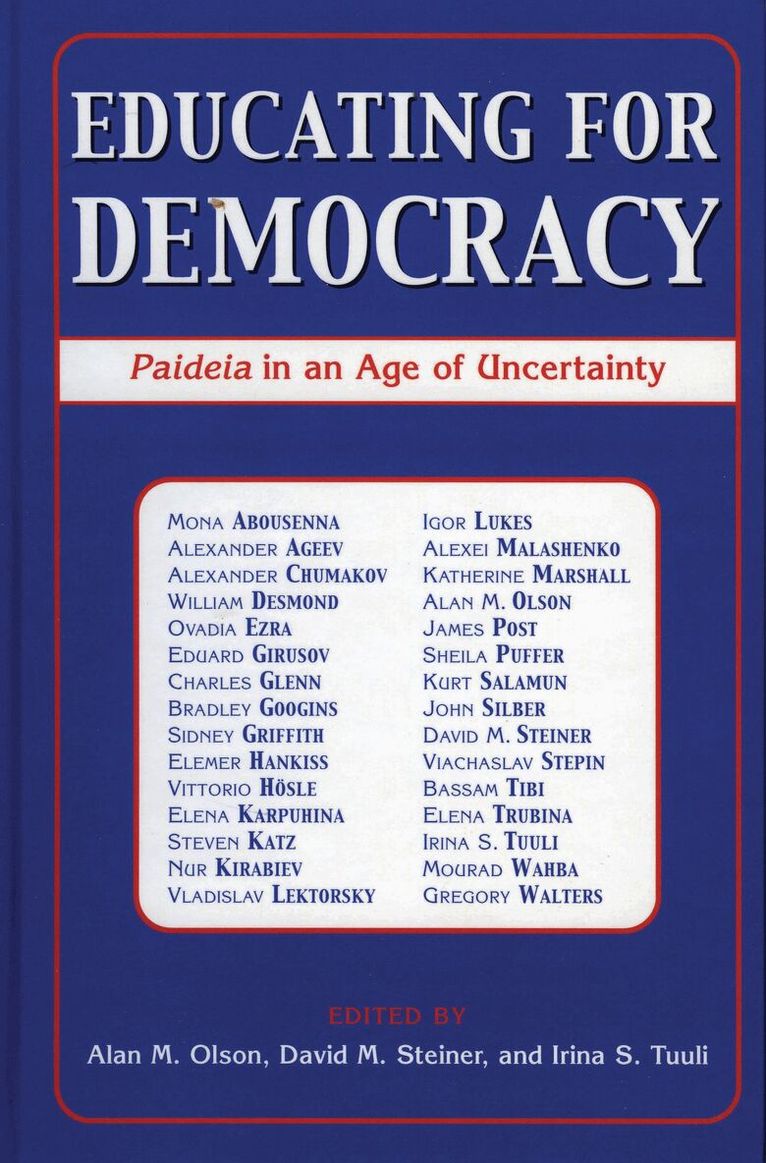
The central conflicts of the world today are closely related to cultural, traditional, and religious differences between nations. As we move to a globalized world, these differences often become magnified, entrenched, and the cause of bloody conflict. Growing out of a conference of distinguished scholars from the MiddleEast, Europe, and the United States, this volume is a singular contribution to mutual understanding and cooperative efforts on behalf of peace. The term paideia, drawn from Greek philosophy, has to do with responsible education for citizenship as a necessary precondition for effective democracy. The problems discussed here are crucial, but not simple. How can we find shared ethical principles on which to build international consensus? How can religious tolerance make inroads in societies accustomed to restrictive fundamentalism? What might bring about de-dogmatization of education in the Middle East as a necessary condition for free and rational inquiry and the broader vistas required by democracy? All of these issues highlight the underlying question, 'What is education really for?' Finally, the volume confronts the promises and perils of economic globalization. Noting that one third of the world's population lives in abject poverty, business has become a battlefield where ethics and trust are clearly at stake.
867 kr
Skickas inom 5-8 vardagar
The central conflicts of the world today are closely related to cultural, traditional, and religious differences between nations. As we move to a globalized world, these differences often become magnified, entrenched, and the cause of bloody conflict. Growing out of a conference of distinguished scholars from the MiddleEast, Europe, and the United States, this volume is a singular contribution to mutual understanding and cooperative efforts on behalf of peace. The term paideia, drawn from Greek philosophy, has to do with responsible education for citizenship as a necessary precondition for effective democracy. The problems discussed here are crucial, but not simple. How can we find shared ethical principles on which to build international consensus? How can religious tolerance make inroads in societies accustomed to restrictive fundamentalism? What might bring about de-dogmatization of education in the Middle East as a necessary condition for free and rational inquiry and the broader vistas required by democracy? All of these issues highlight the underlying question, 'What is education really for?' Finally, the volume confronts the promises and perils of economic globalization. Noting that one third of the world's population lives in abject poverty, business has become a battlefield where ethics and trust are clearly at stake.
370 kr
Tillfälligt slut
This book focuses on the most powerful agency of value formation in our time - the video image as purveyed through television and mass media. Special attention is given to the impact of television on education and the challenges of instructing a generation of children who have never know a time BT, that is, "before television."Both the negative and the positive implications and consequences of video technology are discussed in the book by a range of experts in the humanities and social sciences. Among the prominent issues and questions: How does television function as an agent of value formation? What is the impact of conventional, commercial format on values and critical judgment? What is a video text and how is it different from a convention text? How do we develop the instructional tools to teach people to be critical viewers? What is television's place in the arts and what is a video artist? What happens to consciousness after viewing 30,000 or more hours of television by the time an individual graduates from high school? Is the growing problem of aliteracy directly attributable to television?The social and moral implications of television during its "second 50 years" will be profound and far-reaching. The authors of Video Icons and Values provide valuable clues as to what these implications are, will be, and what can be done about them.
250 kr
Skickas inom 5-8 vardagar
311 kr
Skickas inom 5-8 vardagar
359 kr
Skickas inom 5-8 vardagar
297 kr
Skickas inom 5-8 vardagar
1 064 kr
Skickas inom 10-15 vardagar
Karl Jaspers, who died in 1969, had a profound impact on 20th-century theology and philosophy. His central thesis called for, among other things, a de-centering of philosophy from its Eurocentric roots and a renewal of its dialogue with other traditions, especially Asian ones. This collection of essays includes unpublished work by Jaspers himself as well as testimonies to his life and career by colleagues, associates, and translators, some of who knew Jaspers personally. Readers will also find commentary and interpretation by researchers who have explored Jaspers’ work for decades, and a biographical account of Jaspers’ student Leonard Ehrlich, who handled much of Jaspers’ English translation. The book interrogates Jaspers’ conceptions of ‘philosophical faith’, his philosophy of communication, and the prospects for world philosophy in the future. Focusing on philosophical faith, it assesses Jaspers’ interpretations of key philosophers such as Kant, Hegel, Schelling, Kierkegaard, Nietzsche, and Rosenzweig, as well as examining his personal relationships with Bultmann and Heidegger. Contributors also look at Jaspers’ philosophies of religion and history, his hypothesis of the ‘axial age’ (Achsenzeit), and his contributions to metaphysics, periechontology, and economics. Finally, chapters cover Jaspers’ philosophy of communication and world history. The latter are informed by a burgeoning interest in Kantian ‘Freiheitphilosophie’ that influenced Jaspers, as well as concerns over the future of humanity. These concerns in part account for Jaspers’ growing popularity in the Middle East, Eastern Europe, Central/South America, and Asia. Also included are lucid clarifications of the difference between religious and philosophical faith, and the relevance ofcertainty, trust, and communication for a future of mankind. Trained as a psychiatrist, Jaspers practiced this profession before becoming a philosopher and thus had a keen insight into the workings of the human mind even as he challenged the philosophical establishment of his time. It is perhaps this depth to his background that adds to the contemporary relevance of his work.
1 064 kr
Skickas inom 10-15 vardagar
Karl Jaspers, who died in 1969, had a profound impact on 20th-century theology and philosophy. His central thesis called for, among other things, a de-centering of philosophy from its Eurocentric roots and a renewal of its dialogue with other traditions, especially Asian ones. This collection of essays includes unpublished work by Jaspers himself as well as testimonies to his life and career by colleagues, associates, and translators, some of who knew Jaspers personally. Readers will also find commentary and interpretation by researchers who have explored Jaspers’ work for decades, and a biographical account of Jaspers’ student Leonard Ehrlich, who handled much of Jaspers’ English translation. The book interrogates Jaspers’ conceptions of ‘philosophical faith’, his philosophy of communication, and the prospects for world philosophy in the future. Focusing on philosophical faith, it assesses Jaspers’ interpretations of key philosophers such as Kant, Hegel, Schelling, Kierkegaard, Nietzsche, and Rosenzweig, as well as examining his personal relationships with Bultmann and Heidegger. Contributors also look at Jaspers’ philosophies of religion and history, his hypothesis of the ‘axial age’ (Achsenzeit), and his contributions to metaphysics, periechontology, and economics. Finally, chapters cover Jaspers’ philosophy of communication and world history. The latter are informed by a burgeoning interest in Kantian ‘Freiheitphilosophie’ that influenced Jaspers, as well as concerns over the future of humanity. These concerns in part account for Jaspers’ growing popularity in the Middle East, Eastern Europe, Central/South America, and Asia. Also included are lucid clarifications of the difference between religious and philosophical faith, and the relevance ofcertainty, trust, and communication for a future of mankind. Trained as a psychiatrist, Jaspers practiced this profession before becoming a philosopher and thus had a keen insight into the workings of the human mind even as he challenged the philosophical establishment of his time. It is perhaps this depth to his background that adds to the contemporary relevance of his work.