Alejandro Foxley - Böcker
Visar alla böcker från författaren Alejandro Foxley. Handla med fri frakt och snabb leverans.
4 produkter
4 produkter
684 kr
Skickas inom 3-6 vardagar
Latin American Experiments in Neoconservative Economics explores the emergence and implementation of radical conservative economic policies in Latin America during the late 20th century, focusing on the experiments in Chile, Uruguay, and Argentina. These policies, marked by a combination of monetarist economic stabilization and long-term structural changes, were carried out under authoritarian regimes that repressed dissent and centralized political authority. The book examines how these governments sought to combat extreme inflation and economic instability by implementing drastic measures such as reducing government expenditures, privatizing industries and social services, and emphasizing free-market principles.A central theme of the book is the interplay between short-term stabilization goals and long-term structural reforms. By analyzing the Chilean "Chicago experiment" as a pivotal case, the author delves into the ideological foundations and economic performance of these policies. The book critiques the piecemeal evaluation of monetarist approaches, arguing that such methods fail to account for the broader socio-political transformations these policies entailed. By blending political economy with conventional economics, the study provides a nuanced understanding of how authoritarian governments leveraged conservative economic programs to reshape society, offering both an assessment of their economic impact and an invitation for further research into their enduring legacy.This title is part of UC Press's Voices Revived program, which commemorates University of California Press’s mission to seek out and cultivate the brightest minds and give them voice, reach, and impact. Drawing on a backlist dating to 1893, Voices Revived makes high-quality, peer-reviewed scholarship accessible once again using print-on-demand technology. This title was originally published in 1983.
1 513 kr
Skickas inom 3-6 vardagar
Latin American Experiments in Neoconservative Economics explores the emergence and implementation of radical conservative economic policies in Latin America during the late 20th century, focusing on the experiments in Chile, Uruguay, and Argentina. These policies, marked by a combination of monetarist economic stabilization and long-term structural changes, were carried out under authoritarian regimes that repressed dissent and centralized political authority. The book examines how these governments sought to combat extreme inflation and economic instability by implementing drastic measures such as reducing government expenditures, privatizing industries and social services, and emphasizing free-market principles.A central theme of the book is the interplay between short-term stabilization goals and long-term structural reforms. By analyzing the Chilean "Chicago experiment" as a pivotal case, the author delves into the ideological foundations and economic performance of these policies. The book critiques the piecemeal evaluation of monetarist approaches, arguing that such methods fail to account for the broader socio-political transformations these policies entailed. By blending political economy with conventional economics, the study provides a nuanced understanding of how authoritarian governments leveraged conservative economic programs to reshape society, offering both an assessment of their economic impact and an invitation for further research into their enduring legacy.This title is part of UC Press's Voices Revived program, which commemorates University of California Press’s mission to seek out and cultivate the brightest minds and give them voice, reach, and impact. Drawing on a backlist dating to 1893, Voices Revived makes high-quality, peer-reviewed scholarship accessible once again using print-on-demand technology. This title was originally published in 1983.
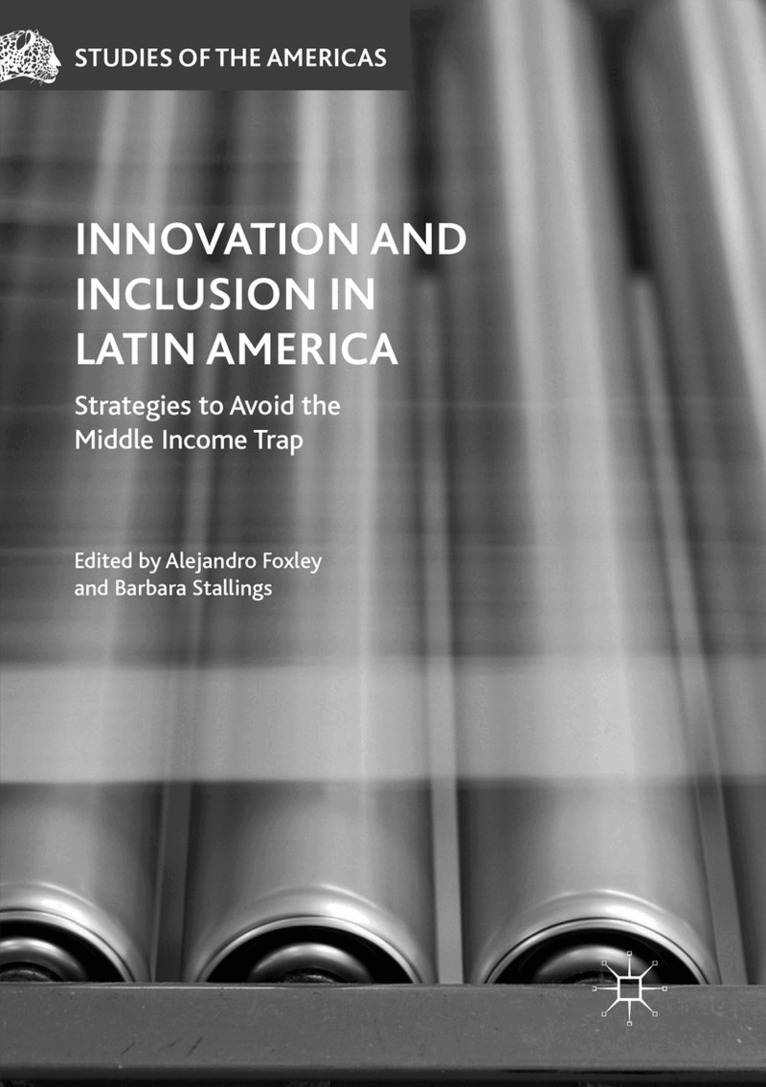
Innovation and Inclusion in Latin America
Strategies to Avoid the Middle Income Trap
Inbunden, Engelska, 2016
1 069 kr
Skickas inom 10-15 vardagar
Arguing that Latin America must face the challenges of innovation for productivity, and inclusion of the population into economic growth, this book identifies lessons from experiences in the region and in East Asia, where the 'middle income trap' has largely been avoided. It is a collaboration by American University s CLALS, and CIEPLAN in Chile.
Innovation and Inclusion in Latin America
Strategies to Avoid the Middle Income Trap
Häftad, Engelska, 2018
1 069 kr
Skickas inom 10-15 vardagar
This book argues that Latin America must confront two main challenges: greater innovation to increase productivity, and greater inclusion to incorporate more of the population into the benefits of economic growth. These two tasks are interrelated, and both require greater institutional capacity to facilitate both innovation and inclusion. Most countries in Latin America are struggling to escape what economists label “the middle income trap.” While much if not all of the region has emerged from low income status, neither growth nor productivity has increased sufficiently to enable Latin America to narrow the gap separating it from the world’s most developed economies. Although income inequality has diminished across much of the region in recent years, social vulnerability remains widespread and institutional weaknesses continue to plague efforts to achieve equitable development. This volume identifies lessons that can be learned and adapted from experiences within the region and inEast Asia, where the middle income trap has largely been avoided.This book is the result of a collaborative project undertaken by American University’s Center for Latin American & Latino Studies (CLALS) and the Corporation for Latin American Studies (CIEPLAN) in Chile, with financial support from the Inter-American Development Bank’s Office of Strategic Planning and Development Effectiveness.