Alexander Garcia Duttmann - Böcker
Visar alla böcker från författaren Alexander Garcia Duttmann. Handla med fri frakt och snabb leverans.
10 produkter
10 produkter
Gift of Language
Memory and Promise in Adorno, Benjamin.Heidegger and Rosenzweig
Häftad, Engelska, 2000
1 254 kr
Skickas inom 5-8 vardagar
This text focuses on the relevance of the proper name in the conceptions of language and history that inform the thought of Adorno, Benjamin, Heidegger and Rosenzweig. Their interest in the proper name is because it does not simply operate as a conventional linguistic sign. A specific experience of the Jewish religious tradition (Adorno, Benjamin, Rosenzweig) and a vision of poetry resulting from the reading of Hoelderlin (Heidegger) lead to the idea of an absolute singularity, it is a singularity that resists all conceptual identificaiton and the proper name expresses this singularity in language. In this analysis, history is conceived as a movement that both betrays and tends towards the absolute singularity that manifests itself in the unsayable, i.e. in the name of God, or in poetical language. questions of gesture, translation and melancholia and the moment of apparition in the work of art are comprehensible within Dr Duttmann's discussion, which should be of interest to students of language, philosophy and theology.
1 332 kr
Skickas inom 10-15 vardagar
What does it mean to oppose AIDS, to be at odds with AIDS? What kind of rupture with history does AIDS represent? How does AIDS and what is said about AIDS relate to gay identity? How does AIDS relate to thinking and acting, particularly deconstructive thinking? The author confronts these questions from a broad philosophical background that ranges from Kant, Nietzsche, Kierkegaard, and Heidegger to contemporary thought concerning gay activism and AIDS research, all brought together in an effort to find a philosophical language capable of doing justice to the singularity of lived experience in the shadow of AIDS.In examining what AIDS reveals about the conditions of existence, García Düttmann develops the idea of the "dis-unity" or "at-odds-ness" of existence, of the "non-belonging" that characterizes the marginalized, outcast, or abandoned, and exposes human existence itself. He analyzes what AIDS reveals about the character of history through two intertwined issues. First, he examines arguments bearing on the epochal significance of AIDS, the idea that AIDS reveals something uniquely characteristic of our time, hence that the epidemic marks a historical caesura. Second, he develops a theory of historical witnessing suggesting that the phenomena of historical event and bearing witness are not at all separate, but instead are co-originary, inhering in the same complex.
320 kr
Skickas inom 7-10 vardagar
What does it mean to oppose AIDS, to be at odds with AIDS? What kind of rupture with history does AIDS represent? How does AIDS and what is said about AIDS relate to gay identity? How does AIDS relate to thinking and acting, particularly deconstructive thinking? The author confronts these questions from a broad philosophical background that ranges from Kant, Nietzsche, Kierkegaard, and Heidegger to contemporary thought concerning gay activism and AIDS research, all brought together in an effort to find a philosophical language capable of doing justice to the singularity of lived experience in the shadow of AIDS.In examining what AIDS reveals about the conditions of existence, García Düttmann develops the idea of the "dis-unity" or "at-odds-ness" of existence, of the "non-belonging" that characterizes the marginalized, outcast, or abandoned, and exposes human existence itself. He analyzes what AIDS reveals about the character of history through two intertwined issues. First, he examines arguments bearing on the epochal significance of AIDS, the idea that AIDS reveals something uniquely characteristic of our time, hence that the epidemic marks a historical caesura. Second, he develops a theory of historical witnessing suggesting that the phenomena of historical event and bearing witness are not at all separate, but instead are co-originary, inhering in the same complex.
747 kr
Skickas inom 10-15 vardagar
Something needs to be changed—be it through the revolutionary overthrow of social conditions, the liberating force of passion, the contemplation and creation of works of art, or the exploration of an unresolved past. Luchino Visconti's films are models for the failure of such attempts. They show that this failure arises whenever people cling to possibilities that stand opposed to the reality of their lives. Does Adorno not write: "The place of utopia is blocked off by possibility, never by immediate reality"? Visconti: Insights into Flesh and Blood draws on aesthetics, film theory, and practical philosophy to propose an original interpretation of the melodramas of a great European director. In the encounter with Visconti's art, we come to see that something has changed already.
364 kr
Skickas inom 7-10 vardagar
A series of philosophical meditations on the nature of aesthetics across a wide array of filmmaking stylesImages, whether filmic or not, cannot be replaced by words. Yet words can make images. This is the general thesis underlying So What, a collection of essays on canonical filmmakers like Luchino Visconti and Orson Welles; more experimental directors, such as Marguerite Duras and Albert Serra; and visual artists, including Hollis Frampton and Agnes Martin. Alexander GarcÍa DÜttmann aims to make these films as if they did not precede his text, capturing their idea and experience.If the relationship between filmic image and text is a heterogeneous one, then this heterogeneity must leave a trace. This is why the book’s chapters are organized not according to historical periods or on the basis of film theories but rather by single concepts that function like dictionary entries. The chapters adopt different forms, blurring the lines between art and philosophy. So What is a practical exercise in “making films with words,” inviting readers to draw out insights from its conceptual play.So What compiles previously untranslated and hard-to-find essays into a single volume, one that represents the absorbing and singular thought process of a major contemporary philosopher.
2 094 kr
Skickas inom 10-15 vardagar
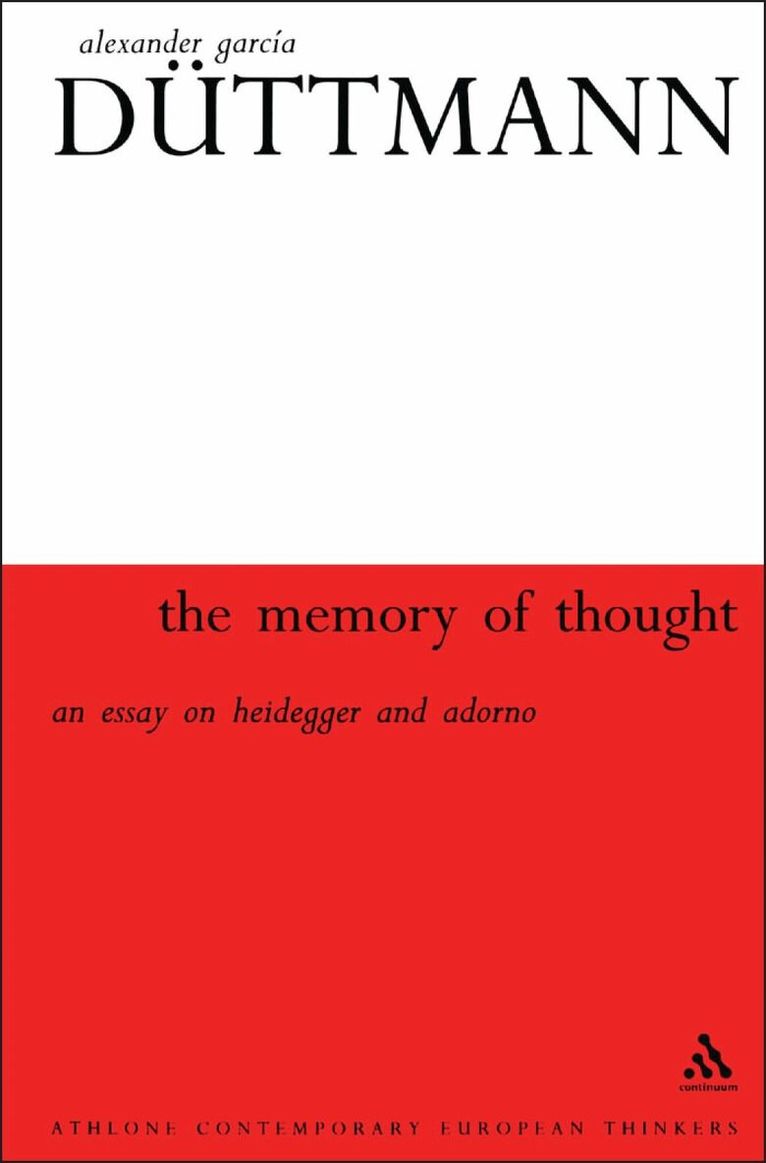
The Memory of Thought reconstructs the philosophy of Adorno and Heidegger in the light of the importance that these thinkers attach to two proper names: Auschwitz and Germanien. In Adorno's dialectical thinking, Auschwitz is the name of an incommensurable historical event that seems to put a provisional end to history as a negative totality. In Heidegger's thinking of Being, Germanien is a name inscribed in an historical mission on which the fate of Western civilization seems to depend: it thus becomes the name of a positive totality of history.
1 209 kr
Skickas inom 10-15 vardagar
A reconstruction of aspects of the philosophy of Adorno and Heidegger. This title reconstructs the philosophy of Adorno and Heidegger in the light of the importance that these thinkers attach to two proper names: Auschwitz and Germanien. In Adorno's dialectical thinking, Auschwitz is the name of an incommensurable historical event that seems to put a provisional end to history as a negative totality. In Heidegger's thinking of Being, Germanien is a name inscribed in an historical mission on which the fate of Western civilization seems to depend: it thus becomes the name of a positive totality of history.
268 kr
Skickas inom 3-6 vardagar
Whenever an individual asks to be recognized, he asks for confirmation of what he believes himself to be. But he also asks for an establishing act which brings about what he is not yet and what he will be only once he has been recognized. Recognition is thus marked by a tension between two incompatible demands, a tension which triggers a struggle for recognition.Between Cultures is a philosophical attempt to discuss issues related to multiculturalism in the light of this struggle for recognition. Moving effortlessly between philosophy, psychoanalysis, sociology, political theory and literature, it refers to the work of Adorno, Derrida, Freud, Hegel, Heidegger, Rawls, Walzer and Wittgenstein to describe a historical and critical politics of recognition. It also addresses questions of national and sexual identities, with particular reference to the notion of a gay identity in the context of Aids.
136 kr
Skickas inom 3-6 vardagar
223 kr
Skickas inom 3-6 vardagar