Alexander M. Schenker - Böcker
Visar alla böcker från författaren Alexander M. Schenker. Handla med fri frakt och snabb leverans.
5 produkter
5 produkter
518 kr
Skickas inom 5-8 vardagar
Mr. Schenker now supplements his Beginning Polish with a selection of fifteen unabridged, annotated short stories, each by a different author, to be used in beginning and intermediate college courses in Polish. All of the stories, which were written within the last twenty-five years, are set in contemporary Poland, and are by authors generally considered to be among the most significant and interesting in post-World War II Poland. Each selection is preceded by an English-language biography and literary appreciation of the author. Problems that might be encountered by the reader – whether of a linguistic or cultural nature – are explained in footnotes, and a glossary at the end of the book contains all of the words occurring in the stories. There is no other reader dealing exclusively with twentieth-century Polish prose.Mr. Schenker is chairman of the Department of Slavic Languages and Literature at Yale University.
504 kr
Tillfälligt slut
971 kr
Skickas inom 3-6 vardagar
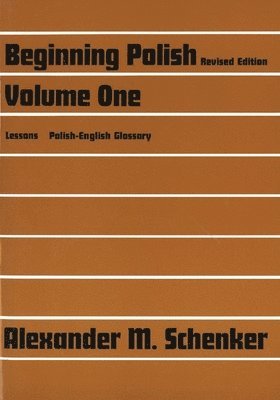
Keyed to the lessons in Volume 1, this volume contains drills specifically designed for classroom instruction. A set of tapes to be used with the drills is available from the Center for Applied Linguistics in Washington, D.C. Preparation of this text was supported by a contract with the U.S. Office of Education.
625 kr
Skickas inom 5-8 vardagar
This book is the first comprehensive treatment in any language of the most consequential work of art ever to be executed in Russia—the equestrian monument to Peter the Great, or The Bronze Horseman, as it has come to be known since it appeared in Alexander Pushkin’s poem bearing that title.The author deals with the cultural setting that prepared the ground for the monument and provides life stories of those who were involved in its creation: the sculptors Etienne-Maurice Falconet and Marie-Anne Collot, the engineer Marin Carburi, the diplomat Dmitry Golitsyn, and Catherine’s “commissar” for culture, Ivan Betskoi. He also touches upon the extraordinary resonance of the monument in Russian culture, which, since the unveiling in 1782, has become the icon of St. Petersburg and has alimented the so-called “St. Petersburg theme” in Russian letters, familiar from the works of such writers as Pushkin, Dostoevsky, Gogol, and Bely.
745 kr
Skickas inom 3-6 vardagar
This unique book weaves linguistic, cultural, and historical themes together to form a concise and accessible account of the development of the Slavic languages. Alexander Schenker demonstrates that inquiry into early Slavic culture requires an understanding of history, language, and texts and that an understanding of early Slavic writing is incomplete outside the context of medieval culture.Drawing on contemporary manuscripts and other primary sources, Schenker presents a historical sketch of Slavic settlement in Europe, tracing the migrations, the political maneuvers, and the integration of the Slavs into the medieval European cultural commonwealth. He next outlines the development of Slavic from its Indo-European origins to the breakup of Slavic linguistic unity and the formation of individual Slavic dialects. In a chapter devoted to the beginnings of Slavic writing, he includes a thematic classification of the oldest Slavic texts, a section on Slavic paleography, and a discussion of the formation of Old Church Slavonic and its role as the first Slavic literary language. An overview of the development of Slavic philology, samples of early Slavic writing with facsimile illustrations, maps, and a chronological table contribute further valuable material to this volume.