Alexander Mikhailov – Författare
Visar alla böcker från författaren Alexander Mikhailov. Handla med fri frakt och snabb leverans.
3 produkter
3 produkter
534 kr
Skickas inom 10-15 vardagar
The principal aim of the book is to give a comprehensive account of the variety of approaches to such an important and complex concept as Integrability. Dev- oping mathematical models, physicists often raise the following questions: whether the model obtained is integrable or close in some sense to an integrable one and whether it can be studied in depth analytically. In this book we have tried to c- ate a mathematical framework to address these issues, and we give descriptions of methods and review results. In the Introduction we give a historical account of the birth and development of the theory of integrable equations, focusing on the main issue of the book – the concept of integrability itself. A universal de nition of Integrability is proving to be elusive despite more than 40 years of its development. Often such notions as “- act solvability” or “regular behaviour” of solutions are associated with integrable systems. Unfortunately these notions do not lead to any rigorous mathematical d- inition. A constructive approach could be based upon the study of hidden and rich algebraic or analytic structures associated with integrable equations. The requi- ment of existence of elements of these structures could, in principle, be taken as a de nition for integrability. It is astonishing that the nal result is not sensitive to the choice of the structure taken; eventually we arrive at the same pattern of eq- tions.
534 kr
Skickas inom 10-15 vardagar
The principal aim of the book is to give a comprehensive account of the variety of approaches to such an important and complex concept as Integrability. Dev- oping mathematical models, physicists often raise the following questions: whether the model obtained is integrable or close in some sense to an integrable one and whether it can be studied in depth analytically. In this book we have tried to c- ate a mathematical framework to address these issues, and we give descriptions of methods and review results. In the Introduction we give a historical account of the birth and development of the theory of integrable equations, focusing on the main issue of the book – the concept of integrability itself. A universal de nition of Integrability is proving to be elusive despite more than 40 years of its development. Often such notions as “- act solvability” or “regular behaviour” of solutions are associated with integrable systems. Unfortunately these notions do not lead to any rigorous mathematical d- inition. A constructive approach could be based upon the study of hidden and rich algebraic or analytic structures associated with integrable equations. The requi- ment of existence of elements of these structures could, in principle, be taken as a de nition for integrability. It is astonishing that the nal result is not sensitive to the choice of the structure taken; eventually we arrive at the same pattern of eq- tions.
Del 52 - Springer Series in Synergetics
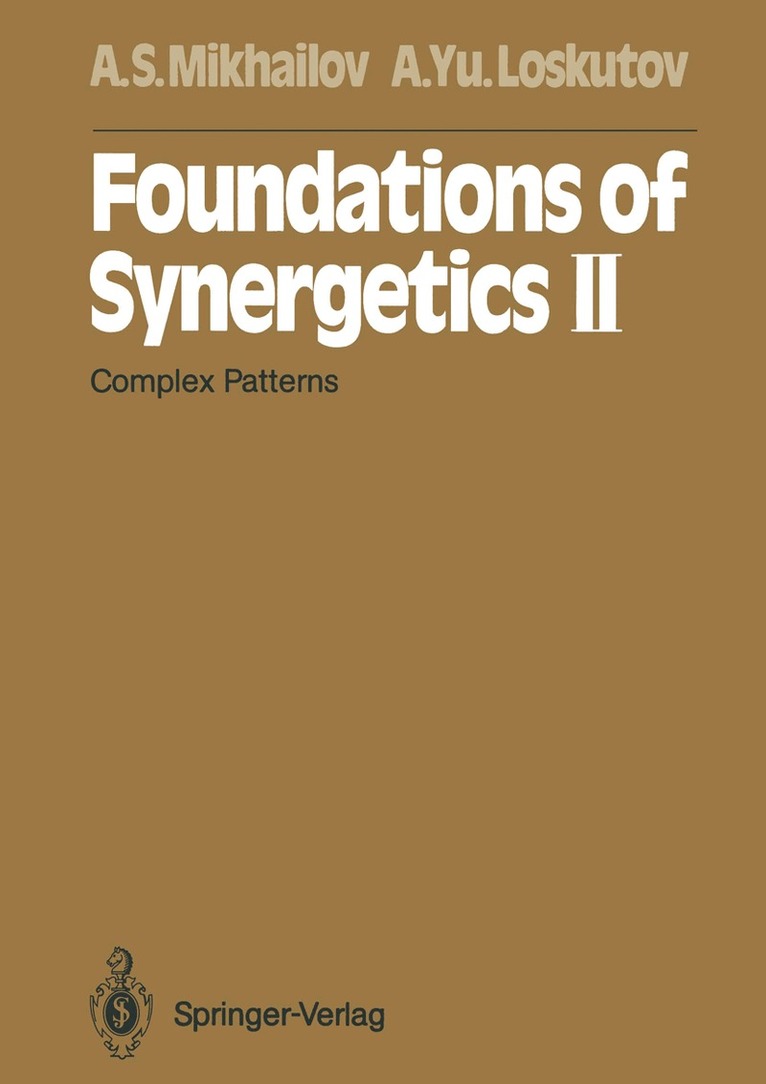
Foundations of Synergetics II
Complex Patterns
Häftad, Engelska, 2012
534 kr
Skickas inom 10-15 vardagar
This textbook is based on a lecture course in synergetics given at the University of Moscow. In this second of two volumes, we discuss the emergence and properties of complex chaotic patterns in distributed active systems. Such patterns can be produced autonomously by a system, or can result from selective amplification of fluctuations caused by external weak noise. Although the material in this book is often described by refined mathematical theories, we have tried to avoid a formal mathematical style. Instead of rigorous proofs, the reader will usually be offered only "demonstrations" (the term used by Prof. V. I. Arnold) to encourage intuitive understanding of a problem and to explain why a particular statement seems plausible. We also refrained from detailing concrete applications in physics or in other scientific fields, so that the book can be used by students of different disciplines. While preparing the lecture course and producing this book, we had intensive discussions with and asked the advice of Prof. V. I. Arnold, Prof. S. Grossmann, Prof. H. Haken, Prof. Yu. L. Klimontovich, Prof. R. L. Stratonovich and Prof. Ya.