Alexander Schönberg – Författare
Visar alla böcker från författaren Alexander Schönberg. Handla med fri frakt och snabb leverans.
2 produkter
2 produkter
1 062 kr
Skickas inom 10-15 vardagar
(Abridged and translated) Organic photochemistry may be divided into three parts: theory which is the province of the physical chemist; instrumentation which requires the skill of both physicist and engineer; and preparation which falls within the sphere of the organic chemist. At one time the same person could cover all three fields without too much difficulty, but this has now become virtually impossible because the disciplines involved have expanded in both breadth and depth; it is there fore timely to have a separate treatment of preparative organic photo chemistry. There appears to be no review of the main photochemical reactions which includes the advances made in recent years available to the organic chemist working in the preparative field. An exception is the excellent "Photochemical Reactions" by C. R. MASSON, V. BOEKELHEIDE and W. A. NoYES JR., published in 1956, which gives a brief review of the reactions which are important in preparative organic photochemistry. The present monograph on the other hand seeks to provide a detailed survey for the chemist; the author does not set out to discuss every photo chemical reaction in the field of organic chemistry but he does include in addition to those of current interest in the preparative field some which are likely to be of interest in the future and which result in single end-products of known composition. The photochemical synthesis of highly polymerized products falls outside the scope of the work.
697 kr
Skickas inom 10-15 vardagar
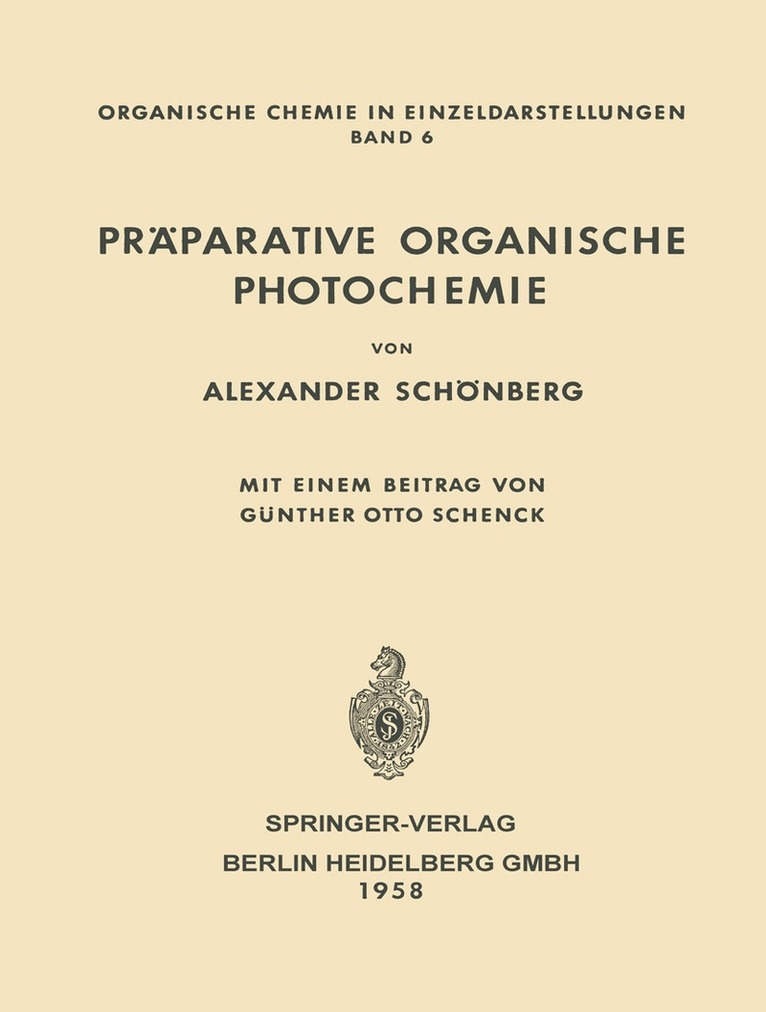
Die organische Photochemie kann in drei Gebiete eingeteilt werden: theoretische Photochemie als Arbeitsgebiet des Physikochemikers, Apparatekunde als Aufgabenbereich des Physikers und Ingenieurs und präparative Photochemie, welche das Feld des organischen Chemikers ist. Während es früher für den einzelnen nicht allzu schwierig war, die Gesamtheit dieser Gebiete zu beherrschen, ist dies jetzt fast unmöglich geworden, da die in Frage kommenden Wissenschaften zu sehr in die Breite und Tiefe gewachsen sind; eine Einzelbehandlung ist daher angezeigt. Viele Gründe können dafür angeführt werden, daß die präparative organische Photochemie sich in den letzten zwei Jahrzehnten in einer Weise entwickelt hat, welche in schroffem Gegensatz zu der langsamen Entwicklung in früheren Jahren steht. Hier soll darauf hingewiesen werden, daß die politischen Um wälzungen der letzten 25 Jahre manche europäischen Chemiker ver anlaßten, ihre Tätigkeit in tropische oder subtropische Länder mit intensiver Sonnenbestrahlung zu verlegen; eine eingehende Beschäf tigung mit Reaktionen im Sonnenlicht lag daher nahe und fand in einer Reihe von Fällen tatsächlich statt. Von größerer Bedeutung ist, daß die Kenntnis von der Wechselwirkur g zwischen Strahlung und organischer Materie eine erhebliche Erweiterung erfahren hat; zum anderen hat man gelernt, radikalisehe bzw. radikalinduzierte Reaktionen (und als solche sieht man heute die meisten photochemischen Reaktionen an) zu be herrschen und zu lenken. Heute sind photochemische Versuche überall leicht und reproduzierbar auszuführen, da die Technik neuartige und meist höchst leistungsfähige Bestrahlungseinheiten, UV-Lampen usw.