Alexander Semyonov – författare
Visar alla böcker från författaren Alexander Semyonov. Handla med fri frakt och snabb leverans.
9 produkter
New Imperial History of Northern Eurasia, 600-1700
From Russian to Global History
Av Marina B. Mogilner, Ilya V. Gerasimov m. fl.
Inbunden, 2023
1317 kr
Lägg i varukorg
A New Imperial History of Northern Eurasia, 600-1700 proposes a new language for studying and conceptualizing the spaces, societies, and institutions that existed on the territory of today’s Northern Eurasia. This is not the story of a certain present-day state or people evolving through …
New Imperial History of Northern Eurasia, 600-1700
From Russian to Global History
Av Marina B. Mogilner, Ilya V. Gerasimov m. fl.
Häftad, 2025
429 kr
Lägg i varukorg
A New Imperial History of Northern Eurasia, 600-1700 proposes a new language for studying and conceptualizing the spaces, societies, and institutions that existed on the territory of today’s Northern Eurasia. This is not the story of a certain present-day state or people evolving through …
New Imperial History of Northern Eurasia, 600-1700
From Russian to Global History
Av Marina B. Mogilner, Ilya V. Gerasimov m. fl.
E-bok, 2023
452 kr
Lägg i varukorg
A New Imperial History of Northern Eurasia, 600-1700 proposes a new language for studying and conceptualizing the spaces, societies, and institutions that existed on the territory of today''s Northern Eurasia. This is not the story of a certain present-day state or people evolving through …
New Imperial History of Northern Eurasia, 600-1700
From Russian to Global History
Av Marina B. Mogilner, Ilya V. Gerasimov m. fl.
E-bok, 2023
466 kr
Lägg i varukorg
A New Imperial History of Northern Eurasia, 600-1700 proposes a new language for studying and conceptualizing the spaces, societies, and institutions that existed on the territory of today''s Northern Eurasia. This is not the story of a certain present-day state or people evolving through …
New Imperial History of Northern Eurasia, 1700-1918
From Russian to Global History
Av Marina B. Mogilner, Alexander Semyonov m. fl.
Häftad, 2026
429 kr
Lägg i varukorg
A New Imperial History of Northern Eurasia, 1700-1918 proposes a new language for studying and conceptualizing the spaces, societies, and institutions that existed on the territory of today’s Northern Eurasia, until recently part of the USSR. Traditional concepts and genealogies that frame human …
New Imperial History of Northern Eurasia, 1700-1918
From Russian to Global History
Av Marina B. Mogilner, Alexander Semyonov m. fl.
Inbunden, 2025
1244 kr
Lägg i varukorg
A New Imperial History of Northern Eurasia, 1700-1918 proposes a new language for studying and conceptualizing the spaces, societies, and institutions that existed on the territory of today’s Northern Eurasia, until recently part of the USSR. Traditional concepts and genealogies that frame human …
New Imperial History of Northern Eurasia, 1700-1918
From Russian to Global History
Av Marina B. Mogilner, Alexander Semyonov m. fl.
E-bok, 2025
1321 kr
Lägg i varukorg
A New Imperial History of Northern Eurasia, 1700-1918 proposes a new language for studying and conceptualizing the spaces, societies, and institutions that existed on the territory of today''s Northern Eurasia, until recently part of the USSR. Traditional concepts and genealogies that frame human …
New Imperial History of Northern Eurasia, 1700-1918
From Russian to Global History
Av Marina B. Mogilner, Alexander Semyonov m. fl.
E-bok, 2025
1364 kr
Lägg i varukorg
A New Imperial History of Northern Eurasia, 1700-1918 proposes a new language for studying and conceptualizing the spaces, societies, and institutions that existed on the territory of today''s Northern Eurasia, until recently part of the USSR. Traditional concepts and genealogies that frame human …
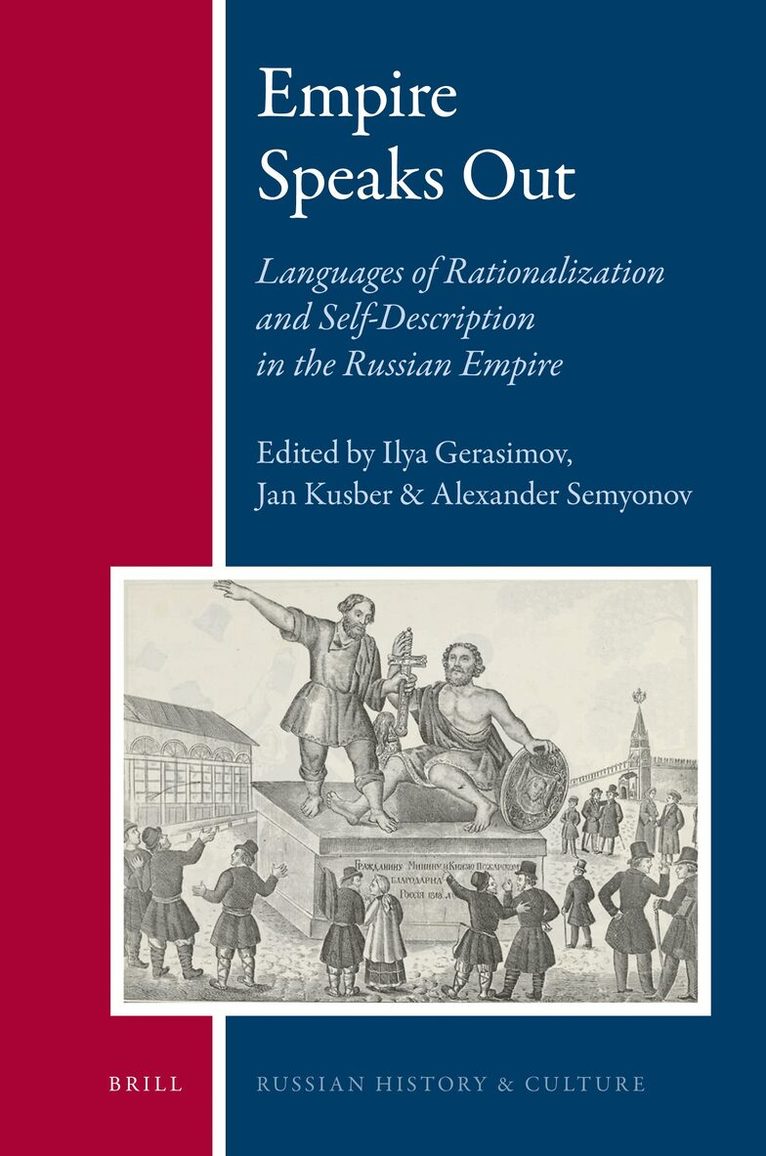
Empire Speaks Out
Languages of Rationalization and Self-Description in the Russian Empire
Av Ilya Gerasimov, Jan Kusber m. fl.
Inbunden, 2009
3089 kr
Lägg i varukorg
Historians habitually write about empires that expand, wage wars, and collapse, as if empires were self-evident and self-conscious entities with a distinct and clear sense of purpose. The stories of empires are told in the language of modern nation-centred social sciences: multi-cultural and …