Alexander Varchenko - Böcker
Visar alla böcker från författaren Alexander Varchenko. Handla med fri frakt och snabb leverans.
2 produkter
2 produkter
603 kr
Skickas
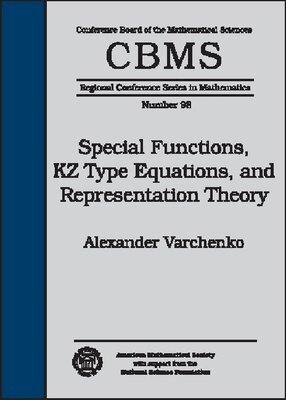
The last twenty years have seen an active interaction between mathematics and physics. This book is devoted to one of the new areas which deals with mathematical structures related to conformal field theory and its $q$-deformations. In the book, the author discusses the interplay between Knizhnik-Zamolodchikov type equations, the Bethe ansatz method, representation theory, and geometry of multi-dimensional hypergeometric functions. This book aims to provide an introduction to the area and expose different facets of the subject. It contains constructions, discussions of notions, statements of main results, and illustrative examples. The exposition is restricted to the simplest case of the theory associated with the Lie algebra $\mathfrak {sl}_2$. This book is intended for researchers and graduate students in mathematics and in mathematical physics, in particular to those interested in applications of special functions.
Del 21 - Advanced Series In Mathematical Physics
Multidimensional Hypergeometric Functions The Representation Theory Of Lie Algebras And Quantum Groups
Inbunden, Engelska, 1995
1 796 kr
Skickas inom 5-8 vardagar
This book recounts the connections between multidimensional hypergeometric functions and representation theory. In 1984, physicists Knizhnik and Zamolodchikov discovered a fundamental differential equation describing correlation functions in conformal field theory. The equation is defined in terms of a Lie algebra. Kohno and Drinfeld found that the monodromy of the differential equation is described in terms of the quantum group associated with the Lie algebra. It turns out that this phenomenon is the tip of the iceberg. The Knizhnik-Zamolodchikov differential equation is solved in multidimensional hypergeometric functions, and the hypergeometric functions yield the connection between the representation theories of Lie algebras and quantum groups. The topics presented in this book are not adequately covered in periodicals.