Alexandra Aikhenvald – författare
Visar alla böcker från författaren Alexandra Aikhenvald. Handla med fri frakt och snabb leverans.
8 produkter
8 produkter
673 kr
Skickas inom 5-8 vardagar
The Oxford Handbook of Evidentiality offers a thorough, systematic, and crosslinguistic account of evidentiality, the linguistic encoding of the source of information on which a statement is based. In some languages, the speaker always has to specify this source - for example whether they saw the event, heard it, inferred it based on visual evidence or common sense, or was told about it by someone else. While not all languages have obligatory marking of this type, every language has ways of referring to information source and associated epistemological meanings. The continuum of epistemological expressions covers a range of devices from the lexical means in familiar European languages and in many languages of Aboriginal Australia to the highly grammaticalized systems in Amazonia or North America. In this handbook, experts from a variety of fields explore topics such as the relationship between evidentials and epistemic modality, contact-induced changes in evidential systems, the acquisition of evidentials, and formal semantic theories of evidentiality. The Oxford Handbook of Evidentiality also contains detailed case studies of evidentiality in language families across the world, including Algonquian, Korean, Nakh-Dagestanian, Nambikwara, Turkic, Uralic, and Uto-Aztecan.
962 kr
Skickas inom 7-10 vardagar
This book considers how forms and meanings of different languages at different times may resemble one another and what the explanation is for this. The author aims (a) to explain and identify the relationship between areal diffusion and the genetic development of languages, and (b) to discover the means of distinguishing what may cause one language to share the characteristics of another. This is done using the example of Arawak and Tucanoan languages spoken in the large area of the Vaupés river basin in northwest Amazonia, which spans Colombia and Brazil. In this region language is seen as a badge of identity: language mixing, interaction, and influence are resisted for ideological reasons. Professor Aikhenvald considers which grammatical categories are most and which are least likely to be borrowed in a situation of prolonged language contact where lexical borrowing is reduced to a minimum. She provides a genetic analysis of the languages of the region and considers their historical relationships with languages of the same family outside it. She also examines changes brought about by recent contact with European languages and culture, and the linguistic and cultural effects of being part of a group that is aware its language and identity are threatened. The book is presented in relatively nontechnical language and will interest linguists and anthropologists.
973 kr
Skickas inom 7-10 vardagar
This book is the first comprehensive description of the Manambu language of Papua New Guinea and is based entirely on the author's immersion fieldwork. Manambu belongs to the Ndu language family, and is spoken by about 2,500 people in five villages: Avatip, Yawabak, Malu, Apa:n, and Yambon (Yuanab) in East Sepik Province, Ambunti district. Manambu can be considered an endangered language.The Manambu language has many unusual properties. Every noun is considered masculine or feminine. Feminine gender - which is unmarked - is associated with small size and round shape, and masculine gender with elongated shape, large size, and importance. The Manambu culture is centered on ownership of personal names, and is similar to that of the Iatmul, described by Gregory Bateson.After an introductory account of the language and its speakers, Professor Aikhenvald devotes chapters to phonology, grammatical relations, word classes, gender, semantics, number, case, possession, derivation and compounding, pronouns, morphohology, verbs, mood and modality, negation, clause structure, pragmatics, discourse, semantics, the lexicon, current directions of change, and genetic relationship to other languages. The description is presented in a clear style in a framework that will be comprehensible to all linguists and linguistically oriented anthropologists.
826 kr
Skickas inom 7-10 vardagar
This book considers how and why forms and meanings of different languages at different times may resemble one another. The author explains the relationship between a real diffusion and the genetic development of languages, and reveals the means of distinguishing what may cause one language to share the characteristics of another. Professor Aikhenvald uses the example of Arawak and Tucanoan languages spoken in the large area of the Vaupés river basin in northwest Amazonia, which spans Colombia and Brazil. In this region language is seen as a badge of identity: language mixing, interaction, and influence are resisted for ideological reasons. The book considers which grammatical categories are most and least likely to be borrowed in a situation of prolonged language contact where lexical borrowing is reduced to a minimum. The author provides a genetic analysis of the languages of the region and considers their historical relationships with languages of the same family outside it. She also examines changes brought about by recent contact with European languages and culture, and the linguistic and cultural effects of being part of a group that is aware of the threat to its language and identity. The book is presented in relatively nontechnical language and will interest linguists and anthropologists.
160 kr
Skickas
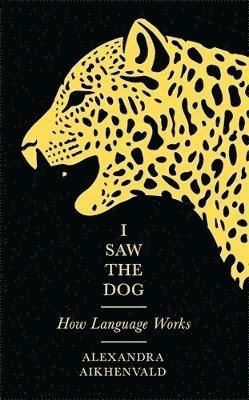
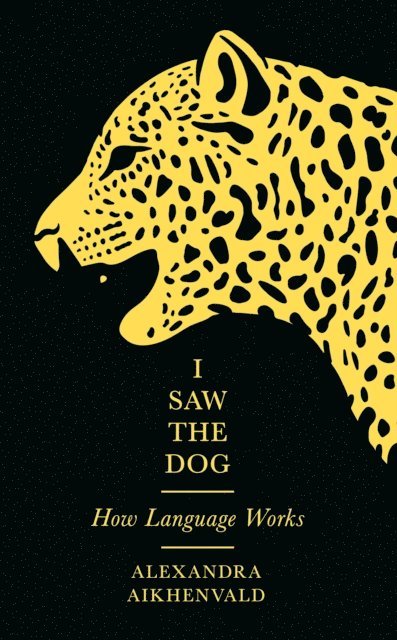
Every language in the world shares a few common features: we can ask a question, say something belongs to us, and tell someone what to do. But beyond that, our languages are richly and almost infinitely varied: a French speaker can't conceive of a world that isn't split into un and une, male and female, while Estonians have only one word for both men and women: tema. In Dyirbal, an Australian language, things might be masculine, feminine, neuter - or edible vegetable. Every language tells us something about the people who use it. In I Saw the Dog, linguist Alexandra Aikhenvald takes us from the remote swamplands of Papua New Guinea to the university campuses of North America to illuminate the vital importance of names, the value of being able to say exactly what you mean, what language can tell us about what it means to be human - and what we lose when they disappear forever.
Del 3 - Brill's Studies in the Indigenous Languages of the Americas
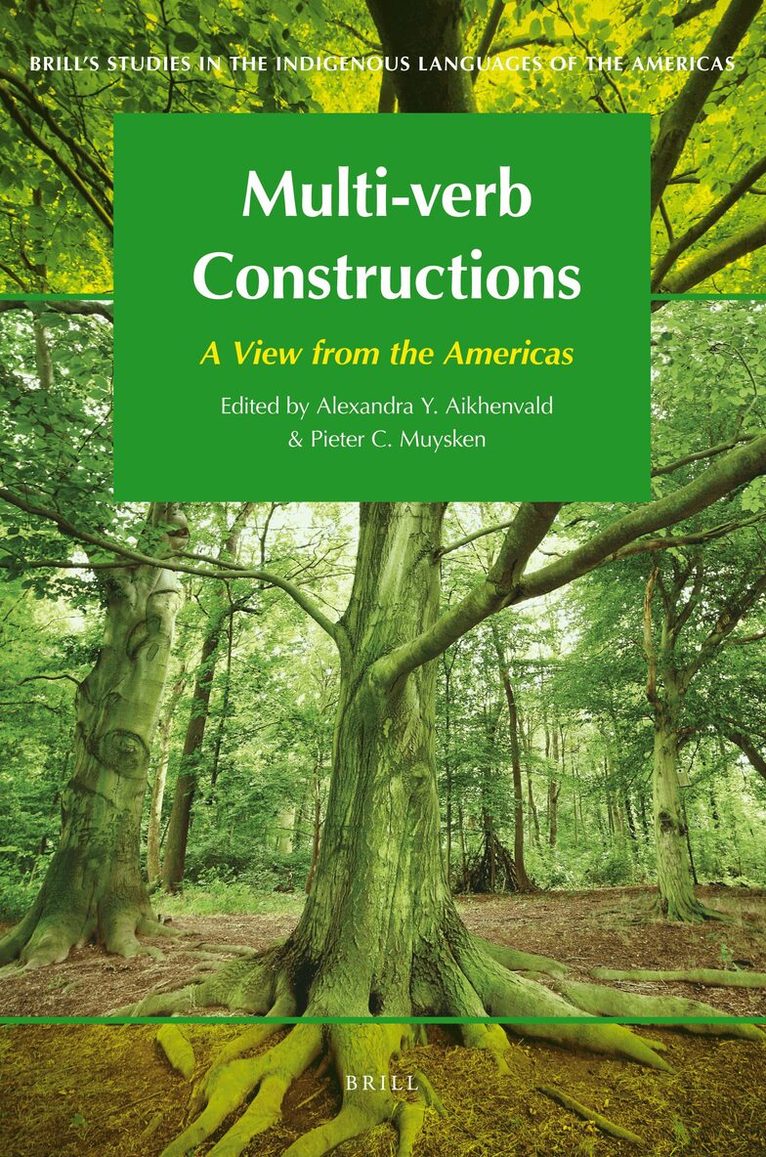
Multi-verb Constructions
A View from the Americas
Inbunden, Engelska, 2010
2 480 kr
Skickas inom 5-8 vardagar
One of the most complex topics in the study of the indigenous languages of the Americas, and indeed in the study of any language set, is the complex behaviour of multi-verb constructions. In many languages, several verbs can co-occur in a sentence, forming a single predicate. This book contains a first survey of such constructions in languages of North, Middle, and South America. Though it is not a systematic typological survey, the combined insights from the various chapters give a very rich perspective on this phenomenon, involving a host of typologically diverse constructions, including serial verb constructions, auxiliaries, co-verbs, phasal verbs, incorporated verbs, etc. Aikhenvald's long introduction puts the chapters into a single perspective.
Del 2 - Empirical Approaches to Linguistic Theory
Language at Large
Essays on Syntax and Semantics
Inbunden, Engelska, 2011
4 177 kr
Skickas inom 5-8 vardagar
The volume brings together important essays on syntax and semantics by Aikhenvald and Dixon, highlighting their expertise in various fields of linguistics. The first part focusses on linguistic typology, covering case markers used on verbs, argument-determined constructions, unusual meanings of causatives, the semantic basis for a typology, word-class-changing derivations, speech reports and semi-direct speech. The second part concentrates on documentation and analysis of previously undescribed languages, from South America and Indigenous Australia. The third part addresses a variety of issues in grammar and lexicography of English. This includes pronouns with transferred reference, comparative constructions, features of the noun phrase, and the discussion of 'twice'. The treatment of Australian Aboriginal words in dictionaries is discussed in the final chapter.
Del 3 - Brill's Studies in Language, Cognition and Culture
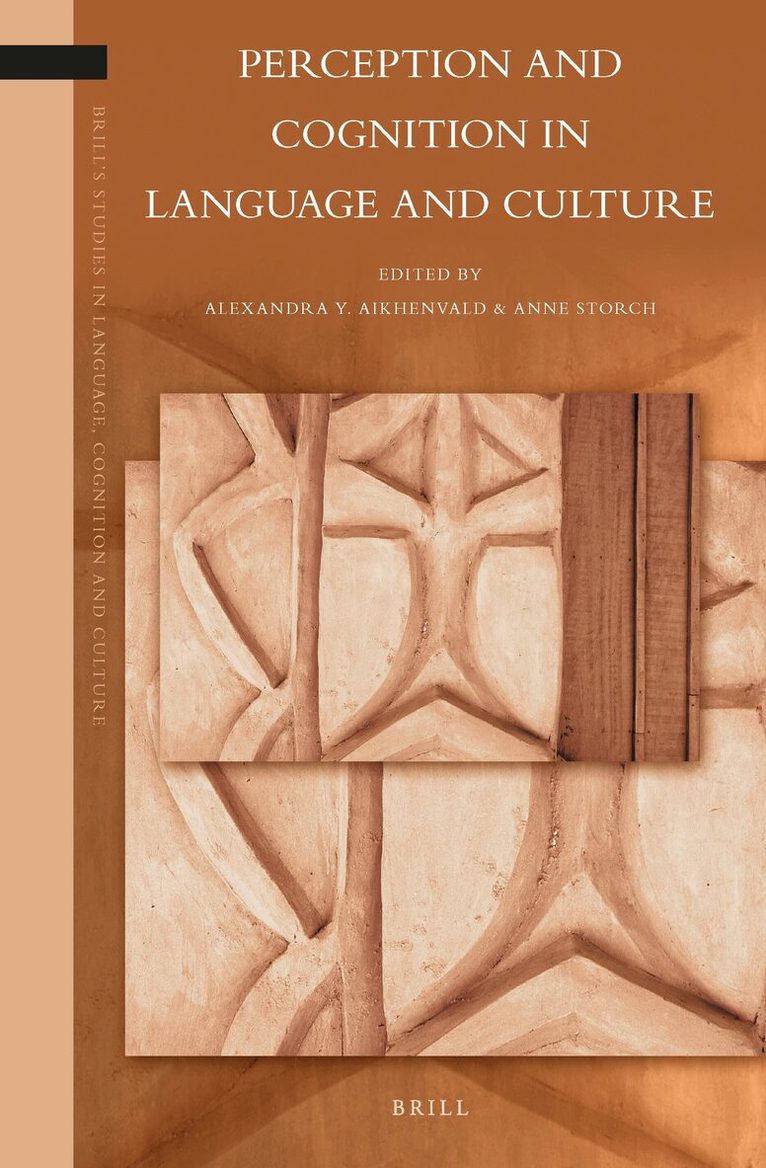
Perception and Cognition in Language and Culture
Inbunden, Engelska, 2013
2 606 kr
Skickas inom 3-6 vardagar
Every language has a way of talking about seeing, hearing, smelling, tasting and touching. In about a quarter of the world's languages, grammatical evidentials express means of perception. In some languages verbs of vision subsume cognitive meanings. In others, cognition is associated with a verb of auditory perception, touch, or smell. 'Vision' is not the universally preferred means of perception. In numerous cultures, taboos are associated with forbidden visual experience. Vision may be considered intrusive and aggressive, and linked with power. In contrast, 'hearing' and 'listening' are the main avenues for learning, understanding and 'knowing'. The studies presented in this book set out to explore how these meanings and concepts are expressed in languages of Africa, Oceania, and South America.