Alexandre Kojève - Böcker
Visar alla böcker från författaren Alexandre Kojève. Handla med fri frakt och snabb leverans.
16 produkter
16 produkter
960 kr
Skickas inom 7-10 vardagar
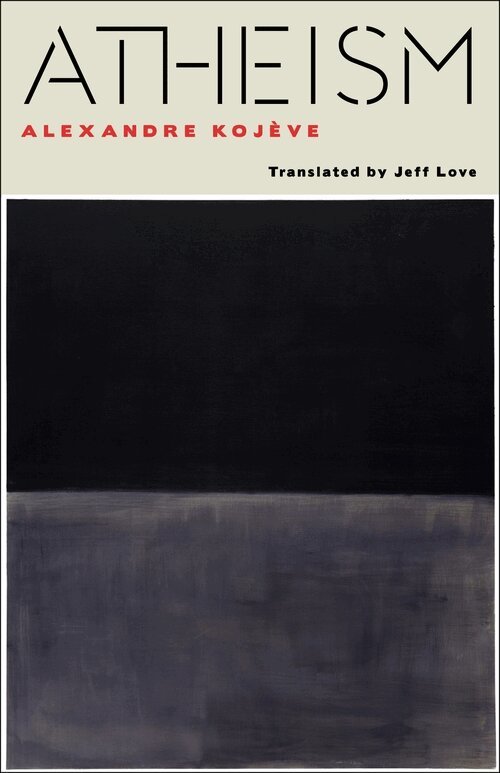
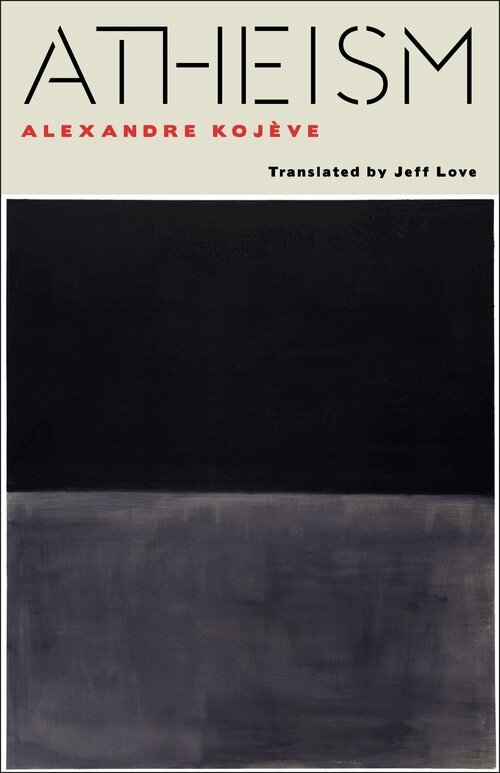
One of the twentieth century’s most brilliant and unconventional thinkers, Alexandre Kojève was a Russian émigré to France whose lectures on Hegel in the 1930s galvanized a generation of French intellectuals. Although Kojève wrote a great deal, he published very little in his lifetime, and so the ongoing rediscovery of his work continues to present new challenges to philosophy and political theory. Written in 1931 but left unfinished, Atheism is an erudite and open-ended exploration of profound questions of estrangement, death, suicide, and the infinite that demonstrates the range and the provocative power of Kojève’s thought.Ranging across Heidegger, Buddhism, Christianity, German idealism, Russian literature, and mathematics, Kojève advances a novel argument about freedom and authority. He investigates the possibility that there is not any vantage point or source of authority—including philosophy, science, or God—that is outside or beyond politics and the world as we experience it. The question becomes whether atheism—or theism—is even a meaningful position since both affirmation and denial of God’s existence imply a knowledge that seems clearly outside our capacities. Masterfully translated by Jeff Love, this book offers a striking new perspective on Kojève’s work and its implications for theism, atheism, politics, and freedom.
245 kr
Skickas inom 7-10 vardagar
One of the twentieth century’s most brilliant and unconventional thinkers, Alexandre Kojève was a Russian émigré to France whose lectures on Hegel in the 1930s galvanized a generation of French intellectuals. Although Kojève wrote a great deal, he published very little in his lifetime, and so the ongoing rediscovery of his work continues to present new challenges to philosophy and political theory. Written in 1931 but left unfinished, Atheism is an erudite and open-ended exploration of profound questions of estrangement, death, suicide, and the infinite that demonstrates the range and the provocative power of Kojève’s thought.Ranging across Heidegger, Buddhism, Christianity, German idealism, Russian literature, and mathematics, Kojève advances a novel argument about freedom and authority. He investigates the possibility that there is not any vantage point or source of authority—including philosophy, science, or God—that is outside or beyond politics and the world as we experience it. The question becomes whether atheism—or theism—is even a meaningful position since both affirmation and denial of God’s existence imply a knowledge that seems clearly outside our capacities. Masterfully translated by Jeff Love, this book offers a striking new perspective on Kojève’s work and its implications for theism, atheism, politics, and freedom.
608 kr
Skickas inom 10-15 vardagar
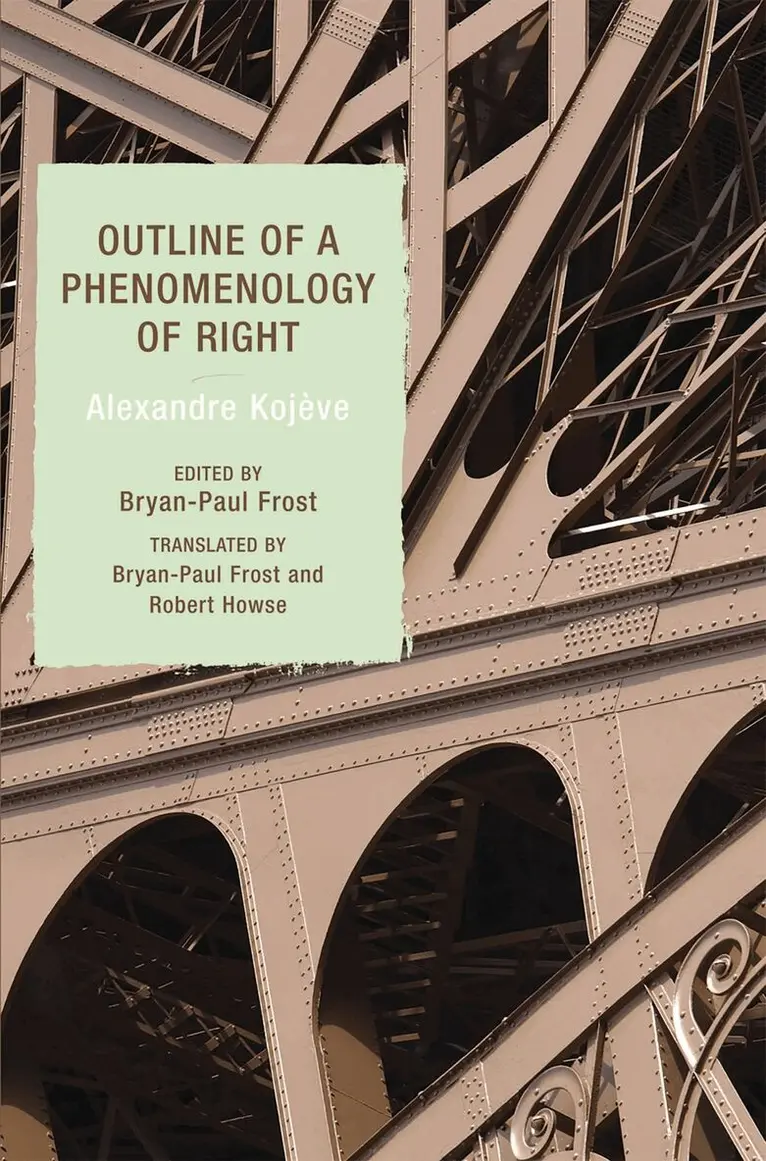
Alexandre Koj_ve offers a systematic discussion of key themes such as right, justice, law, equality, and autonomy in which he presages our contemporary world of economic globalization and international law. Edited and translated (with Robert Howse) by Bryan-Paul Frost, this is the authoritative English language translation of a monumental work in political philosophy.
261 kr
Skickas inom 10-15 vardagar
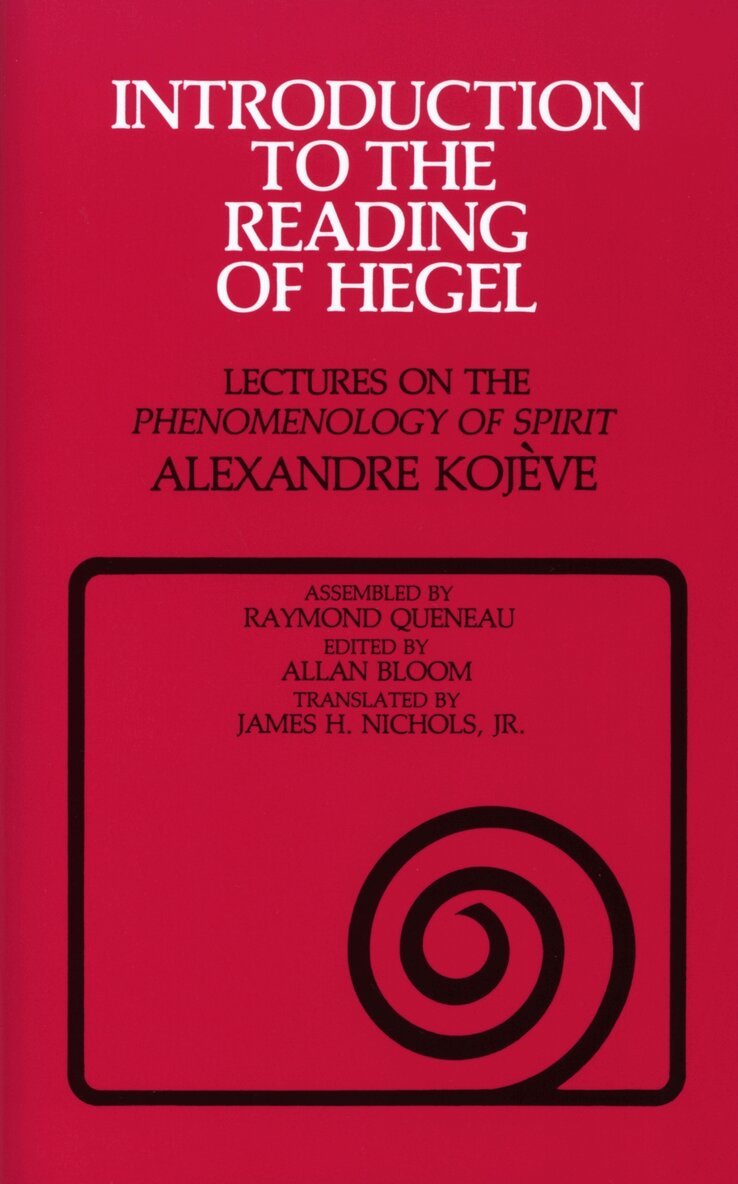
"This collection of Kojeve's thoughts about Hegel constitutes one of the few important philosophical books of the twentieth century—a book, knowledge of which is requisite to the full awareness of our situation and to the grasp of the most modern perspective on the eternal questions of philosophy."—Allan Bloom (from the Introduction)During the years 1933–1939, the Russian-born and German-educated Marxist political philosopher Alexandre Kojève (1902–1968) brilliantly explicated—through a series of lectures—the philosophy of Hegel as it was developed in the Phenomenology of Spirit. This collection of lectures—originally compiled by Raymond Queneau and edited for its English-language translation by Allan Bloom—shows the intensity of Kojève's study and thought and the depth of his insight into Hegel's Phenomenology. More important—for Kojève was above all a philosopher and not an ideologue—this profound and venturesome work on Hegel will expose the readers to the excitement of discovering a great mind in all its force and power.
325 kr
Skickas inom 7-10 vardagar
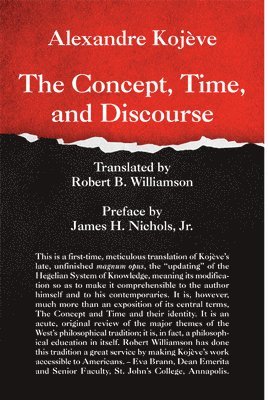
Alexandre Kojève (1902–1968) is most widely known in America for his provocative assertion that history is at its end, that is, its completion. In the “practical” sense, this means that the process of historical development can at last be seen (if from a distance) as the realization of the Marxist “universal and homogeneous state.” However, Kojève claimed as well that the history of philosophical thinking had also reached its goal in the transformation of philosophy, as the “love of wisdom” (or the unsatisfied quest for comprehensive knowledge), into that very Wisdom itself and had done so in the most essential respects in the philosophy of Hegel.The Concept, Time, and Discourse is the first volume of Kojève’s magnum opus, which was to have given an exposition of the (Hegelian) System of Knowledge and of which five volumes were written before his death. It contains, along with a preliminary discussion of the need for an updating of the Hegelian system, the first two of three introductions to the exposition of that system: a First Introduction of the Concept (the integrated totality of what is comprehensible, which is the final object of philosophic inquiry) and a Second Introduction concerning Time, both introductions leading to the (Hegelian) identification of the Concept with Time, an identification which alone takes adequate account of the fact that Philosophy is necessarily discursive (that it must actualize the requirements and essential structure of Discourse).The present volume offers Kojève’s fullest statement of his Ontology. It includes a critical discussion of the traditional oppositions of the “general” to the “particular” and of the “abstract” to the “concrete” and an analysis of the act of “generalizing abstraction,” which detaches Essence from the Existence of Things. Kojève then discusses the three great figures in the three-stage development of philosophy into wisdom: Parmenides, Plato, and Hegel. Parmenides’ monadic account of Being (= Eternity) rendered it ineffable, thereby reducing philosophy to (non-philosophic) silence; Plato’s dyadic account of Being (as eternal) was intended to make Being a possible subject of discourse but failed to reflect adequately the triadic (and temporally developing) structure which Plato himself discerned in Discourse. Finally, Hegel’s triadic account of Being as itself “dialectical” achieved the final identification of the Concept with Time.This is a first-time, meticulous translation of Kojève’s late, unfinished magnum opus, the “updating” of the Hegelian System of Knowledge, meaning its modification so as to make it comprehensible to the author himself and to his contemporaries. It is, however, much more than an exposition of its central terms, The Concept and Time and their identity. It is an acute, original review of the major themes of the West’s philosophical tradition; it is, in fact, a philosophical education in itself. Robert Williamson has done this tradition a great service by making Kojève’s work accessible to Americans. – Eva Brann, Dean Emerita and Senior Faculty, St. John’s College, Annapolis, MarylandWe now recognize Alexandre Kojève as one of the central figures of 20th century European philosophy. A translation of his The Concept, Time, and Discourse will enable English speaking readers to have a fuller understanding of his remarkably ambitious intellectual project. – Michael S. Roth, President, Wesleyan University, Middletown, Connecticut.Robert B. Williamson is Tutor Emeritus at St. John’s College in Annapolis, Maryland, where he continues to teach. He is co-author, with Alfred Mollin, of An Introduction to Ancient Greek (University Press of America) and the author of articles on Plato’s philosophy and Einstein’s early work on relativity theory.James H. Nichols, Jr. is Professor of Government and Dr. Jules L. Whitehill Professor of Humanism and Ethics at Claremont McKenna College, where he teaches political philosophy. Among his publications are Epicurean Political Philosophy: The De rerum natura of Lucretius, translations with interpretations of Plato’s Gorgias and Phaedrus, and most recently Alexandre Kojève: Wisdom at the End of History.
519 kr
Kommande
106 kr
Skickas inom 7-10 vardagar
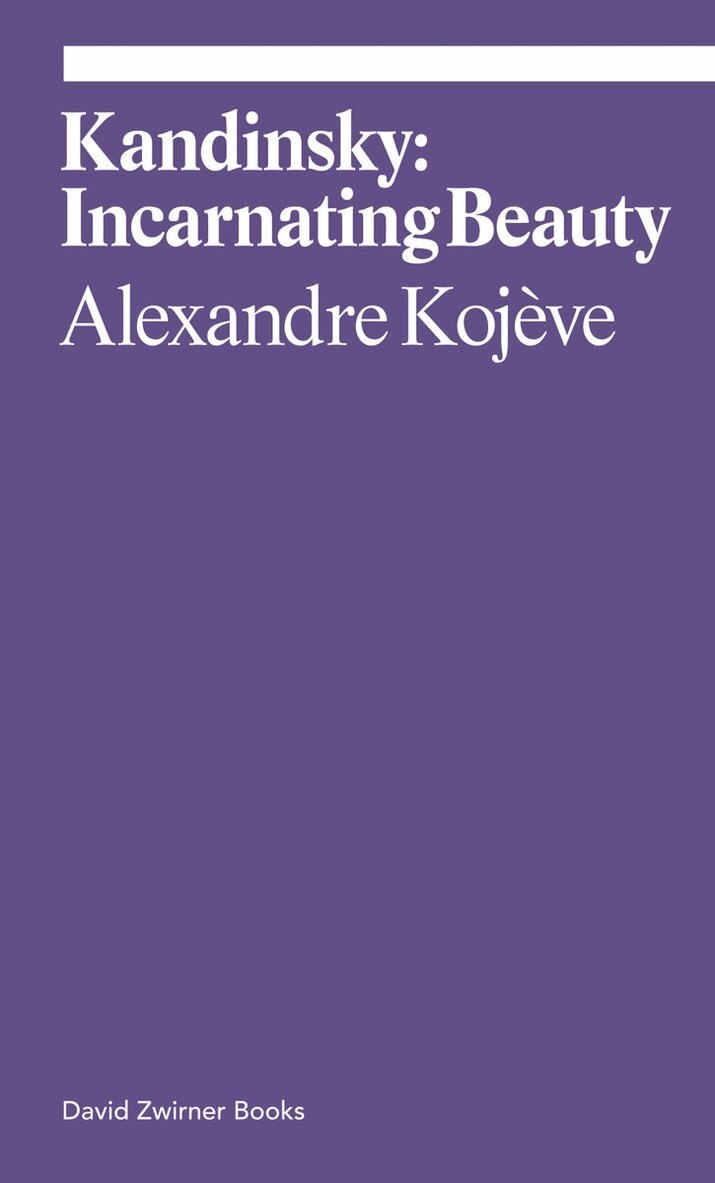
A teacher to Jacques Lacan, André Breton, and Albert Camus, Kojève defined art as the act of extracting the beautiful from objective reality. His poetic text, “The Concrete Paintings of Kandinsky,” endorses nonrepresentational art as uniquely manifesting beauty. Taking the paintings of his renowned uncle, Wassily Kandinsky, as his inspiration, Kojève suggests that in creating (rather than replicating) beauty, the paintings are themselves complete universes as concrete as the natural world. Kojève’s text considers the utility and necessity of beauty in life, and ultimately poses the involuted question: What is beauty?Including personal letters between Kandinsky and his nephew, this book further elaborates the unique relationship between artist and philosopher. An introduction by Boris Groys contextualizes Kojève’s life and writings.
196 kr
Skickas
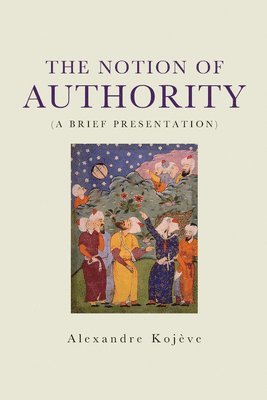
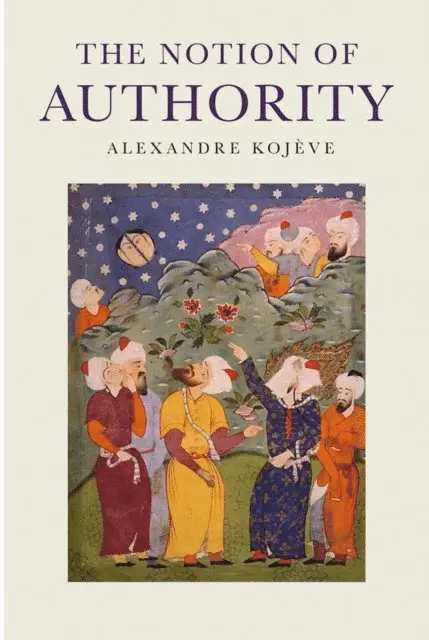
In The Notion of Authority, written in the 1940s in Nazi-occupied France, Alexandre Kojève uncovers the conceptual premises of four primary models of authority, examining the practical application of their derivative variations from the Enlightenment to Vichy France. This foundational text, translated here into English for the first time, is the missing piece in any discussion of sovereignty and political authority, worthy of a place alongside the work of Weber, Arendt, Schmitt, Agamben or Dumézil. The Notion of Authority is a short and sophisticated introduction to Kojève's philosophy of right. It captures its author's intellectual interests at a time when he was retiring from the career of a professional philosopher and was about to become one of the pioneers of the Common Market and the idea of the European Union.
254 kr
Skickas inom 7-10 vardagar
Immanuel Kant's philosophical system, Kojève argues, is haunted by the Thing-in-itself as the ultimate expression of 'bourgeois hypocrisy' and its internally divided reason, split between action and discourse. Making a case for the post-historical moral imperative to turn away from infinite progress and the practical justification of the ideas of God and the immortality of the soul, Kant outlines the material conditions of possibility for revolutionary action within the twin horizons of accomplished and recollected history.
696 kr
Skickas inom 10-15 vardagar
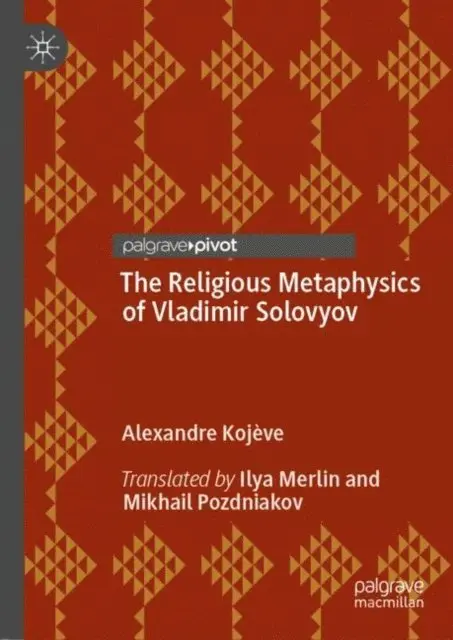
This English translation presents Kojève’s attempt to unify the religious philosophy of Vladimir Solovyov into a metaphysical system that Solovyov strived for but was never able to fully articulate in his lifetime.
266 kr
Skickas inom 3-6 vardagar
111 kr
Skickas inom 3-6 vardagar
136 kr
Skickas inom 3-6 vardagar
234 kr
Skickas inom 3-6 vardagar
180 kr
Skickas inom 3-6 vardagar
145 kr
Skickas inom 5-8 vardagar
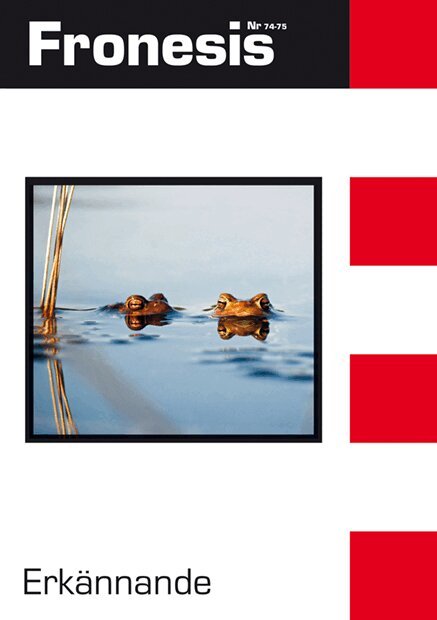
ERKÄNNANDE Ambitionen med Fronesis nr 74–75 är att fördjupa förståelsen av erkännande. Genom några centrala texter belyser vi olika aspekter av denna komplexa erfarenhet hela vägen från existentiell strävan till politisk kamp. Hegels herre–slav-dialektik återkommer ständigt i diskussionen av erkännandets dynamik. I numret presenteras den rysk-franske filosofen Alexandre Kojève, vars begärsfokuserade tolkning av dialektiken är grundläggande för all nutida diskussion av erkännande. Den text som vi låtit översätta är introduktionen till Hegelföreläsningarna, som hölls i Paris på 1930-talet. Den amerikanska filosofen och queerteoretikern Judith Butler står för ett radikalt ifrågasättande av erkännandet. Hennes tolkning av herre–slav-dialektikens utgång utgör en vattendelare mellan de olika värderingarna av erkännandets roll i historien. I Hegeltraditionens huvudfåra är samhällsmoralen en språngbräda till förverkligandet av mera frihet, medan den för Butler representerar förtryckande normer som underkuvar människor på ett sätt som de själva inte kommer åt. Den kanadensiska sociologen Michèle Lamont diskuterar i sin text hur erkännandet blivit ojämnare fördelat på senare tid. Det ojämnt fördelade erkännandet tycks bero på ojämnt fördelade resurser – man känner sig inte sedd och värdesatt som lågavlönad och arbetslös i ett samhälle där andra skyltar med sina framgångar, karriärplaner och resor – likaväl som på förskjutningar i statusordningar – man känner inte längre igen sig i ett samhälle där livsval och det man själv håller högt inte värdesätts av andra. Därigenom rör hon sig bortom frågan »omfördelning eller erkännande?«, som präglade 1990-talets återupplivade diskussion om erkännande. Rörelsen i numret kan förefalla vara riktad bort från politiken och mot existentiella dilemman och begärets natur. Samtidigt handlar allt om politikens förutsättningar – den förpolitiska mylla eller existentiella erfarenhet som politikens visioner och konflikter slår rot i. Numret bärs upp av en idé om att alla politiska mobiliseringar måste knyta an till den under ytan pågående kampen hos människor att fullt ut bli en del av samhället utifrån en förståelse om att detta i sig är ett rörligt mål. Det är en utmaning för alla såväl som en framgångsfaktor. Innehåll i Fronesis nr 74–75 (240 sidor): Magnus Hörnqvist och Johan Lindgren: Från existentiell strävan till politisk kamp. Carl-Göran Heidegren: Fichte och Hegel om ömsesidigt erkännande Axel Honneth: Från begär till erkännande Alexandre Kojève: I stället för inledning. Judith Butler: Egensinnig bindning, kroppslig underkastelse. Carl-Göran Heidegren: Axel Honneths erkännandeteori Nancy Fraser: Social rättvisa i identitetspolitikens tidsålder. Rahel Jaeggi: Erkännande och underkastelse Magnus Hörnqvist: Ett erkännande i kampen? Michèle Lamont: Till frågan om erkännandeklyftor Redaktörer: Magnus Hörnqvist och Johan Lindgren