Alexis M. Elder – författare
Visar alla böcker från författaren Alexis M. Elder. Handla med fri frakt och snabb leverans.
8 produkter
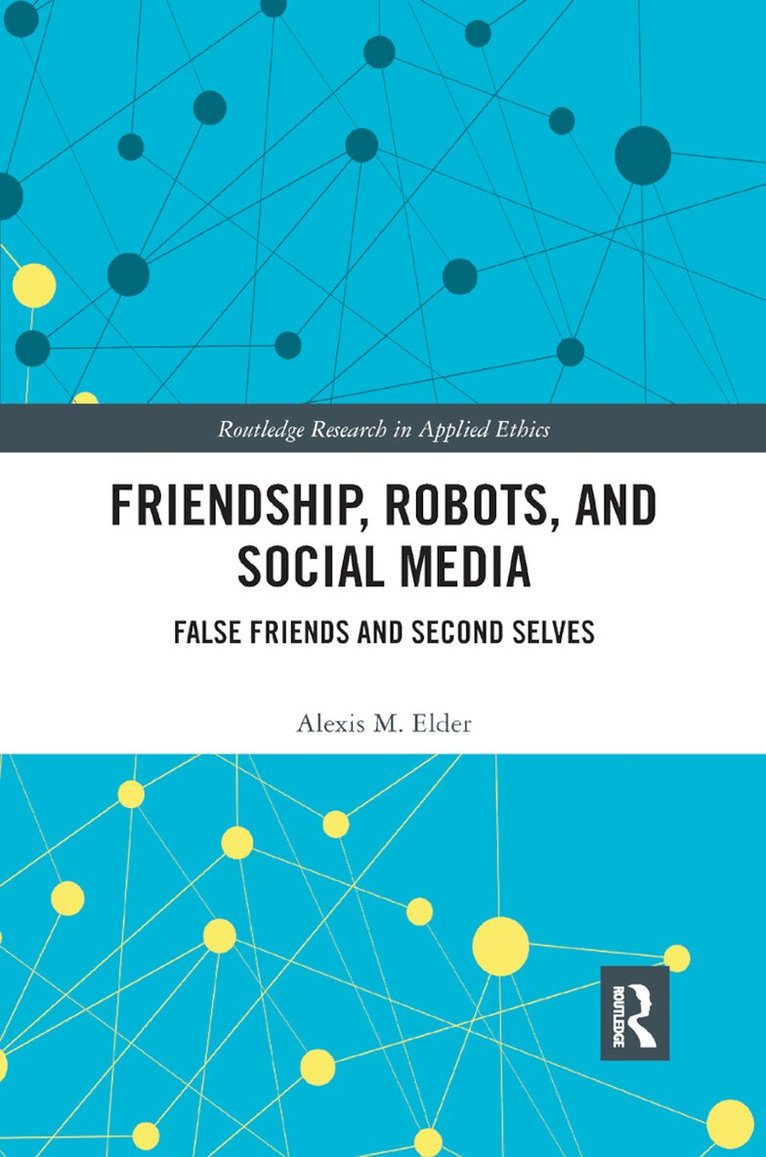
Friendship, Robots, and Social Media
False Friends and Second Selves
Häftad, 2019
733 kr
Lägg i varukorg
Various emerging technologies, from social robotics to social media, appeal to our desire for social interactions, while avoiding some of the risks and costs of face-to-face human interaction. But can they offer us real friendship? In this book, Alexis Elder outlines a theory of friendship drawing …
Ethics of Digital Ghosts
Confucian, Mohist, and Zhuangist Perspectives on AI and Death
E-bok, 2025
724 kr
Lägg i varukorg
Advances in artificial intelligence (AI) are enabling the construction of “digital ghosts”: algorithmic reconstructions of deceased individuals based on patterns of interaction in their text messages, social media posts, and other personal data. This book develops an ethics of digital ghosts using …
Ethics of Digital Ghosts
Confucian, Mohist, and Zhuangist Perspectives on AI and Death
E-bok, 2025
724 kr
Lägg i varukorg
Advances in artificial intelligence (AI) are enabling the construction of “digital ghosts”: algorithmic reconstructions of deceased individuals based on patterns of interaction in their text messages, social media posts, and other personal data. This book develops an ethics of digital ghosts using …
Ethics of Digital Ghosts
Confucian, Mohist, and Zhuangist Perspectives on AI and Death
Häftad, 2026
694 kr
Kommande
Advances in artificial intelligence (AI) are enabling the construction of “digital ghosts”: algorithmic reconstructions of deceased individuals based on patterns of interaction in their text messages, social media posts, and other personal data. This book develops an ethics of digital ghosts using …
Ethics of Digital Ghosts
Confucian, Mohist, and Zhuangist Perspectives on AI and Death
Inbunden, 2025
2504 kr
Lägg i varukorg
Advances in artificial intelligence (AI) are enabling the construction of “digital ghosts”: algorithmic reconstructions of deceased individuals based on patterns of interaction in their text messages, social media posts, and other personal data. This book develops an ethics of digital ghosts using …
Friendship, Robots, and Social Media
False Friends and Second Selves
Inbunden, 2017
2504 kr
Lägg i varukorg
Various emerging technologies, from social robotics to social media, appeal to our desire for social interactions, while avoiding some of the risks and costs of face-to-face human interaction. But can they offer us real friendship? In this book, Alexis Elder outlines a theory of friendship drawing …
Friendship, Robots, and Social Media
False Friends and Second Selves
E-bok, 2017
779 kr
Lägg i varukorg
Various emerging technologies, from social robotics to social media, appeal to our desire for social interactions, while avoiding some of the risks and costs of face-to-face human interaction. But can they offer us real friendship? In this book, Alexis Elder outlines a theory of friendship drawing …
Friendship, Robots, and Social Media
False Friends and Second Selves
E-bok, 2017
779 kr
Lägg i varukorg
Various emerging technologies, from social robotics to social media, appeal to our desire for social interactions, while avoiding some of the risks and costs of face-to-face human interaction. But can they offer us real friendship? In this book, Alexis Elder outlines a theory of friendship drawing …