Algis Mickunas - Böcker
Visar alla böcker från författaren Algis Mickunas. Handla med fri frakt och snabb leverans.
10 produkter
10 produkter
675 kr
Skickas inom 10-15 vardagar
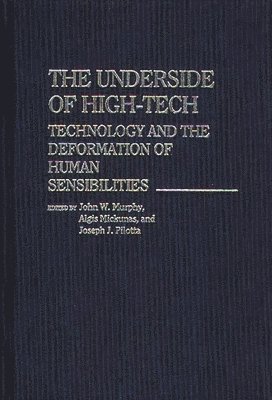
This volume details the philosophical propositions of technology, illustrates its impact on various facets of social life, and demonstrates how the disruptive effects of technology can be reduced by providing it with a new philosophical base. Philosophical principles that will help to foster the responsible use of technology are developed. The contributors deal specifically with the ways in which technology shapes a person's view of politics, capital punishment, education, health and illness, work, communications, and the human body. They argue that technology tends to deanimate these aspects of life, thereby purging society of its creativity and spontaneity. Collectively, they suggest ways in which this trend can be reversed by the creation of a socially responsible technology.
270 kr
Skickas inom 7-10 vardagar
Existential philosophy has perhaps captured the public imagination more completely than any other philosophical movement in the twentieth century. But less is known about the phenomenological method lying behind existentialism. In this solid introduction to phenomenological philosophy, authors David Stewart and Algis Mickunas show that phenomenology is neither new nor bizarre but is a contemporary way of raising afresh the major problems of philosophy that have dominated the traditions of Western thought. The authors carefully lead the reader trough the maze of terminology, explaining the major problems phenomenology has treated and showing how these are a consistent extension of the traditional concerns of philosophy.In concise, uncluttered, and straightforward terms, the history, development, and contemporary status of phenomenology is explained with a copiously annotated bibliography following each chapter. Nothing in print combines the extensive introductory materials with a guide to the massive literature that has been produced by phenomenological and existential studies.
565 kr
Skickas
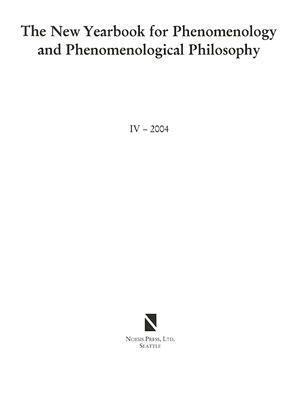
Each Yearbook provides an annual international forum for phenomenology and phenomenological philosophy in the spirit of Edmund Husserl's groundbreaking work. These respected philosophers have contributed essays on a wide range of concerns: Rudolf Bernet - Husserl's Transcendental Idealism Revisited; Ian Angus - In Praise of Fire - Responsibility, Manifestation, Polemos, Circumspection; Dieter Lohmar - Husserl's Hesitant Revisionism in the Field of Logic; Torsten Pietrek - A Reconstruction of Phenomenological Method for Metaethics; Renaud Barbaras - Sensing and Creating - Phenomenology and the Unity of Aesthetics; Christian Lotz - Recollection, Mourning and the Absolute Past, Husserl, Freud and Derrida; Karlheinz Ruhstorfer - Adieu - Derrida's God and the Beginning of Thinking; and Rosemary R. P. Lerner - Husserl vs. Neo-Kantianism Revisited - On Skepticism, Foundationalism, and Intuition. This book also includes: Sebastian Luft - A Hermeneutic Phenomenology of Spirit - Husserl, Natorp and Cassirer; Heribert Boeder - Truth in the First Epoch of Philosophy; Marcus Brainard - Epoche and Epoch in Logotectonic Thought; Edmund Husserl - Tobaccology (German/English); Johannes Daubert - Notes from Husserl's Mathematical-Philosophical Exercises (1905), ed. and intro by Mark van Atten and Karl Schuhmann (German/English); Dorion Cairns - On Eugen Fink's ""The Problem of Husserl's Phenomenology"".
648 kr
Skickas inom 10-15 vardagar
The text presents arguments, demonstrating what domain belongs to philosophy and what areas are ""unphilosophical"" and at time ""antiphilosophical."" The ""unphilosophical"" systems are claims are based on the notion--even if not explicit--of ""man as the measure of things,"" while the unphilosophical"" trend consists of pronouncements whose veracity is not to be questioned. Since philosophy, in principle, is a quest for rational justification of any claim, then its questioning of those pronouncements leads to the denouncement and, in principle, forbidding, destruction of philosophical writings and philosophers. The argument is extended to disclose that both mentioned trends end up in ""metaphysics of the will"" wherein the human self-understanding as not only the measure, but also the ""creator"" of all things through the scientific-technical, is hence isometric with the antiphilosophical trends and its pronouncements of the supremacy of the will of the creator. At this level, modern ""philosophical"" trends become identical with the metaphysics of the will--divine complex.Counter to this trend is the philosophical classical tradition whose first principle is ""fallible reason"" and resultantly a demand and a duty to contest every claim, to find arguments for and against any position and its claim to the ""only truth."" Philosophy demands not only arguments, but a direct evidence in unhindered and uninterpreted phenomena--leading to the denial that ""man is the measure of all things."" The text purports to explicate--at the end--an ontological position that is also epistemological in order to encompass the classical notion of the primacy of the perceivable things of the world, but also of the principles of their space-time unfolding. At this level, there is a critique of the principles of ""first philosophies,"" both in their ontological and metaphysical forms
301 kr
Skickas inom 10-15 vardagar
The text presents arguments, demonstrating what domain belongs to philosophy and what areas are ""unphilosophical"" and at time ""antiphilosophical."" The ""unphilosophical"" systems are claims are based on the notion--even if not explicit--of ""man as the measure of things,"" while the unphilosophical"" trend consists of pronouncements whose veracity is not to be questioned. Since philosophy, in principle, is a quest for rational justification of any claim, then its questioning of those pronouncements leads to the denouncement and, in principle, forbidding, destruction of philosophical writings and philosophers. The argument is extended to disclose that both mentioned trends end up in ""metaphysics of the will"" wherein the human self-understanding as not only the measure, but also the ""creator"" of all things through the scientific-technical, is hence isometric with the antiphilosophical trends and its pronouncements of the supremacy of the will of the creator. At this level, modern ""philosophical"" trends become identical with the metaphysics of the will--divine complex.Counter to this trend is the philosophical classical tradition whose first principle is ""fallible reason"" and resultantly a demand and a duty to contest every claim, to find arguments for and against any position and its claim to the ""only truth."" Philosophy demands not only arguments, but a direct evidence in unhindered and uninterpreted phenomena--leading to the denial that ""man is the measure of all things."" The text purports to explicate--at the end--an ontological position that is also epistemological in order to encompass the classical notion of the primacy of the perceivable things of the world, but also of the principles of their space-time unfolding. At this level, there is a critique of the principles of ""first philosophies,"" both in their ontological and metaphysical forms
809 kr
Skickas inom 10-15 vardagar
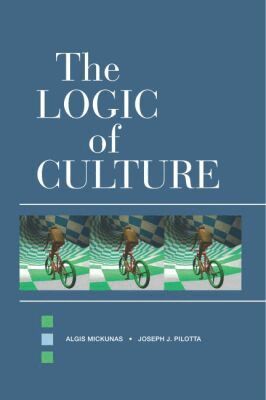
This book is a condensation of critical essays in contemporary culture within the context of European phenomenology, employing its own self-critiques in order to demonstrate the methodological and experiential dimensions of the logic of culture.The essays are neither a part of foundationalism or foundation-less. Rather the experience of the space-time movement—logic of permanence/flux, stasis/flux, and the permutation of enhancement/reclamation and of permanence/flux and permanent/permanence—are critical for opening cultural studies to civilization and cosmological (world) investigations. The contemporary world of globalization, with boundaries becoming rather insignificant and the intermixing of global expressions, requires broader and more-encompassing observations.This book will be of interest in the social sciences and in comparative studies in the humanities, for programs in cultural studies, and in courses emphasizing cultural systems such as physical anthropology.
354 kr
Skickas inom 10-15 vardagar
This book is a condensation of critical essays in contemporary culture within the context of European phenomenology, employing its own self-critiques in order to demonstrate the methodological and experiential dimensions of the logic of culture.The essays are neither a part of foundationalism or foundation-less. Rather the experience of the space-time movement—logic of permanence/flux, stasis/flux, and the permutation of enhancement/reclamation and of permanence/flux and permanent/permanence—are critical for opening cultural studies to civilization and cosmological (world) investigations. The contemporary world of globalization, with boundaries becoming rather insignificant and the intermixing of global expressions, requires broader and more-encompassing observations.This book will be of interest in the social sciences and in comparative studies in the humanities, for programs in cultural studies, and in courses emphasizing cultural systems such as physical anthropology.
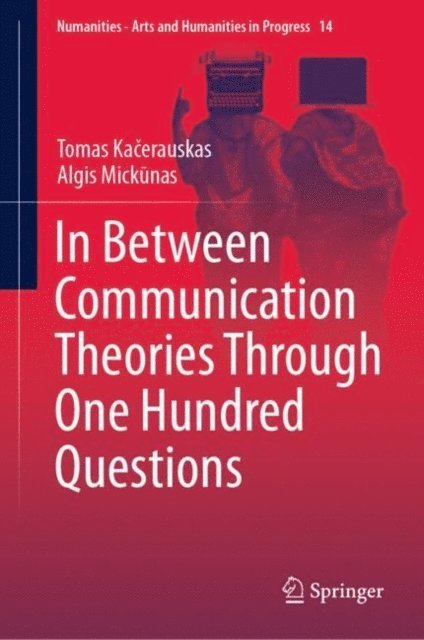
Del 14 - Numanities - Arts and Humanities in Progress
In Between Communication Theories Through One Hundred Questions
Inbunden, Engelska, 2020
537 kr
Skickas inom 10-15 vardagar
The book includes both presentation of different communication schools and philosophizing on the issues of communication. The authors debate numerous topics by providing the definition and etymology of communication, examining the limits of communication, and using a poli-logical base of communication.
Del 14 - Numanities - Arts and Humanities in Progress
In Between Communication Theories Through One Hundred Questions
Häftad, Engelska, 2021
537 kr
Skickas inom 10-15 vardagar
The book includes both presentation of different communication schools and philosophizing on the issues of communication. The authors debate numerous topics by providing the definition and etymology of communication, examining the limits of communication, and using a poli-logical base of communication.
489 kr
Skickas inom 5-8 vardagar
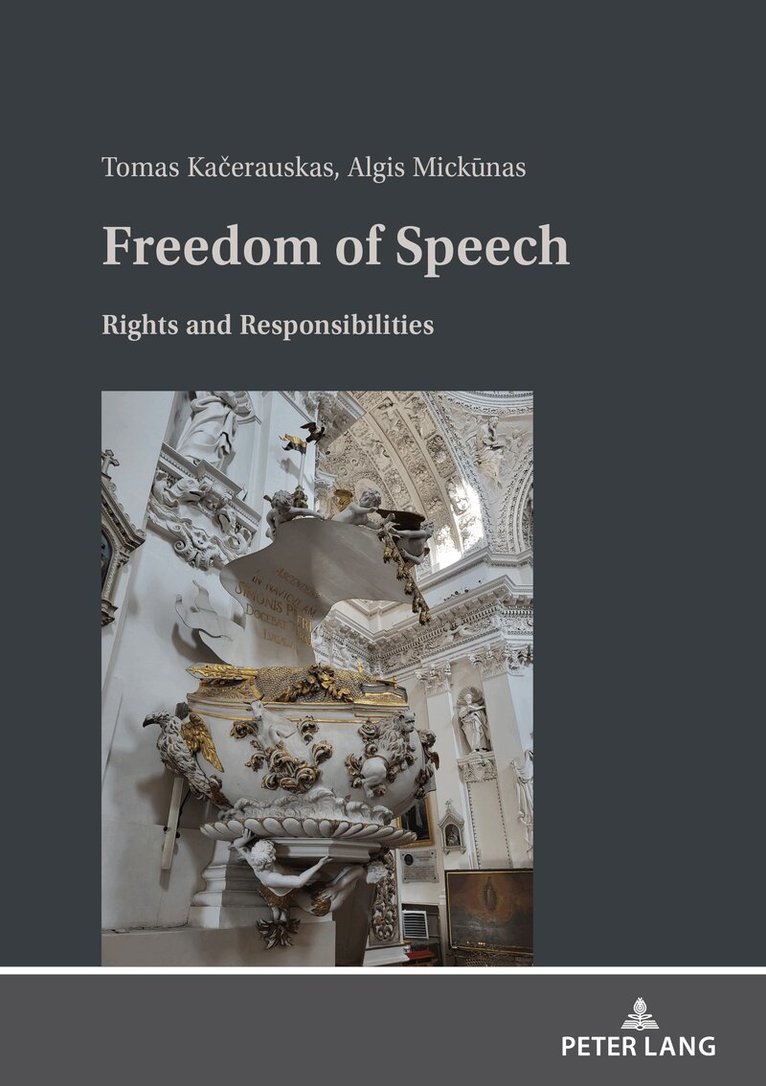
The book’s focus is on freedom of speech and what content can place it in jeopardy. The sources, discussions and limitations of free speech, the relationship between ideology, freedom of speech in the media, and public issues are analyzed. From historical point of view, the citizens of more or less democratic societies assume freedom of speech as a basic right to challenge dictatorships, totalitarianisms and authority of any kind. Freedom of speech cannot be understood without the fundamental principles of democratic society, including a tolerance of others, their right to express various and unique opinions, open to challenge by others, and requiring mutual respect. Three domains for social responsibility concerning freedom of speech are addressed: practical, ecological and creative.