Ali H. Sayed - Böcker
Visar alla böcker från författaren Ali H. Sayed. Handla med fri frakt och snabb leverans.
7 produkter
7 produkter
1 925 kr
Skickas inom 7-10 vardagar
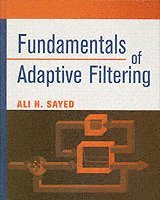
Adaptive filtering is a topic of immense practical and theoretical value, having applications in areas ranging from digital and wireless communications to biomedical systems. This book enables readers to gain a gradual and solid introduction to the subject, its applications to a variety of topical problems, existing limitations, and extensions of current theories. The book consists of eleven parts?each part containing a series of focused lectures and ending with bibliographic comments, problems, and computer projects with MATLAB solutions.
2 609 kr
Skickas inom 11-20 vardagar
This book is based on a graduate level course offered by the author at UCLA and has been classed tested there and at other universities over a number of years. This will be the most comprehensive book on the market today providing instructors a wide choice in designing their courses.* Offers computer problems to illustrate real life applications for students and professionals alike* An Instructor's Manual presenting detailed solutions to all the problems in the book is available from the Wiley editorial department. An Instructor's Manual presenting detailed solutions to all the problems in the book is available from the Wiley editorial department.
3 452 kr
Tillfälligt slut
This extraordinary three-volume work, written in an engaging and rigorous style by a world authority in the field, provides an accessible, comprehensive introduction to the full spectrum of mathematical and statistical techniques underpinning contemporary methods in data-driven learning and inference. The first volume, Foundations, establishes core topics in inference and learning, and prepares readers for studying their practical application. The second volume, Inference, introduces readers to cutting-edge techniques for inferring unknown variables and quantities. The final volume, Learning, provides a rigorous introduction to state-of-the-art learning methods. A consistent structure and pedagogy is employed throughout all three volumes to reinforce student understanding, with over 1280 end-of-chapter problems (including solutions for instructors), over 600 figures, over 470 solved examples, datasets and downloadable Matlab code. Unique in its scale and depth, this textbook sequence is ideal for early-career researchers and graduate students across many courses in signal processing, machine learning, statistical analysis, data science and inference.
1 149 kr
Skickas inom 7-10 vardagar
This extraordinary three-volume work, written in an engaging and rigorous style by a world authority in the field, provides an accessible, comprehensive introduction to the full spectrum of mathematical and statistical techniques underpinning contemporary methods in data-driven learning and inference. This first volume, Foundations, introduces core topics in inference and learning, such as matrix theory, linear algebra, random variables, convex optimization and stochastic optimization, and prepares students for studying their practical application in later volumes. A consistent structure and pedagogy is employed throughout this volume to reinforce student understanding, with over 600 end-of-chapter problems (including solutions for instructors), 100 figures, 180 solved examples, datasets and downloadable Matlab code. Supported by sister volumes Inference and Learning, and unique in its scale and depth, this textbook sequence is ideal for early-career researchers and graduate students across many courses in signal processing, machine learning, statistical analysis, data science and inference.
1 019 kr
Skickas inom 7-10 vardagar
This extraordinary three-volume work, written in an engaging and rigorous style by a world authority in the field, provides an accessible, comprehensive introduction to the full spectrum of mathematical and statistical techniques underpinning contemporary methods in data-driven learning and inference. This second volume, Inference, builds on the foundational topics established in volume I to introduce students to techniques for inferring unknown variables and quantities, including Bayesian inference, Monte Carlo Markov Chain methods, maximum-likelihood estimation, hidden Markov models, Bayesian networks, and reinforcement learning. A consistent structure and pedagogy is employed throughout this volume to reinforce student understanding, with over 350 end-of-chapter problems (including solutions for instructors), 180 solved examples, almost 200 figures, datasets and downloadable Matlab code. Supported by sister volumes Foundations and Learning, and unique in its scale and depth, this textbook sequence is ideal for early-career researchers and graduate students across many courses in signal processing, machine learning, statistical analysis, data science and inference.
1 019 kr
Skickas inom 7-10 vardagar
This extraordinary three-volume work, written in an engaging and rigorous style by a world authority in the field, provides an accessible, comprehensive introduction to the full spectrum of mathematical and statistical techniques underpinning contemporary methods in data-driven learning and inference. This final volume, Learning, builds on the foundational topics established in volume I to provide a thorough introduction to learning methods, addressing techniques such as least-squares methods, regularization, online learning, kernel methods, feedforward and recurrent neural networks, meta-learning, and adversarial attacks. A consistent structure and pedagogy is employed throughout this volume to reinforce student understanding, with over 350 end-of-chapter problems (including complete solutions for instructors), 280 figures, 100 solved examples, datasets and downloadable Matlab code. Supported by sister volumes Foundations and Inference, and unique in its scale and depth, this textbook sequence is ideal for early-career researchers and graduate students across many courses in signal processing, machine learning, data and inference.
1 368 kr
Skickas inom 7-10 vardagar
Complex cognitive systems, such as social networks, robotic swarms, or biological networks, are composed of individual entities (the agents) whose actions typically arise from some sophisticated form of “social” interaction with other agents. For example, consider the way humans form their individual opinions about a certain phenomenon. The opinions take shape via repeated interactions with other individuals, whether through physical contact or virtually. A diffusion mechanism emerges through which opinions, information, or even fake news propagate.Social learning also arises over man-made systems in the form of decision-making strategies by multiple agents interacting over a network. Consider a robotic swarm deployed over a hazardous area, where some robots operating under disadvantageous conditions (e.g., with limited visibility or partial information) would only be able to perform their task (such as saving a life during a rescue operation) by leveraging significant cooperation from other robots that have better access to critical information. Nature itself provides many other excellent examples of cooperative learning in the form of biological networks. The main topic of this book relates to mechanisms for information diffusion and decision-making over graphs, and the study of how agents’ decisions evolve dynamically through interactions with neighbors and the environment.