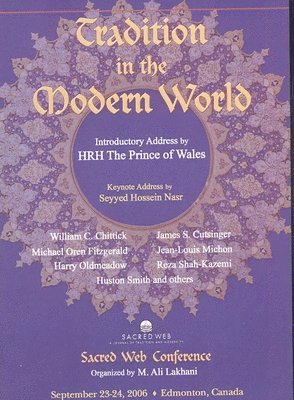
The conference, convened by the traditionalist journal , Sacred Web featured presentations from many of the world's leading traditionalists/perennialists such as Seyyed Hossein Nasr, Huston Smith, Jean-Louis Michon, James S. Cutsinger, Reza Shah-Kazemi, as well as another generation of thinkers and writers.Each topic during the two days demonstrated the need to preserve traditional spiritual thought and values and their critical relevance to numerous areas of modern human thought and activity. The topics ranged from the most interior issues of one's spiritual life, to the educating of children, to the pernicious effects of central modernist theories, to reconciling how different faiths view scriptural stories, to the traditional view of art as opposed to the modern and much, much more. The five hour, forty-five minutes of video highlights gives some presentations almost in their entirety, while others are more abbreviated. Even so, the two-disc set gives an excellent introduction to the central ideas of the Perennialist/Traditionalist school of thought, its most important figures, and what it can offer to a world lost in its own intellectual and material refuse. The set would be a very good learning tool for university classrooms and in libraries, which want to include the full history of contemporary even if not "modern" thought.
The conference, convened by the traditionalist journal , Sacred Web featured presentations from many of the world's leading traditionalists/perennialists such as Seyyed Hossein Nasr, Huston Smith, Jean-Louis Michon, James S. Cutsinger, Reza Shah-Kazemi, as well as another generation of thinkers and writers.Each topic during the two days demonstrated the need to preserve traditional spiritual thought and values and their critical relevance to numerous areas of modern human thought and activity. The topics ranged from the most interior issues of one's spiritual life, to the educating of children, to the pernicious effects of central modernist theories, to reconciling how different faiths view scriptural stories, to the traditional view of art as opposed to the modern and much, much more. The five hour, forty-five minutes of video highlights gives some presentations almost in their entirety, while others are more abbreviated. Even so, the two-disc set gives an excellent introduction to the central ideas of the Perennialist/Traditionalist school of thought, its most important figures, and what it can offer to a world lost in its own intellectual and material refuse. The set would be a very good learning tool for university classrooms and in libraries, which want to include the full history of contemporary even if not "modern" thought.